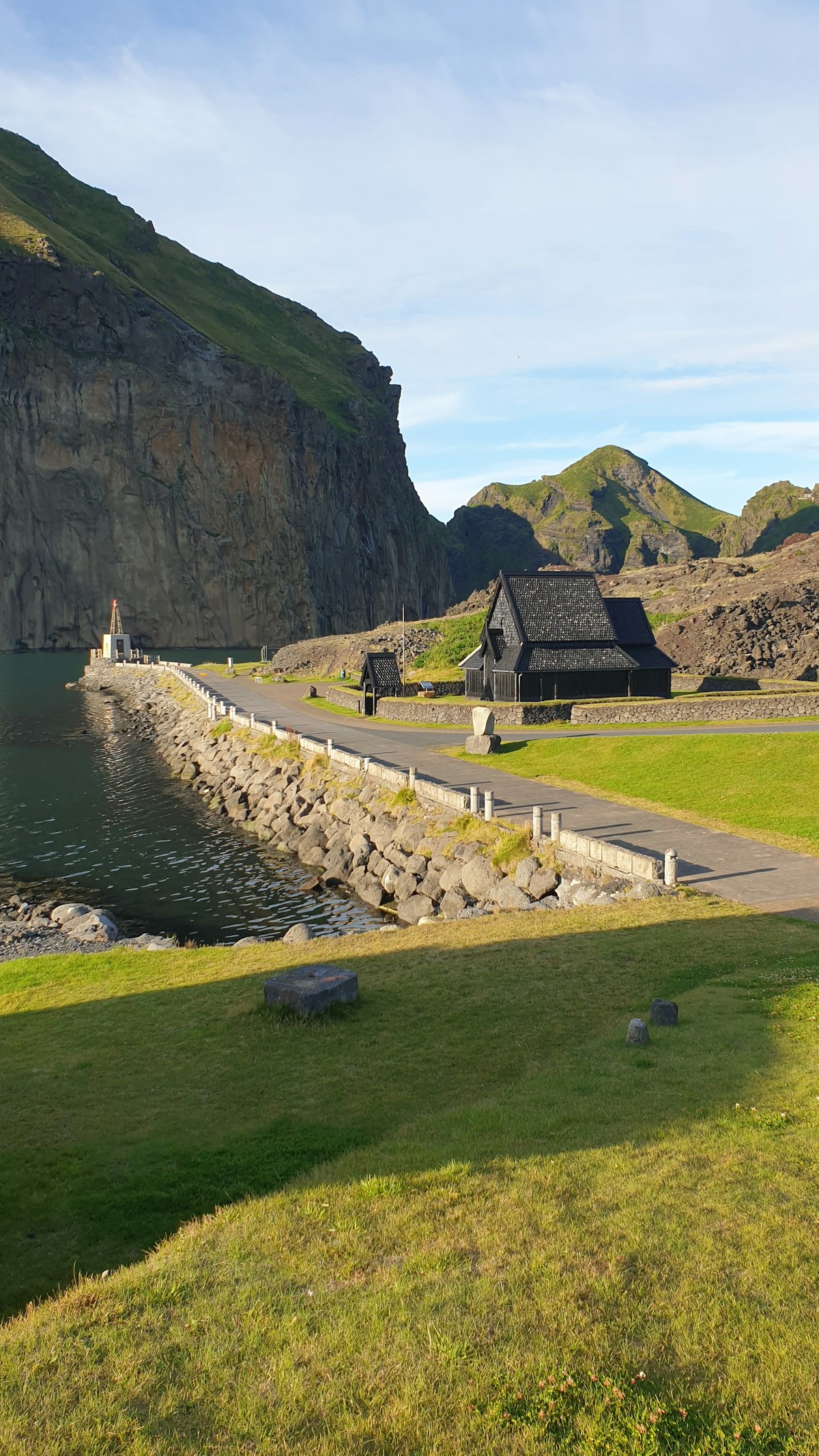
Heimaey is compact enough (13 km²) that its most dramatic features - Eldfell volcano, the Stórhöfði puffin headland, the 1973 lava field, the Eldheimar museum - are all reachable on foot or by bicycle from the town. Day trips from the island itself extend outward by boat: to the uninhabited sea stacks, through the arches and sea caves, and toward Surtsey on the horizon.
Here’s what’s worth doing within the Westman Islands and on the waters around them.
Eldfell Volcano Hike
In January 1973, a volcanic fissure opened without warning at the edge of Heimaey town. The eruption lasted five months, buried a third of the island under lava and ash, and nearly destroyed the harbour - the only economic lifeline of the community. Eldfell is the cone that grew from that eruption. It now stands 220 metres high and takes 30–40 minutes to reach from the town centre via a marked trail over the lava field.
The summit rewards the effort: views of the whole island, the other Westman Islands in the distance, and on clear days the Icelandic mainland on the horizon. The soil under your feet is warm in places where volcanic heat hasn’t fully dissipated. There are no fees to hike Eldfell; no specialist equipment is needed, though boots are better than trainers on the loose black scoria.
Allow 1.5–2 hours for the round trip, plus time at the summit. Combine it with a walk through the 1973 lava field, where buried houses are sometimes visible at the edges of the hardened flow.
Eldheimar - Pompeii of the North
The Eldheimar museum stands adjacent to an excavated 1973 lava flow, built around a real house that was engulfed and preserved under the ash. The centrepiece is the excavated structure itself - you can see the walls, the household objects, the way the ash settled around furniture. The exhibition documents the eruption, the evacuation (500 fishing boats ferried 5,000 residents to the mainland in one night), and the effort to save the harbour with cold seawater.
Entry costs approximately ISK 2,800 per adult as of 2026; children under 14 are free. The museum is open daily approximately 11:00–18:00 in summer (check current hours). Allow 1.5–2 hours. It’s one of the best small museums in Iceland.
Stórhöfði Puffin Colony
Stórhöfði is the southern headland of Heimaey, reachable on foot in about 45 minutes from the town centre or by bike in 15. The headland hosts one of the largest Atlantic puffin colonies in the world - during peak season (late May to early August), hundreds of thousands of birds nest in burrows across the grassy slopes. The birds are remarkably unafraid and approach within a few metres of respectful walkers.
No fee is charged to visit Stórhöfði. The headland also has a weather station and offers some of the most dramatic cliff views on the island. Walk early in the morning or in the evening for best light and fewer people. Bring a good telephoto lens or accept that phone cameras don’t do the experience justice.
Boat Tours of the Sea Cliffs and Caves
The Westman Islands archipelago is 15 volcanic islands surrounded by sheer sea cliffs, basalt sea stacks, and sea caves carved by North Atlantic waves. The only way to see most of this is by boat. Several operators run tours from Heimaey harbour.
A typical tour lasts 1–3 hours and circuits the outer cliffs of Heimaey and the nearby stacks, entering some of the sea caves and approaching the puffin nesting colonies from the water. Longer tours loop past the uninhabited islands and approach Surtsey on the southern horizon. Costs run approximately ISK 8,500–12,000 per adult as of 2026 for a standard tour.
RIB (rigid inflatable boat) tours are faster and more visceral; larger boat tours are calmer. Both visit the same essential landscapes. Book in advance in July - the best operators fill up early.
Surtsey Viewpoint
Surtsey emerged from the North Atlantic in 1963 following a submarine volcanic eruption and is now a UNESCO World Heritage Site. It’s off-limits to visitors, but from Heimaey - roughly 20 km to the south - the island is clearly visible on clear days. Some boat tours extend their routes to pass within closer range of Surtsey, offering views of the youngest land surface on Earth. The island’s vegetation is minimal - scientists monitor the natural colonisation of species without human interference.
Hlíðarendi - The 1973 Lava Fields
The outer edges of Heimaey town are defined by the 1973 lava field - a solidified flow of grey and black basalt that stopped metres from the harbour wall. Walking trails lead through the field, and the boundary between the old town and the new lava surface is visible at street level. Several houses were buried up to their eaves; their chimney tops and dormer windows sometimes peek above the hardened lava at the field’s margins. No guide is needed; the walks are self-directed and free.
Browse Iceland tours - day trips, activity bookings, and multi-day packages across the country in one place.
Compare car hire in Iceland - a 4WD or campervan gives the flexibility to explore at your own pace.
Practical Notes
Bikes: Bike hire is available in Vestmannaeyjar town for approximately ISK 2,500–4,000 per day as of 2026. The island is flat enough in its northern section for comfortable cycling; Stórhöfði is a longer but manageable ride.
Weather: The Westman Islands are known for fast-changing weather - the southern coast is exposed to Atlantic fronts that move through quickly. Rain gear and a windproof layer are essential regardless of season.
For eating well between excursions, see best restaurants in the Westman Islands. For where to sleep, see our Westman Islands accommodation guide.
For accommodation nearby, Search hotels in Westman Islands on Booking.com.