Akureyri sits at the head of Eyjafjörður, Iceland’s longest fjord, and within a two-hour radius of some of the country’s most dramatic landscapes. Lake Mývatn, Húsavík, Dettifoss, and Goðafoss are all accessible as day trips — and unlike day trips from Reykjavík, these routes involve almost no other tourists until you reach the destinations themselves.
Lake Mývatn — 50km East, 1.5 Hours
Lake Mývatn is the most rewarding day trip from Akureyri and one of the most geologically active places you’ll visit anywhere in Europe. The lake itself is a shallow, dark-water body ringed by volcanic formations, but the real draws are scattered around the eastern shore.
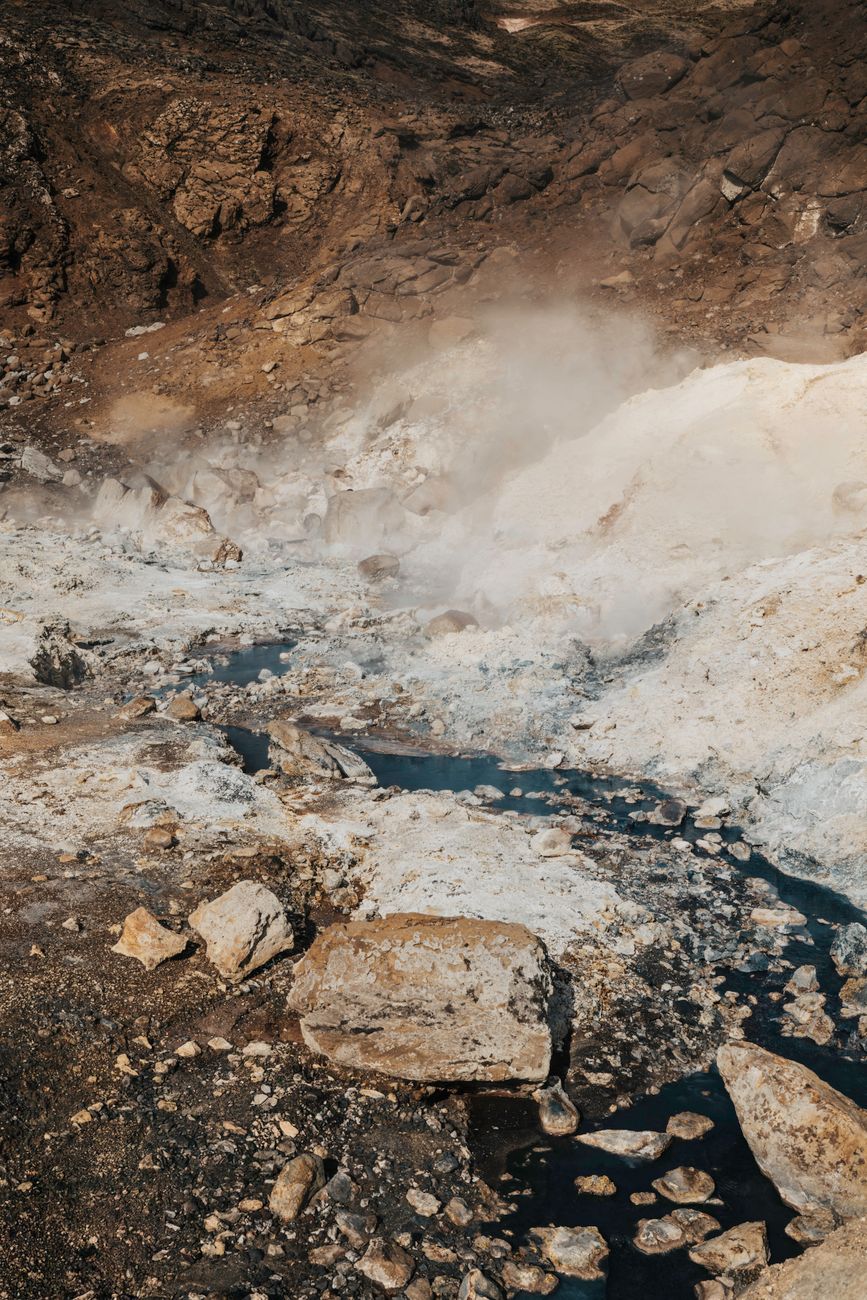
Námaskarð (also called Hverir) is the first thing to stop at: a lunar-grey hillside pocked with boiling mud pots and sulphur-yellow fumaroles. The smell is intense — hot hydrogen sulphide — but the colour contrast between the orange-brown ground and white steam plumes is extraordinary. Entry is free; it’s accessible year-round.
Skútustaðagígar pseudo-craters are on the southern shore of the lake, formed when lava flowed over boggy wetland thousands of years ago, trapping water that then exploded upward. The result looks like a moonscape of shallow craters. There’s a 2km walking trail around the main cluster — allow 45 minutes and flat terrain.
Dimmuborgir (“dark castles”) is a 3km²-lava-field east of the lake, where pillars, arches, and caves of solidified lava create a maze-like landscape. Multiple marked trails run through it, from 500m to 2.5km.
Krafla caldera and Viti crater are 7km north of Mývatn — a steep-sided explosion crater filled with acid-green water, surrounded by steaming black lava from the Krafla eruptions of 1975–84.
Mývatn Nature Baths sit on the northern shore and offer geothermal bathing in a silica-blue pool at lower crowds and lower cost than the Blue Lagoon. Entry is approximately ISK 7,800 for adults as of 2026; open year-round, closes 22:00 in summer.
Allow a full day for Mývatn if you want to cover more than one or two sites.
Húsavík Whale Watching — 80km East, 1 Hour
Húsavík is Iceland’s whale watching capital and one of the better bets in Europe for reliably spotting humpbacks between May and September. The harbour is compact and charming — it takes about 10 minutes to walk end to end — and the Húsavík Whale Museum (ISK 2,500 as of 2026) is worth 45 minutes before or after your tour.
Whale watching tours depart Húsavík Harbour from approximately April through October. Prices start at around ISK 12,000 per adult as of 2026 for a 3-hour traditional oak boat tour. RIB boat tours (faster, fewer passengers) cost more — typically ISK 17,000–19,000 — but cover more ground.
Humpback whales are the most common sighting; minke whales appear regularly. Blue whales and orcas are rarer but sighted several times each summer. Operators typically offer a free re-tour if you don’t see any cetaceans, though they’re rare on that count.
From Akureyri, drive east on Route 1 to Laugar junction, then north on Route 87 into Húsavík.
Goðafoss — 50km East, 45 Minutes
Goðafoss (“waterfall of the gods”) sits right on the Ring Road as you head east from Akureyri — impossible to miss and impossible to skip. The horseshoe-shaped falls span about 30m across and drop 12m into a rocky gorge. Entry is free; there are viewpoints on both banks.
The story attached to Goðafoss is that in the year 1000 CE, the lawspeaker Þorgeir Ljósvetningagoði threw his Norse pagan idols into the falls after Iceland voted to convert to Christianity — though historians note this is likely legend rather than fact.
Most visitors spend 30–45 minutes here, which is enough. If you’re combining with Mývatn (another 50km east), it works well as a first stop on the outward journey.
Dettifoss — 140km East, 1.5–2 Hours
Europe’s most powerful waterfall by volume, Dettifoss drops 44m into the Jökulsárgljúfur canyon with a roar and spray cloud you can see and hear well before you reach the viewing platforms. It’s free to enter.
Two roads give access from the Ring Road junction at Reykjahlíð: Route 862 (paved, gives access to the west bank — the more dramatic view) and Route 864 (rough gravel, east bank). Both are accessible in summer. Check conditions before driving 864 in wet weather.
From Akureyri, allow a minimum of 3 hours driving plus 1–1.5 hours at the falls. Most visitors combining Dettifoss with Mývatn in a single day cover approximately 280–320km total.
Selfoss, 500m upstream from Dettifoss, is gentler in character — wider, more colourful canyon walls — and takes 20 minutes to reach on foot along the canyon rim.
Hiring a Car vs Joining a Tour
Hiring a car gives full flexibility on timing and stops. Akureyri has all the major rental agencies (Hertz, Budget, Avis, Enterprise, Europcar) at or near the airport. Rates start at approximately ISK 12,000–18,000 per day for a small car as of 2026, plus fuel. Most Mývatn roads are paved; Dettifoss Route 864 requires care but not a 4×4 in summer.
Joining a guided tour makes sense if:
- You’re travelling solo and costs are roughly equivalent to hiring a car plus fuel
- You want local commentary (guides cover geology, history, and folklore along the route)
- You prefer not to navigate unfamiliar Icelandic roads, especially in winter when icing is common
Expect to pay approximately ISK 14,000–22,000 per person for a guided Mývatn day tour from Akureyri (2026 prices), or ISK 12,000–19,000 for Húsavík whale watching tours exclusive of the drive up.
Bus connections to Mývatn exist in summer via SBA-Norðurleið, though schedules are limited and a car gives far more freedom.
For accommodation nearby, Search hotels in Akureyri on Booking.com.