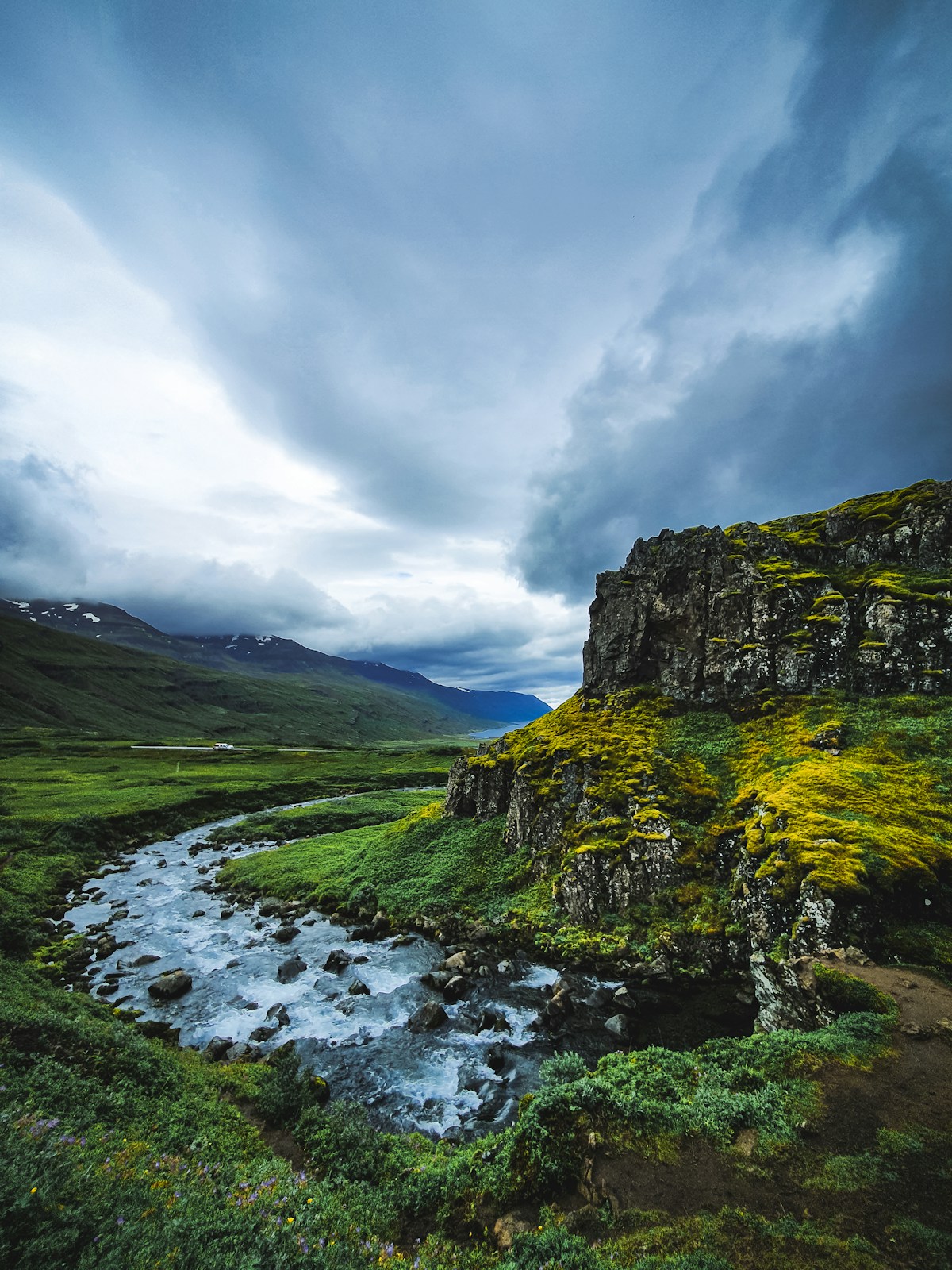
The East Fjords stretch for roughly 200km along Iceland’s eastern coastline, a series of deep inlets separated by steep ridges. The region sees a fraction of the tourist traffic that hits the Golden Circle or South Coast, and that relative quiet is part of the appeal. The hub is Egilsstaðir, with fjord towns strung along Route 1 and the secondary roads that branch off it.
Most East Fjords visitors pass through in a single Ring Road day. Slowing down to two or three days reveals a region with genuinely distinctive attractions - basalt canyon formations, a remarkable private mineral collection, Europe’s only weekly ferry connection to the continent, and puffin access with no crowds.
Seyðisfjörður
The most visited town in the East Fjords, set at the end of a 17km fjord with waterfalls dropping directly into the water on both sides. The drive from Egilsstaðir (50km, allow 45–60 minutes) crosses a mountain pass at around 600m that can be impassable in winter and even in poor summer weather - check conditions before you go.
The town is compact and walkable. Rainbow Street (Regnbogagatan) runs from the ferry terminal toward the iconic blue wooden church (Bláa Kirkjan) - the rainbow is painted on the road itself, and it reads as a deliberate piece of civic artwork rather than a gimmick. The church is free to enter.
Seyðisfjörður is also home to the LungA Art Festival each August - a week of exhibitions, music, and workshops centred on the town’s arts community. Ticketed events cost approximately ISK 3,000–8,000 as of 2026; much of the programme is free to walk through.
The Fardagafoss waterfall hike starts from the edge of town and takes 2–3 hours return, with views back over the fjord. No entry fee.
Stuðlagil Canyon
One of Iceland’s newer landmark discoveries - a narrow river gorge flanked by some of the most regular basalt column formations in the country. The columns are only fully visible when the Jökulsá á Dal river is low (the hydroelectric dam upstream reduced the flow significantly, which is what made the columns accessible). The canyon itself is free to visit.
Getting there requires Route 923 from Egilsstaðir, a roughly 1-hour drive partly on unsealed road. Check conditions before going - the access tracks can be muddy after rain. Guided tours from Egilsstaðir are available from approximately ISK 8,000 per person and include transport and narration on the geology.
Borgarfjörður Eystri Puffin Colony
The cliffs at Borgarfjörður Eystri hold one of Iceland’s most accessible Atlantic puffin colonies. A well-maintained path leads to a viewing platform directly above active burrows - no long hike required. The colony is present June through mid-August. Entry is free.
The road to Borgarfjörður Eystri from Egilsstaðir (70km) is mostly paved but narrows at points - allow 1.5 hours each way. The town also has a small cafe and is worth combining with time at the local church and the colourful mountain backdrop.
Petra’s Stone Collection, Stöðvarfjörður
Petra Sveinsdóttir spent her life collecting minerals, crystals, and rocks from the East Fjords - the result fills her house and garden at Fjarðarbraut 21 in Stöðvarfjörður and is now Iceland’s most unusual private museum. The collection runs to thousands of specimens, many of extraordinary size and quality. Entry approximately ISK 1,500 as of 2026. Allow at least an hour - the variety is genuinely surprising if you have any interest in geology.
Fáskrúðsfjörður French Hospital Museum
In the late 19th and early 20th centuries, hundreds of French fishermen worked the waters around Iceland each season. Fáskrúðsfjörður (then known to the French as Budereyri) was their main base, and the French government built a hospital, consul’s house, and chapel there. The museum at Fosshótel Fáskrúðsfjörður documents this largely forgotten chapter of Icelandic-French history. Entry approximately ISK 1,000 as of 2026. Signs around the village are bilingual in Icelandic and French.
Snæfell Hiking
Snæfell (1,833m) is the highest peak outside the Central Highlands and sits at the northern edge of the Vatnajökull National Park near the East Fjords. Reaching it requires a 4WD (the F-road approach), and most visitors hire a guide for the full ascent. Guided day tours cost approximately ISK 15,000 per person as of 2026. The summit views, on a clear day, cover the entire eastern quarter of Iceland.
Reindeer in the Eastern Highlands
Iceland’s only wild reindeer population was introduced from Norway in the 18th century and now numbers around 3,000–4,000 animals. They range across the highlands east of Egilsstaðir and are most commonly spotted in autumn when they move to lower ground. There is no entrance fee and no organised tour required - drive the roads east of Egilsstaðir and look for movement on the hillsides. Early morning and evening are the best times.
Browse Iceland tours - day trips, activity bookings, and multi-day packages across the country in one place.
Compare car hire in Iceland - a 4WD or campervan gives the flexibility to explore at your own pace.
Practical Notes
- Base yourself in Egilsstaðir - it has the most accommodation in the region and is within reach of all the attractions above. See our where to stay in Egilsstaðir guide.
- Fill up on fuel in Egilsstaðir - the fjord towns have limited petrol stations and some are unstaffed.
- Distances are deceptive - the fjord roads add significant time over straight-line distances. A journey of 60km on the map might take 90 minutes on the winding coastal road.
- The East Fjords are covered in our broader East Iceland guide.
For accommodation nearby, Search hotels in East Fjords on Booking.com.