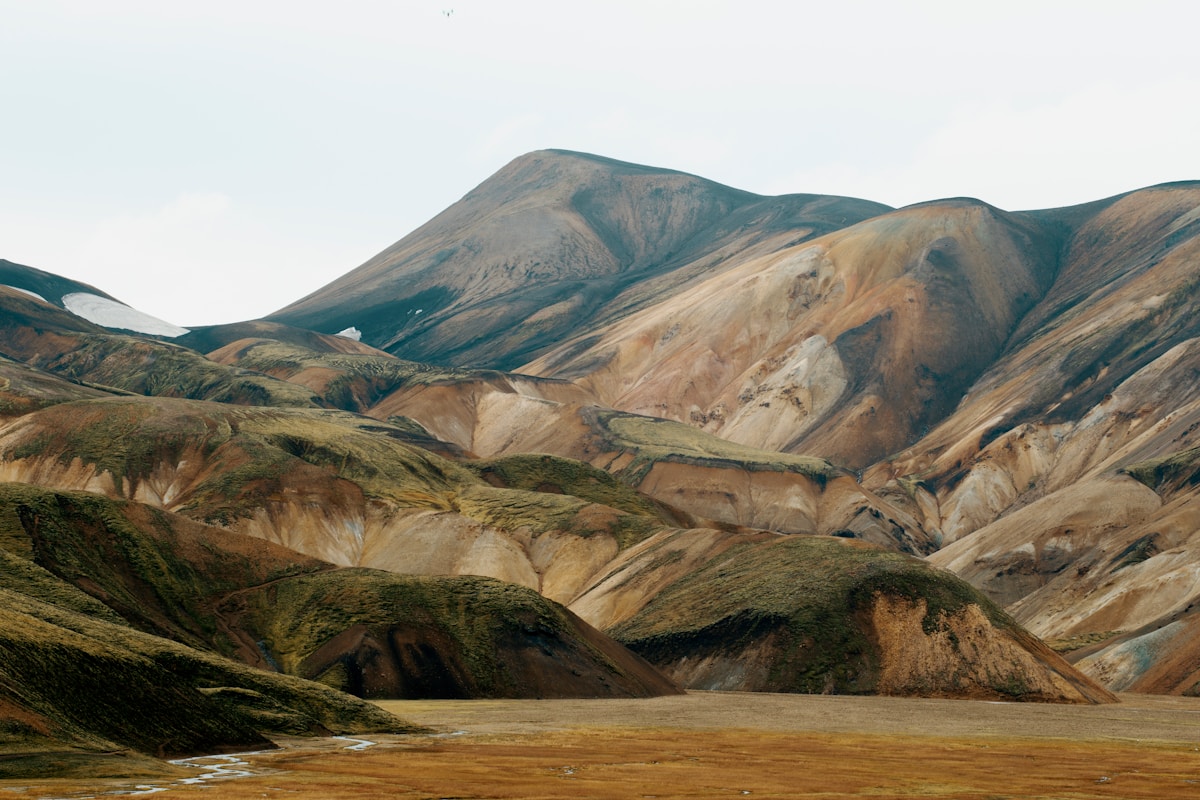
Landmannalaugar and Þórsmörk are the two endpoints of the Laugavegur Trail, Iceland’s most celebrated multi-day trek. Each can be visited as a standalone destination - for a day, a weekend, or longer - or you can walk the 55-kilometre route between them and experience both. The question most travellers face is not whether these places are worth visiting (they are, emphatically), but which to prioritise if time is limited, and whether one suits their style more than the other.
Overview
Landmannalaugar sits at around 600 metres in the southern highlands, reached via F-roads through lava fields and across river fords. Its defining characteristic is the rhyolite - a fine-grained volcanic rock that weathers into extraordinary shades of green, yellow, red, orange, and purple across the surrounding mountains. Nowhere else in Iceland, and arguably nowhere else in the world, produces colours like this at this scale. A geothermal hot spring sits beside the campsite, warm enough to bathe in comfortably even when air temperatures drop in late September.
Þórsmörk - the Valley of Thor - sits lower, at around 400 metres, in a sheltered valley surrounded by three glaciers: Eyjafjallajökull to the south, Mýrdalsjökull to the east, and Tindfjallajökull to the north. The name comes from its unusual density of birch and willow scrub - remarkable by Icelandic standards, where most highland terrain is bare. The combination of glacier panoramas, river braids, and the forest floor makes it feel more enclosed and intimate than Landmannalaugar’s open mountain terrain.
Getting There - F-Roads Are Non-Negotiable
Both Landmannalaugar and Þórsmörk require F-roads, and this is not a technicality you can work around. F-roads in Iceland are mountain tracks that cross rivers and unstable terrain. Driving them in a 2WD vehicle is illegal, voids your rental insurance, and can leave you stranded in a river crossing with no phone signal. Every tour company and rental agency will tell you the same thing: these roads require a high-clearance 4WD vehicle, full stop.
The good news is that there are alternatives to driving. Bus services from Reykjavik’s BSÍ terminal reach both destinations in summer, operated primarily by Reykjavik Excursions. One-way fares to Landmannalaugar run from approximately 7,500 to 9,500 ISK per person; to Þórsmörk from around 6,500 to 8,500 ISK. These run daily at peak season, are booked online in advance, and cover the river crossings in purpose-built vehicles. If you are not renting a 4WD, the bus is the correct approach - it is reliable, well-organised, and lets you focus on the landscape rather than the road.
If you are driving, the route to Landmannalaugar from Reykjavik is about 200 kilometres via Route 26 and then F208 - roughly three and a half to four hours with the river crossings factored in. The road typically opens in late June and closes in early to mid-October, but the exact dates vary by snow conditions and are published on road.is. Þórsmörk is about 150 kilometres from Reykjavik, primarily via Route 249 and F249, with multiple river crossings before reaching the valley. It typically opens a few weeks earlier than Landmannalaugar - sometimes late May - and closes in mid-October. Always check road.is before departing; conditions change quickly and an open F-road one day can be impassable the next after rainfall.
The Laugavegur Trail
The Laugavegur Trail is the thread that connects Landmannalaugar and Þórsmörk, and understanding it helps clarify what each destination offers as a standalone versus as part of a through-hike.
The trail runs 55 kilometres, typically over four days, with three mountain hut nights at Hrafntinnusker (12km), Álftavatn (25km), and Emstrur (43km). Most hikers walk south from Landmannalaugar to Þórsmörk - the overall elevation trend is downward, and ending in the birch forest feels like a natural arrival. The huts are operated by Ferðafélag Íslands (FÍ), and bookings typically open in early winter for the following summer season. Hut beds cost approximately 10,000 to 12,000 ISK per night, which includes use of cooking facilities and a warm sleeping space. Camping beside the huts costs around 5,000 to 6,500 ISK per person per night and requires you to carry a tent and sleeping bag.
The trail sells out. If you want hut beds in July or August, book as early as possible - January or February at the latest for peak season. Those who miss hut reservations either camp (which adds weight and reduces comfort in bad weather) or look for cancellations. Camping-only trips are entirely feasible but require more planning around gear weight and weather contingencies.
Standalone Visits
If you are visiting one location for a day or a weekend rather than hiking between them, each offers a different experience.
Landmannalaugar as a standalone destination centres on the hot spring and the day hikes. The geothermal pool at the campsite is included in your camping fee (around 3,000 to 4,500 ISK per night, depending on season). After a long day walking, lowering yourself into warm water with rhyolite mountains on every side is one of those experiences that justifies a long journey. The most popular day hikes are Brennisteinsalda (two to three hours return, a ridge walk with sulphur vents and extraordinary colour variation) and Bláhnúkur (four to five hours return, a harder climb to a summit with views across the entire rhyolite landscape). Both are well-marked and require no technical skills, though good waterproof boots and wind-proof layers are essential.
Þórsmörk as a standalone offers panoramic glacier views and forest hiking that contrast sharply with the bare lava highlands. The Valahnúkur viewpoint is reachable in one to two hours return from the main camp at Húsadalur and gives a 360-degree panorama of all three surrounding glaciers - arguably the most rewarding summit-to-effort ratio in Icelandic hiking. Rjúpnafell is a harder four to five hour route with more demanding terrain. The birch scrub forest at valley level is remarkable simply because it exists - Iceland’s interior is almost entirely treeless, and walking under any kind of canopy, even knee-high willow, is unexpectedly pleasant. For more detail on routes and timing: things to do in Landmannalaugar and things to do in Thorsmork.
Where to Stay
Search hotels in Landmannalaugar on Booking.com
At Landmannalaugar, the FÍ mountain hut offers sleeping bag spaces at around 10,000 ISK per night - bunk beds in a shared dormitory, access to cooking facilities, and a basic shower. The camping area is directly beside the hot spring, with pitches at approximately 4,500 ISK per night per person. There are no grocery shops at Landmannalaugar and no café open year-round. Bring everything you plan to eat.
Þórsmörk has slightly more developed infrastructure. Húsadalur, operated as Volcano Huts, offers a range of accommodation from camping (around 3,500 ISK per night) to private hut rooms and yurts (from approximately 15,000 ISK per night). The facilities are more comfortable than Landmannalaugar’s: there is a small café, hot showers, and more sleeping configurations. The FÍ-run Básar hut is at the western end of the valley - sleeping bag spaces at around 10,000 ISK, similar to the Landmannalaugar hut. If you are arriving by bus and want company rather than solitude, Volcano Huts tends to be livelier; Básar is quieter and closer to the Laugavegur trail terminus.
Search huts and accommodation near Þórsmörk on Booking.com
What to Pack
Neither destination has a shop or resupply point, so everything you need for your stay must come with you. The essentials for both locations: a waterproof jacket and trousers (highland weather changes without warning, rain is common even in July), warm mid-layer, wool or synthetic base layers, good waterproof boots with ankle support, hiking poles (genuinely useful on river crossings and steep descents), headlamp, first aid kit, and enough food for every meal plus emergency snacks. Water from glacial streams and rivers is safe to drink at both locations, so you do not need to carry large quantities - filter or purify if you are unsure of any source near human activity.
Midges are present at Landmannalaugar from June through August, concentrated around the hot spring in calm weather. A midge net and long sleeves help in the evenings. Þórsmörk is less affected.
Phone signal is intermittent at best in both locations. Download offline maps (maps.me or Gaia GPS) before you leave the main road, and carry a paper map or printout of your route as backup.
Budget
Getting there: Bus from Reykjavik costs approximately 7,000 to 9,500 ISK one-way per person. If you are renting a 4WD to access F-roads, the vehicle upgrade from a standard small car can add 20,000 to 35,000 ISK per day to your rental bill, depending on the company and season.
Accommodation: Mountain hut sleeping bag space runs around 10,000 to 12,000 ISK per night. Camping is 3,500 to 6,500 ISK per person per night. Volcano Huts’ more comfortable options start around 15,000 ISK.
Food: Self-catering is the only option. Budget 3,000 to 5,000 ISK per day for food if you are buying supplies in Reykjavik or Hella before the journey.
Full Laugavegur Trail budget (4 nights, self-catered, bus transport each way): approximately 70,000 to 100,000 ISK per person, depending on accommodation choices. This excludes kit and clothing.
Season
Both destinations are summer-only. Landmannalaugar typically opens in late June and closes in early to mid-October. Þórsmörk usually opens a few weeks earlier, sometimes late May, and closes around mid-October. Snow can fall at any point in the highlands, including in July - morning snow that melts by noon is not unusual. The hot spring at Landmannalaugar is actually most pleasant in late August and September, when the air temperature has dropped enough to make the contrast between the warm water and the cool air striking.
Outside these windows, both destinations are inaccessible by road. The bus services also stop at the end of the season.
Book Laugavegur trek options - guided and self-guided packages with luggage transfers available.
Compare car hire in Iceland - a 4WD or campervan gives the flexibility to explore at your own pace.
The Verdict
Choose Landmannalaugar if the rhyolite colour palette is what drew you to the Icelandic highlands in the first place. There is no substitute for the experience of walking through mountains that are genuinely green, red, orange, and yellow - it looks surreal in photographs and more surreal in person. Add the hot spring and two strong day hikes and you have a weekend that stands completely on its own.
Choose Þórsmörk if glacier panoramas and the relief of arriving in a sheltered valley after open highland terrain appeal more than the colour spectacle. The Valahnúkur viewpoint is extraordinary, the accommodation infrastructure is slightly more comfortable, and as the Laugavegur terminus, it tends to have more of a celebratory atmosphere among hikers finishing the trail.
Do both if you have the time. The Laugavegur Trail between them is the definitive experience of Iceland’s interior - four days of terrain that shifts from volcanic colour to glacier rivers to birch scrub, with no road access and almost no noise except wind. If you have the fitness, the gear, and the four to five days to commit, walking between Landmannalaugar and Þórsmörk is worth arranging your entire Iceland trip around. More on each destination: Landmannalaugar and Thorsmork.
More Iceland Comparisons
- Snæfellsnes vs Westfjords — Accessible western peninsula versus remote northwest
- Vík vs Höfn — Two south coast Ring Road overnight bases
- Reykjavík vs Akureyri — Iceland’s capital versus the north Iceland hub
- Westman Islands vs Snæfellsnes — Volcanic island versus glacier peninsula