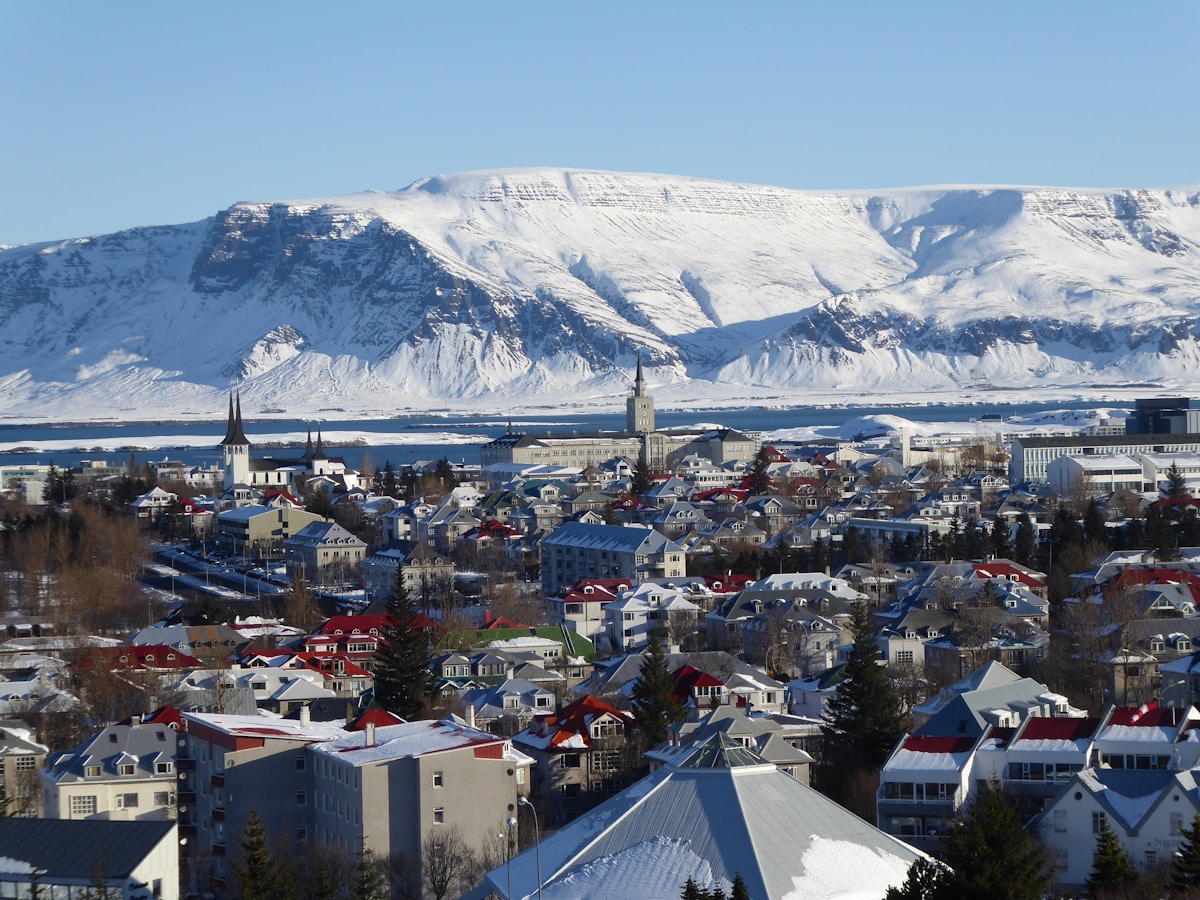
Iceland punches well above its weight for a country with fewer than 400,000 people, and choosing where to base yourself is one of the first real decisions you’ll make when planning a trip. Reykjavik and Akureyri are the two cities most travellers compare - not because they’re interchangeable, but because they represent genuinely different Iceland experiences.
Overview
Reykjavik is home to around 130,000 people - roughly a third of Iceland’s total population in one city. It sits on the southwest coast and functions as the country’s only true international gateway. Keflavik International Airport, 50km away, handles almost all incoming international traffic. The capital offers the widest range of hotels, restaurants, museums, and tour operators on the island. Ring Road kilometre zero starts here.
Akureyri is a different proposition: a town of around 20,000 people in a fjord in north Iceland, 460km from the capital by road. Icelanders call it the “Capital of the North,” which says something about how far removed it feels from Reykjavik, and also how central it is to the northern part of the island. The town sits at the head of Eyjafjörður, Iceland’s longest fjord, and is flanked by mountains. It has a small domestic airport and acts as the main logistics hub for anyone exploring north Iceland without wanting to drive 5 hours back to Reykjavik each evening.
These are not competing cities in any meaningful sense. Most travellers who go to Akureyri combine it with Reykjavik. The question is really about where to spend more time, and what to use as your primary base.
Getting There and Around
Getting to Reykjavik is straightforward. Keflavik Airport is served by dozens of international carriers. From the airport to the city centre, the Flybus takes around 45 minutes and costs approximately 3,000 ISK (around $22) one-way. The city has a public bus network - Strætó - that covers most central areas, though many visitors hire a car for flexibility with Golden Circle and south coast day trips.
Akureyri has its own domestic airport, just 3km from the town centre. Air Iceland Connect runs multiple daily flights from Reykjavik’s domestic Reykjavik Airport (not Keflavik) to Akureyri, with a flying time of 40–60 minutes. Fares typically start from around 15,000 ISK (~$110) one-way, though you’ll often find better prices booking ahead. The drive from Reykjavik to Akureyri takes roughly 5 hours via the Ring Road (Route 1), covering about 460km - it’s a manageable drive in good conditions and passes through some excellent highland scenery, especially around the Holtavörðuheiði moor.
Travelling between the two by public bus is possible: Strætó’s route 57 runs in summer and takes approximately 7 hours, costing around 6,500 ISK (~$47). If you plan to explore extensively north of Akureyri - Mývatn, Húsavík, the Diamond Circle - renting a car in Reykjavik and driving north gives you the most flexibility.
Things to Do
Reykjavik’s pull is a combination of urban culture and easy access to some of Iceland’s most famous natural attractions. In the city itself: Hallgrímskirkja church is free to enter (the tower observation deck costs 1,000 ISK), the National Museum charges 1,800 ISK and gives a solid grounding in Icelandic history, and the Reykjavik Art Museum covers multiple venues. Whale watching from the Old Harbour runs May to October, with tours priced between 12,000 and 15,000 ISK per person. The Laugardalslaug geothermal pool - a local favourite - costs around 1,100 ISK.
Beyond the city, Reykjavik is the obvious starting point for the Golden Circle (Þingvellir, Geysir, Gullfoss), the south coast waterfalls, and the Blue Lagoon geothermal spa. Blue Lagoon entry ranges from 45,000 to 90,000 ISK depending on the package - it’s expensive, and you need to book well in advance. We cover more options in our guide to things to do in Reykjavik, and a full breakdown of what’s reachable in a day in our Reykjavik day trips guide.
Akureyri rewards more independent exploration. The Botanical Garden (free, and impressively lush given the latitude) and Akureyri Church are easy starting points. Within an hour of town, the picture is significantly different: Goðafoss waterfall - one of Iceland’s most photogenic - sits 40km east of Akureyri along Route 1 and costs nothing to visit. The Mývatn region, an hour’s drive further, offers volcanic craters, geothermal pools, and one of Iceland’s best collections of bird species. Whale watching tours also operate from Akureyri’s harbour, with prices around 11,000 ISK - though whale sighting rates are generally lower here than at Húsavík. In winter, Hlíðarfjall ski resort on the edge of town opens December through April. Our full rundown of the area is in the Akureyri things to do guide.
Where to Stay
Search hotels in Reykjavík on Booking.com
Reykjavik has the widest spread of accommodation options in Iceland at every price point. Budget travellers can find dorm beds at Kex Hostel from around 6,000 ISK per night ($43). The mid-range bracket - hotels like Fosshotel Reykjavik or Canopy by Hilton - starts from around 30,000 ISK per night ($218), though prices rise sharply in July and August. At the luxury end, The Retreat at Blue Lagoon is Iceland’s headline property, with rooms from around 120,000 ISK (~$870) per night. There are also hundreds of apartments and guesthouses. Our Reykjavik accommodation guide covers the neighbourhoods and what to expect in each price band.
Akureyri’s accommodation is smaller in scale but generally good value by Icelandic standards. Akureyri Backpackers offers dorm beds from around 5,500 ISK ($40) per night. Icelandair Hotel Akureyri is the main mid-range property, from around 28,000 ISK ($204) per night. Gula Villan is a popular guesthouse option from approximately 22,000 ISK (~$160) per night. During peak summer, book ahead - Akureyri has far fewer rooms than Reykjavik and fills quickly. See our Akureyri where to stay guide for more detail.
Search hotels in Akureyri on Booking.com
Food and Drink
Reykjavik is comfortably Iceland’s best city for eating out, with a restaurant scene that has improved significantly over the past decade. Café Loki, across the road from Hallgrímskirkja, serves traditional Icelandic dishes including a buffet option at around 3,500 ISK. Grillmarkaðurinn offers upscale Icelandic grill cooking with mains typically around 5,000 ISK. Bæjarins Beztu Pylsur - the famous downtown hot dog stand - remains the cheapest reliable meal in the city at around 600 ISK. The city’s nightlife and bar scene also significantly outpaces anywhere else in the country. We cover the full range in our Reykjavik restaurants guide and food to try in Reykjavik.
Akureyri has a tighter selection but strong options for a town its size. Rub23 is the standout - a well-regarded sushi and grill restaurant with mains around 4,500 ISK. Strikið sits above the harbour and offers good views alongside its menu, with mains in the 4,000–6,000 ISK range. Bláa Kannan is a reliable café for coffee and lighter meals. See our Akureyri restaurants guide for the current shortlist.
Budget Comparison
Both cities are roughly comparable in terms of daily costs. Iceland is expensive everywhere - budget around 15,000–25,000 ISK per person per day for food, transport, and activities at a moderate level, excluding accommodation. Akureyri can be fractionally cheaper on accommodation due to less premium pricing pressure. The major variable is getting between the two: a return domestic flight adds around 30,000–40,000 ISK per person. Driving one-way and flying the other is a common approach for travellers doing a Ring Road loop.
Season and Weather
Reykjavik has a relatively mild climate by Icelandic standards - temperatures range from around 0°C in January to 12°C in July, with persistent wind and rain throughout the year. The city is accessible and fully operational in all seasons. Northern lights are visible from Reykjavik on clear nights between October and March, though light pollution reduces contrast. The Golden Circle and south coast day trips are do-able year-round, though some roads close in winter.
Akureyri runs colder in winter, averaging around -5°C in January, but is also drier than the south coast. The ski season typically runs December through April. In June, the midnight sun is more pronounced here than in Reykjavik - the sun remains above the horizon for longer, and on the summer solstice the light is genuinely extraordinary. Northern lights season extends from October to April, with darker skies than Reykjavik offering better viewing conditions.
Browse Reykjavík tours - city walking tours, food experiences, and day trips from the capital.
Compare car hire in Iceland - a 4WD or campervan gives the flexibility to explore at your own pace.
The Verdict
These two cities serve different purposes in an Iceland itinerary.
Choose Reykjavik if you’re on your first visit to Iceland, if you’re flying in and out of Keflavik and have limited time, if the Golden Circle and south coast waterfalls are your primary targets, or if you want a city base with broad options for restaurants, nightlife, and organised tours.
Choose Akureyri if north Iceland is your main focus, if the Mývatn region, Húsavík whale watching, or the Diamond Circle are central to your itinerary, or if you want a smaller, quieter town atmosphere. Akureyri also makes a natural base for multi-day drives through the Eastfjords.
Many visitors do both. A common pattern is to fly Reykjavik to Akureyri, explore the north for three to five days, then drive back along the Ring Road - or vice versa.
For more on each city: Reykjavik city guide and Akureyri city guide.
More Iceland Comparisons
- Húsavík vs Akureyri — Two north Iceland bases: whale watching town versus regional hub
- Vík vs Höfn — Two south coast overnight stops compared
- Blue Lagoon vs Sky Lagoon — Iceland’s two famous geothermal spas
- Snæfellsnes vs Westfjords — Accessible western peninsula versus remote northwest