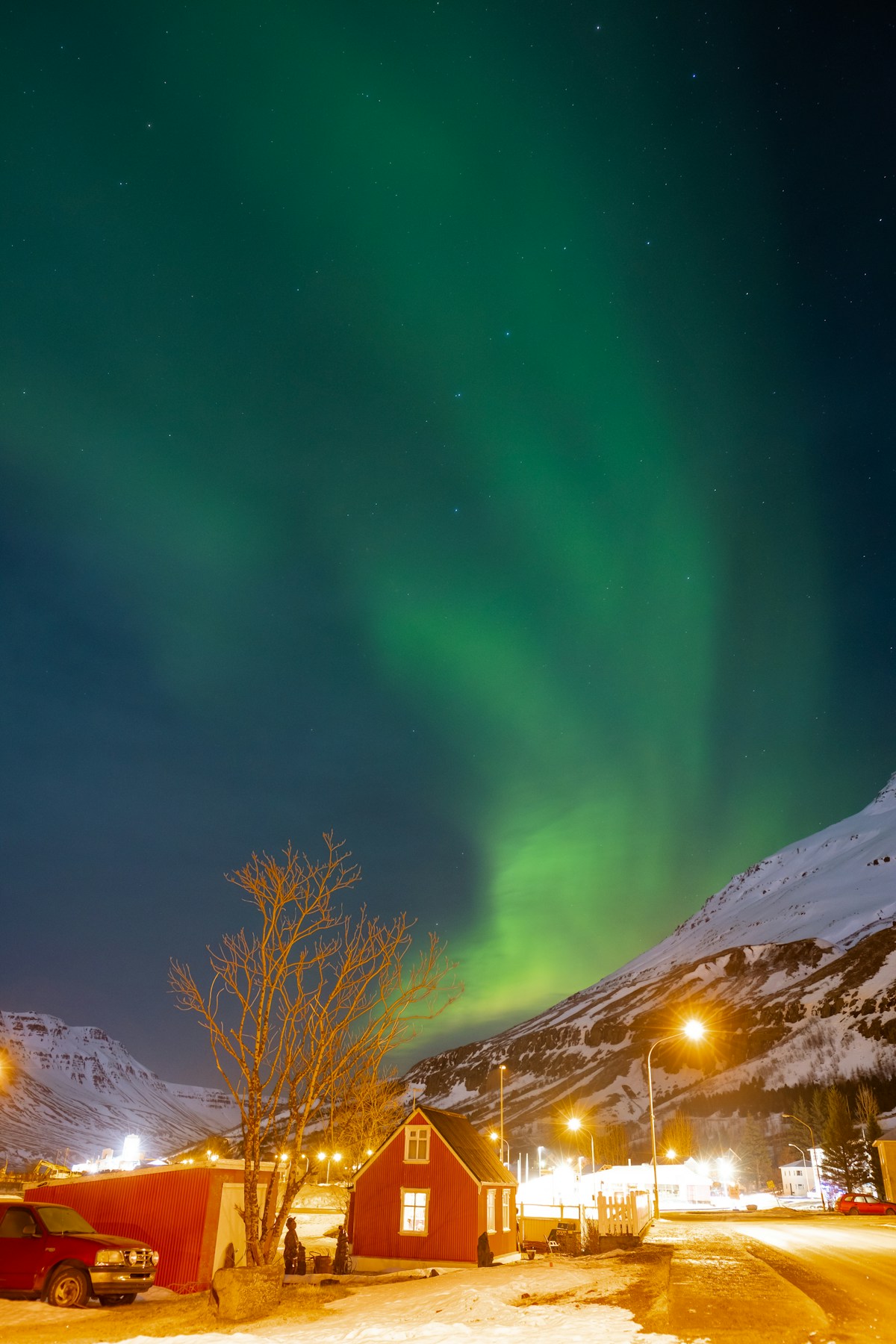
Iceland has dozens of small towns, but only a handful stop you in your tracks the moment you arrive. Seydisfjördur and Siglufjörður are two of them - both set in steep fjords, both built around colourful timber buildings, and both far enough from the main Ring Road to feel genuinely removed from the standard tourist circuit. They are also on opposite sides of the country, which means choosing between them usually comes down to which end of your Iceland itinerary you are exploring.
Overview
Seydisfjördur sits in east Iceland, 27 kilometres east of Egilsstaðir at the end of a dramatic mountain road. Its population is around 700 - small enough that you notice new faces. The town has developed a reputation as Iceland’s arts and culture hub, partly because of its Skaftfell art centre and partly because of the Smyril Line ferry that arrives weekly from Denmark and the Faroe Islands, bringing an international flow of visitors and residents who add to the creative energy. The most photographed street in the country might be the Rainbow Road leading to the town’s blue wooden church.
Siglufjörður is in north Iceland, 40 kilometres north of Akureyri via the Héðinsfjörður tunnel. Its population is around 1,200. For the first half of the twentieth century, it was one of the most important towns in the North Atlantic: the herring fishing boom turned it into a densely packed, raucous processing port where thousands of seasonal workers - including a large number of women known as herring girls - worked around the clock during summer. When herring stocks collapsed in the late 1960s, the town emptied almost overnight. What remains is a beautifully preserved harbour town with an exceptional museum dedicated to that era, and a quieter, more reflective atmosphere that rewards visitors who take time with it.
Getting There
The approach to Seydisfjördur is itself part of the experience. Route 93 climbs steeply from Egilsstaðir over the Fjarðarheiði pass at 610 metres, then descends in switchbacks to the fjord below. The road is dramatic and rewarding in clear weather but can close in winter and spring due to avalanche risk and ice - always check road.is before attempting the pass in shoulder seasons. From Reykjavik, the drive is approximately 680 kilometres via the Ring Road, taking seven to eight hours. Flights from Reykjavik domestic airport to Egilsstaðir take around 45 minutes and cost from roughly 15,000 ISK one-way, after which the 27-kilometre drive to Seydisfjördur takes about 30 minutes. The Smyril Line ferry arrives on Thursdays from Hirtshals (Denmark) via Tórshavn (Faroe Islands), making Seydisfjördur the first Icelandic stop for those arriving by sea from Europe.
Getting to Siglufjörður is more straightforward, at least from the north. The Héðinsfjörður tunnel, which opened in 2010, replaced a challenging mountain pass that previously cut off the town in poor weather. The tunnel connects Siglufjörður to Ólafsfjörður and from there to Dalvík and Akureyri - the whole journey from Akureyri takes about 40 minutes. From Reykjavik, you can fly to Akureyri (about 45 minutes, from around 12,000 ISK one-way) and then drive north, or make the seven-plus-hour drive via the Ring Road. The tunnel access has made Siglufjörður considerably more accessible than it was before 2010, and day trips from Akureyri are now common.
Things to Do
Seydisfjördur rewards slow exploration on foot. The Rainbow Road is a short painted walkway leading from the town centre to Blaakirkjan, the town’s blue wooden church - it was repainted during the pandemic and has since become one of the most replicated images in Icelandic travel photography. The Technical Museum of East Iceland (around 1,500 ISK) holds the old town telephone exchange and various industrial artefacts from the fjord’s fishing and processing past. The Skaftfell cultural centre runs exhibitions from local and international artists and is free to enter. Several waterfalls are reachable on short hikes from town: the walk to Vestdalseyri passes a particularly clean set of cascades above the fjord. The town is compact enough that you can cover most of it on foot in half a day, leaving time for the art centre, a café, and a longer hike in the afternoon. More on planning your time: things to do in Seydisfjordur.
Siglufjörður’s main attraction is the Herring Era Museum - Síldarminjasafnið - and it is one of the best museums in Iceland. Rather than display cases and photographs, the museum occupies several original harbour buildings used during the herring era, including a salting station, a packing house, and a boat shed with a restored smack and motor vessel. The experience of walking through the actual spaces where thousands of workers processed fish through the long summer days is visceral in a way that a conventional exhibit cannot match. Entry costs around 3,000 ISK and the museum is worth every minute of two hours. In winter, the Skarðsdalur ski area above the town operates a handful of runs with day passes at around 5,500 ISK - it is not a large ski resort, but the slopes are well-maintained and the views across the fjord are exceptional. Segull 67 microbrewery is in the town centre; the taproom is free to visit and samples are available. A seasonal ferry runs to Hofsós across the Skagafjörður for those extending their north Iceland itinerary. Our guide to things to do in Siglufjordur covers all of this in more detail.
Where to Stay
Search hotels in Seyðisfjörður on Booking.com
In Seydisfjördur, Hotel Aldan occupies four different buildings spread across the town - the main hotel, a separate old bank building, and two guesthouses - and manages to feel both boutique and local at the same time. Doubles start from around 28,000 to 35,000 ISK per night depending on room type and season. Hafaldan HI Hostel is housed in the town’s old hospital building, which is an unusual setting that works well: dorm beds start at around 6,500 ISK per night, with private rooms from around 22,000 ISK. There is also a campsite in town for those travelling with tents or campervans.
Siglufjörður’s most distinctive accommodation option is Sigló Hótel, a boutique hotel right on the harbour with views across the water to the mountains. It is one of the more expensive options in north Iceland, with doubles from around 38,000 to 50,000 ISK per night, but the location and the quality of the common areas make it worth considering for a special night. Herring Guesthouse offers a more straightforward base at around 22,000 ISK per night, and camping is available in summer. The smaller accommodation pool in Siglufjörður means booking ahead matters, particularly in July and August.
Search hotels in Siglufjörður on Booking.com
Food and Drink
Seydisfjördur has a small but varied selection for a town of its size. Kaffi Lára is the everyday option - soup, sandwiches, cake, and reliable coffee in a warm interior. Nord Austur is the most surprising restaurant: sushi and a small bar in a former fish factory, with a menu that draws on both Icelandic ingredients and Japanese technique. Skaftfell Bistro operates in the art centre building and is a good lunch option during gallery hours.
In Siglufjörður, Hannes Boy is a home-cooking restaurant run out of a small house near the harbour - the menu is limited but the food is good, with mains around 3,500 ISK. Kaffi Rauðka is the main café for coffee and light meals. Segull 67 brewery bar doubles as an evening spot for drinks, and it is the liveliest venue in town on most weeknights. The food options are more limited than in Seydisfjördur, so if you are staying several nights, stock up in Akureyri before making the drive north.
Budget Comparison
Costs are broadly similar in both towns. Sigló Hótel is the most expensive accommodation in either place; at the budget end, Seydisfjördur’s hostel gives backpackers more affordable options than Siglufjörður can match. Food spending is comparable, though Siglufjörður’s limited restaurant range means you may end up self-catering more. Museum entry is the main paid activity in both places: around 1,500 ISK in Seydisfjördur (Technical Museum), 3,000 ISK in Siglufjörður (Herring Era Museum). Getting to either requires fuel or flights; Seydisfjördur is further from Reykjavik in driving terms, which adds to the cost if you are covering the whole Ring Road.
Weather and Access Notes
Seydisfjördur’s main weather risk is the Fjarðarheiði pass on the approach road. Avalanche closures are not uncommon in late winter and spring - sometimes lasting several days - and the switchbacks can be icy. The town itself is sheltered in the fjord, but heavy snowfall can trap visitors who arrived before a closure and delay those trying to leave. This is worth factoring in if you have a flight to catch. Check road.is before driving the pass in any month from October through May.
Siglufjörður’s access situation has improved dramatically since the Héðinsfjörður tunnel opened. The old Strákagil mountain pass that previously connected the town to the rest of north Iceland was often impassable in winter; the tunnel made year-round access reliable for almost any vehicle. The town itself sits in a north-facing fjord and gets significant snow in winter, but road closures are now rare.
Photography
Seydisfjördur is, frankly, one of the most photogenic towns in Iceland. The combination of colourful wooden buildings, steep fjord walls, waterfalls visible from the town centre, and the Rainbow Road creates opportunities at almost every corner. Morning light falls on the church and the lower town; the fjord walls catch late afternoon light in summer. The most crowded time for photography is Thursday morning, when the Smyril Line ferry arrives and day-trippers flood in.
Siglufjörður rewards patience rather than obvious compositions. The harbour buildings of the Herring Era Museum photograph well in afternoon light, when the low northern sun hits the painted timber directly. The ski slopes above town give aerial views of the fjord. In winter, the whole town under snow against the dark fjord water has a quality that summer photographs rarely capture - if you are in north Iceland between December and March, it is worth the detour.
The Verdict
Choose Seydisfjördur if you are travelling the Ring Road from Reykjavik eastward, or if you are arriving by Smyril Line ferry and this is your entry point to Iceland. The arts scene, the Rainbow Road, and the hostel accommodation make it a natural stop for travellers who want something more than scenery - though the scenery is exceptional. It is also slightly more visitor-ready in terms of food and accommodation variety.
Choose Siglufjörður if you are based in or passing through Akureyri and want a day trip or overnight stop that goes well beyond a pretty view. The Herring Era Museum alone justifies the drive - it is the kind of experience you remember long after the landscape photographs have blurred together. The ski area makes it the better winter option of the two. More on each town: Seydisfjordur and Siglufjordur.
Browse Iceland tours - day trips, activity bookings, and multi-day packages across the country in one place.
Compare car hire in Iceland - a 4WD or campervan gives the flexibility to explore at your own pace.
See Also
- Seyðisfjörður travel guide - The East Fjords arts village: Blue Street, ferry connections, and the fjord landscape
- Siglufjörður travel guide - The Herring Era Museum town in North Iceland’s Tröllaskagi Peninsula
- East Fjords guide - The broader East Iceland region context
- Akureyri city guide - The main North Iceland hub, 65km from Siglufjörður via the mountain tunnel
- Ring Road Iceland - How both towns fit into a full Ring Road circuit
More Iceland Comparisons
- Húsavík vs Akureyri — Two north Iceland bases: whale watching town versus regional hub
- Reykjavík vs Akureyri — Iceland’s capital versus the north Iceland hub
- Vík vs Höfn — Two south coast Ring Road overnight bases
- Mývatn vs Reykjanes — Northern geothermal region versus the Blue Lagoon peninsula