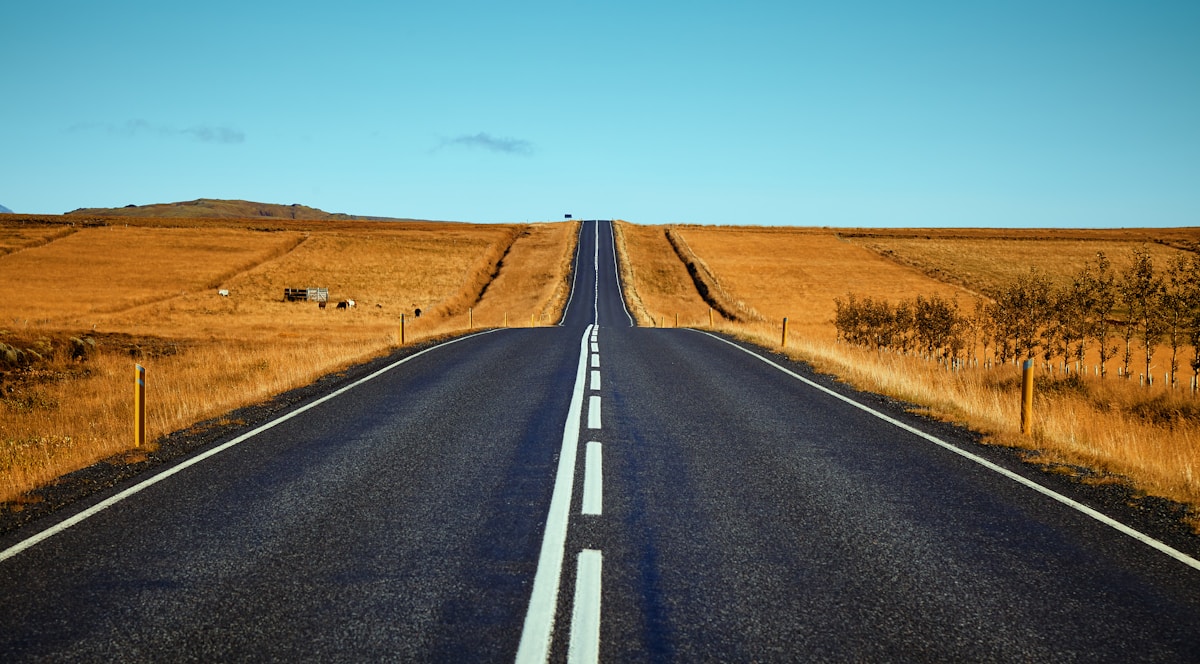
Iceland’s Route 1 - the Ring Road - is a 1,322km circuit of the entire country. It connects Reykjavík through the South Coast, the East Fjords, North Iceland, and the West, returning to the capital. It’s one of the world’s great road trips: volcanic landscapes, waterfalls, glaciers, and remote coastline accessible by car, with the road passing through multiple distinct ecosystems. If this is your first time in Iceland, read our first-time Iceland guide before planning your route.
Essential Driving Information
Mandatory winter tyres: Required by law from November 1 through April 15. Rental cars come with winter tyres fitted in this period. Check your rental terms.
Speed limits: 90km/h on paved rural roads (including most of the Ring Road), 80km/h on gravel, 50km/h in towns. Iceland has speed cameras and fines are substantial.
Gravel roads (F-roads): Marked with ‘F’ prefix. Not accessible by standard rental cars - you’ll void your insurance. Always check road.is before detouring.
Single-lane bridges: Numerous on the Ring Road - slow down, check for oncoming traffic, yield if necessary.
Sheep: Open-range sheep wander onto the road, particularly in summer. Slow down in rural areas.
Fuel: Fill up whenever you have a chance in remote areas. Petrol stations can be 100+ km apart in parts of the East Fjords and North Iceland.
The Route: Clockwise from Reykjavík
Most drivers go clockwise - South Coast first. This is the most popular direction and means the most dramatic sights come early.
Reykjavík → Vík (187km, approximately 2.5 hours)
Key stops:
- Seljalandsfoss (approximately 120km from Reykjavík) - waterfall you can walk behind. ISK 900 entry for the behind-the-falls path as of 2026.
- Skógafoss (approximately 150km) - 60m waterfall, free, staircase alongside
- Sólheimasandur Plane Wreck (approximately 167km) - 4km walk from the car park. Free.
- Reynisfjara Beach (near Vík) - black sand, sneaker wave danger. Stay 30m from water.
- Selfoss - a practical overnight base 63km from Reykjavík, closer to Þingvellir and the South Coast than the capital
Vík → Höfn (195km, approximately 2.5 hours)
Key stops:
- Kirkjubæjarklaustur - the only significant stop between Vík and Höfn; fuel, food, and Fjaðrárgljúfur canyon
- Skaftafell (Vatnajökull National Park) - glacier walks, Svartifoss waterfall
- Jökulsárlón Glacier Lagoon - zodiac boat tours from ISK 9,900; free to walk the shore
- Diamond Beach - icebergs washed onto black sand, immediately beside Jökulsárlón
- Höfn - Iceland’s langoustine capital and the end of the South Coast section
Höfn → Egilsstaðir (270km, approximately 3.5–4 hours)
The East Fjords section - 270km of winding coastal road through a dozen separate fjords.
Key stops:
- Djúpivogur - harbour village, Eggs of Merry Bay sculpture
- Stöðvarfjörður - Petra’s stone collection
- Fáskrúðsfjörður - French fishing history, bilingual street signs
Egilsstaðir → Akureyri (265km, approximately 3 hours)
North Iceland begins. Fewer dramatic waterfalls, more spacious Highland scenery.
Key stops:
- Dettifoss (detour, approximately 90km from Egilsstaðir) - Europe’s most powerful waterfall
- Mývatn (100km west of Egilsstaðir) - full day needed (see separate Mývatn guide)
Akureyri → Reykjavík (390km, approximately 5 hours direct)
Key stops:
- Goðafoss (47km southeast of Akureyri) - free, 45 minutes, roadside stop
- Siglufjörður - optional 65km detour north; the Herring Era Museum is the best in Iceland
- Varmahlíð and Skagafjörður - horse country, optional detour
- Borgarnes - Settlement Centre museum (2 hours); junction for Snæfellsnes and Westfjords
- Akranes - lighthouse and Folk Museum, 50km from Reykjavík via the Hvalfjörður tunnel
- Snæfellsnes Peninsula - major detour off the Ring Road, full day (see separate guide)
Estimated Times by Section
| Section | Distance | Direct Drive | Recommended Time |
|---|---|---|---|
| Reykjavík → Vík | 187km | 2.5 hrs | Full day |
| Vík → Höfn | 195km | 2.5 hrs | Full day |
| Höfn → Egilsstaðir | 270km | 3.5 hrs | Full day |
| Egilsstaðir → Akureyri | 265km | 3 hrs | 1–2 days |
| Akureyri → Reykjavík | 390km | 5 hrs | 1–2 days |
Total for full circuit with stops: 7–10 days minimum.
Car Rental Practical Notes
- Book your rental car well in advance for summer (prices increase dramatically July–August)
- Mandatory gravel protection (SAAP) insurance approximately ISK 2,000–5,000/day if you drive on gravel
- Collision damage waiver (CDW) is included in most basic rates but check deductible amounts
- Major operators: Hertz, Avis, Budget (airport desks), and Icelandic companies (Geysir, Blue Car, Saga)
- Credit card hold of approximately ISK 50,000–150,000 required at pickup
Clockwise vs Counterclockwise
Go clockwise. The South Coast — Seljalandsfoss, Skógafoss, Reynisfjara, Jökulsárlón — is the most photogenic section and easiest to drive. Starting with it means maximum motivation early in the trip, when energy is highest. The East Fjords and North Iceland in the second half of a clockwise circuit are slower to drive but absorb you gradually.
The counterclockwise case: Fewer drivers go counterclockwise, which means you’ll arrive at popular South Coast stops when crowds are leaving rather than arriving (useful in summer). Akureyri and North Iceland provide a scenic introduction before the South Coast payoff at the end.
Winter: In winter conditions, going counterclockwise means approaching the South Coast — Iceland’s wettest, stormiest section — later in the trip after you’ve built up driving experience in Iceland’s conditions. Some winter drivers prefer this approach.
Verdict: For first-timers, clockwise in summer. For experienced drivers or winter travel, counterclockwise is worth considering.
When to Drive the Ring Road
| Period | Conditions | Notes |
|---|---|---|
| June–August | All roads open, maximum daylight, all services available | Peak crowds and prices; book accommodation months ahead |
| September–October | Northern Lights possible; autumn colours in East Fjords; some highland F-roads closing | Excellent value; fewer crowds; most services still open |
| November–April | Shorter daylight; winter tyres mandatory; some mountain passes may close | Scenic and uncrowded; requires cold-weather preparation and flexibility |
| May | Spring thaw; most roads clear; waterfalls high | A strong shoulder option; book ahead as summer prices begin |
The Ring Road (Route 1) itself is ploughed and maintained year-round. Weather closures occur but are usually cleared within hours.
Where to Stay: Key Overnight Stops
These are the accommodation options at the main overnight stops on the clockwise circuit. All are verified on Booking.com as of 2026.
Vík (Night 1–2)
Iceland’s southernmost village is the most popular first overnight on the Ring Road. Most services: fuel, supermarket, restaurants.
- Hótel Kría — mid-range hotel with restaurant and bar, approximately ISK 30,000–45,000/night. Views toward the Reynisdrangar sea stacks.
- Hotel Vík í Mýrdal — central, reliable, family rooms available, approximately ISK 28,000–42,000/night.
- Vík Hostel — budget beds from approximately ISK 7,000–10,000 per person in a dorm; private rooms also available.
Book Vík accommodation months ahead for July and August — it is the most popular overnight stop on the Ring Road and sells out fastest.
Höfn (Night 3)
Gateway to Jökulsárlón and the glacier lagoon area. Also Iceland’s capital for langoustine — try it at a local restaurant.
- Hotel Höfn — the town’s central hotel, approximately ISK 28,000–40,000/night. Restaurant on site.
- Fosshotel Glacier Lagoon — mid-range option closer to Jökulsárlón than Höfn itself, with glacier views and a restaurant, approximately ISK 40,000–60,000/night. Excellent if you want to be at Diamond Beach at sunset without a long drive.
- Höfn Hostel — budget option in town, from approximately ISK 7,500/person.
Egilsstaðir (Night 4–5)
The East Fjords hub. Smaller service town with a supermarket and a handful of restaurants. A quieter overnight than Vík or Höfn.
- Gistihúsið — Lake Hotel Egilsstadir — the main hotel in town, renovated farmhouse setting beside Lake Lagarfljót, restaurant on site, approximately ISK 25,000–38,000/night.
- Lyngás Guesthouse — basic rooms on Route 1, shared kitchen, budget pricing from approximately ISK 12,000–18,000/night double.
Akureyri (Night 6–7)
Iceland’s second city. Full services, excellent restaurants, a swimming pool with geothermal hot tubs, and the best nightlife outside Reykjavík.
- Hotel Kea by Keahotels — the flagship Akureyri hotel, central, approximately ISK 35,000–55,000/night. Within walking distance of the botanical garden and Akureyri Church.
- Berjaya Iceland Hotels Akureyri (formerly Icelandair Hotel Akureyri) — restaurant and bar on site, a 2-minute walk to the swimming pool, approximately ISK 28,000–42,000/night.
Daily Cost Estimate
| Budget level | Accommodation | Food | Fuel + activities | Daily total |
|---|---|---|---|---|
| Budget | Hostel dorm (ISK 7,000–10,000) | Self-catered (ISK 3,000–5,000) | ISK 5,000–8,000 | ~ISK 15,000–23,000 |
| Mid-range | Hotel (ISK 28,000–42,000) | Mix of restaurants (ISK 8,000–12,000) | ISK 6,000–10,000 | ~ISK 42,000–64,000 |
| Comfort | Mid-range hotel with dinner (ISK 40,000–60,000) | Restaurants (ISK 12,000–18,000) | ISK 8,000–14,000 | ~ISK 60,000–92,000 |
Per-person estimates based on two people sharing a room. Fuel costs assume approximately 400–500km/day at current ISK fuel prices. Activities (glacier walks, boat tours, entry fees) are additional and can add ISK 5,000–20,000 per day depending on choices.
Related Guides
- 10 days in Iceland itinerary - Day-by-day Ring Road itinerary with accommodation, costs, and what to book ahead
- 7 days in Iceland itinerary - A compressed Ring Road circuit for those with a week
- Iceland car rental guide - Full guide to car hire in Iceland: what type of car, insurance, and the best operators
- Iceland driving guide - Rules of the road, F-road restrictions, winter driving, and road conditions app
- South Coast drive - The Reykjavík to Höfn section in detail, with all stops, distances, and overnight options
- Iceland F-roads guide - Which F-roads branch off the Ring Road and what vehicle you need