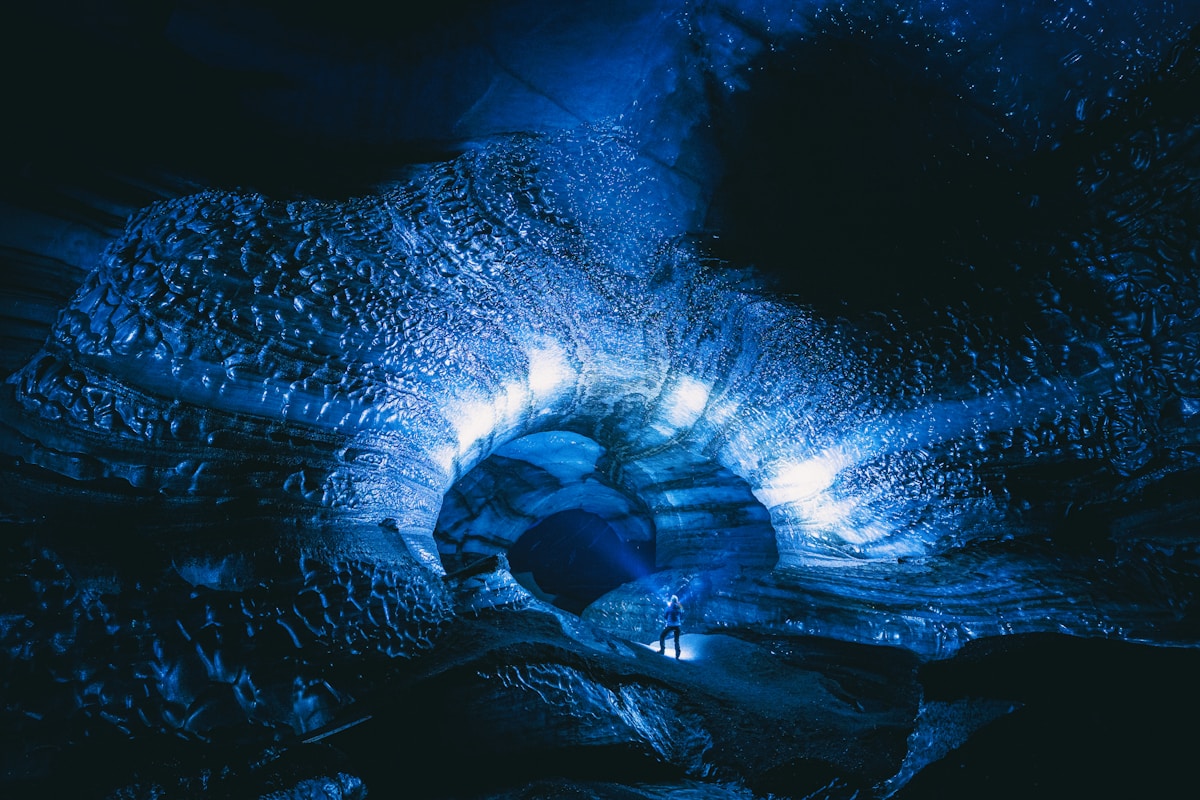
Iceland’s glaciers contain ice caves that form and dissolve with the seasons. The most impressive are inside Vatnajökull, the largest glacier in Europe by volume, and its outlet glaciers in the southeast. The season for glacier ice cave tours runs from October through March. Outside this window, the caves become unsafe as surface meltwater works its way through the ice.
Ice Cave Locations
Vatnajökull Ice Caves (Southeast Iceland)
Vatnajökull and its outlet glaciers - Breiðamerkurjökull (near Jökulsárlón), Svínafellsjökull (near Skaftafell), and others - are the main destination for ice cave tours in Iceland.
The ice caves that form each winter inside these glaciers are sometimes called crystal ice caves for the quality of their translucent blue walls. These are natural, temporary formations - they change each season and do not exist in the same form from year to year. Guides assess conditions regularly and route visits to the best available formations.
Tour operators in this area:
Local Guide of Vatnajökull (localguide.is): One of the most established operators in the southeast, running small-group ice cave tours from Jökulsárlón. Tours depart daily in season. Group sizes are typically 8–12 people.
Icelandic Mountain Guides (mountainguides.is): A well-regarded operator running both group and private glacier and cave tours in Vatnajökull. They also offer more technical glacier courses for visitors wanting to go beyond a standard guided cave tour.
Meeting point: Most southeast ice cave tours meet at the Jökulsárlón car park or at Skaftafell. Check the individual operator’s instructions - some pick up from Höfn if you are based there.
Katla Ice Cave (Near Vík, South Iceland)
Katla is a subglacial volcano beneath Mýrdalsjökull glacier, roughly 180 km from Reykjavík. The Katla ice cave is unusual because it operates year-round - the volcanic heat beneath the glacier means the cave structure is not dependent on winter temperatures in the same way as Vatnajökull’s caves.
The ice in the Katla cave has a distinct dark colouring from volcanic ash layers, creating a different visual effect from the pure blue ice of Vatnajökull. The cave is roughly 1.5–2 hours from Reykjavík.
Access: Tours are run by local operators based near Vík, including Arcanum Glacier Tours (arcanum.is). Departure points are typically the Arcanum base near Mýrdalsjökull. Prices as of 2026 start from approximately ISK 19,900 per person for a group tour.
Crystal Ice Cave vs Blue Ice Cave
These terms are sometimes used interchangeably by marketing materials, which creates confusion. The practical distinction:
Crystal ice cave refers to the highest-quality natural winter ice caves inside Vatnajökull’s outlet glaciers, where the ice is free of volcanic ash and forms translucent walls with a deep blue hue. These are the most photographed type. They require cold weather to develop well - the best crystal formations typically occur in December and January.
Blue ice cave is a broader descriptor covering any cave formed in glacial ice. A blue ice cave may not have the same clarity or dramatic formations as a crystal cave, but the ice colouring is still impressive.
When booking, ask operators directly which type of cave you will be visiting and what the current conditions are. Operators check cave status daily and will divert to an alternative location if conditions are poor.
What to Wear
Tour operators provide:
- Crampons (fitted at the meeting point)
- Safety helmet
- Some operators provide ice axes for stability
You need to bring or wear:
- Waterproof outer layer (jacket and trousers) - the glacier surface is wet
- Insulated mid-layer - temperatures inside caves are near 0°C, outside on the glacier is colder
- Warm base layer
- Waterproof boots with ankle support - operators check footwear suitability
- Warm hat and gloves
- Merino wool or thermal socks
Do not wear cotton - it retains moisture and becomes cold quickly. Merino wool or synthetic base layers are appropriate.
Physical Requirements
Most ice cave tours require:
- Ability to walk on uneven terrain with crampons for 1–2 km
- Ability to crouch through low passages (some caves require this)
- No recent knee, hip, or ankle injuries
- Minimum age typically 8–10 (varies by operator)
- Maximum weight limits may apply to certain tours - check with operators
The tours are not technically demanding, but the terrain underfoot is uneven and the ground is slippery. Follow your guide’s instructions on crampon technique - it takes about five minutes to feel comfortable.
Pricing Summary (as of 2026)
| Tour type | Approximate price |
|---|---|
| Group ice cave tour (Vatnajökull area) | from ISK 19,900/person |
| Group ice cave tour (Katla, near Vík) | from ISK 19,900/person |
| Day tour from Reykjavík with transport | from ISK 25,000/person |
| Private ice cave tour | from ISK 45,000–60,000 (whole group) |
Practical Tips
Book in advance: Ice cave season tours, particularly in December and January around holidays, book out weeks ahead. If you have a fixed Iceland travel date, book as soon as possible.
Same-day cancellations: Operators cancel or reroute tours when conditions are unsafe. Most offer a full refund or rebooking if this happens. Do not book non-refundable flights or accommodation assuming your cave tour will proceed - weather and ice conditions in Iceland are variable.
Photography: Bring a wide-angle lens if possible. The caves are dark - a high ISO capable camera helps. Flash photography is generally allowed but rarely flatters ice cave interiors. Tripods may not be practical in narrow passages.
Combining with Jökulsárlón: If visiting the southeast for an ice cave tour, most visitors also stop at Jökulsárlón glacier lagoon and Diamond Beach. See our Jökulsárlón guide for details on boat tours and Diamond Beach access.
For spots that open due to late cancellations, check our last-minute Iceland tours page - ice cave slots do free up, especially mid-week in January and February.
Browse ice cave tours in Iceland - guided trips into Vatnajökull and Langjökull, bookable year-round with expert local guides.
Get travel insurance for Iceland - policies covering glacier hikes, F-road driving, and volcanic disruption.
Related Guides
- Glacier hiking in Iceland - Summer glacier walks on Vatnajökull and other outlets
- Höfn travel guide - The nearest town to the Vatnajökull ice cave area: accommodation and restaurants
- Iceland winter itinerary - A full winter trip plan built around ice caves, auroras, and the South Coast
- Northern lights tours from Reykjavík - Pairing ice cave visits with aurora hunting on a winter trip