Iceland sits at the junction of the Atlantic and Arctic zones and hosts more than 330 recorded bird species. Around 80 of these breed on the island each year, many in colonies large enough to make Iceland one of the most important seabird countries in the world. The lack of land predators historically allowed ground-nesting species to evolve with a tolerance for close human approach - which makes birdwatching here unlike anywhere else in the Northern Hemisphere.
Best Birdwatching Seasons
May to August is the core birding season. Most migratory species arrive from late April and have departed by mid-August. Within that window:
- Late April–May: Arrival of Arctic terns, puffins, waders, and most ducks. Good for watching territorial behaviour and pair bonding.
- June–July: Peak breeding activity. Chick-rearing at seabird colonies. Midnight sun gives light almost around the clock for photography.
- August: Chicks fledging. Waders begin southward migration. Juvenile birds in unfamiliar plumage provide good identification challenges.
- September–March: Fewer species but snow buntings, purple sandpiper, and some wintering ducks remain. Gyrfalcon sightings increase in the quieter landscape.
Key Species Beyond Puffins
For a dedicated guide to puffin watching - including the best cliff colonies, boat tours, and timing - see our puffin watching Iceland article. Below are the species that make Iceland distinctive for broader birding.
Arctic Tern
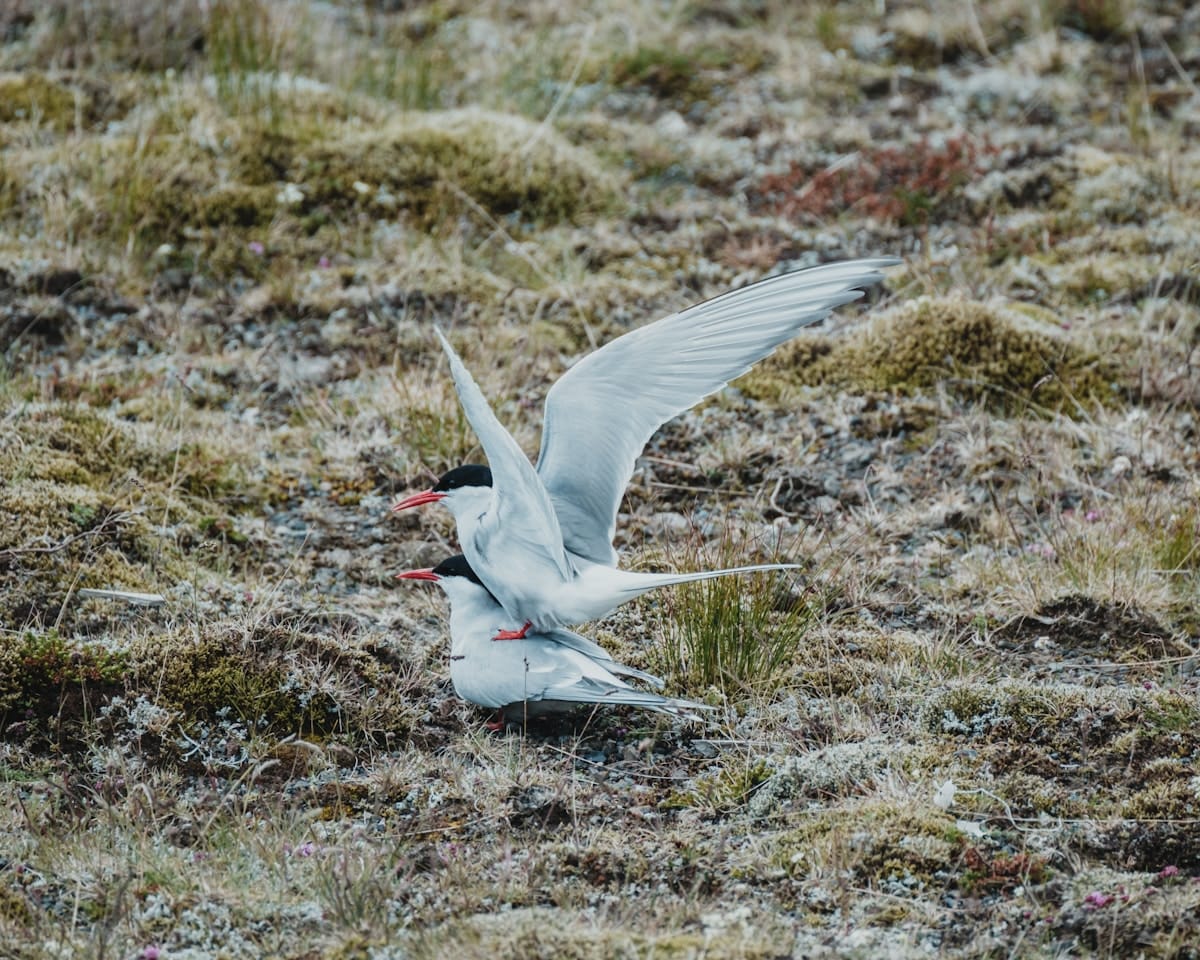
Iceland’s most abundant seabird, with colonies at virtually every sheltered coastal site. The Arctic tern undertakes the longest migration of any animal - from Iceland to Antarctic waters and back - yet arrives back in May with extraordinary precision. Nesting colonies can be aggressive: birds will dive-bomb anyone approaching a nest, and carrying a raised stick above your head (not to use, just to divert the terns) is standard practice. The combination of Iceland’s prolonged golden light and the terns’ elegant aerobatics makes them one of the most photographed birds in the country.
White-Tailed Eagle
Reintroduced after local extinction, Iceland now supports a growing white-tailed eagle population of around 90 breeding pairs as of 2026. The Westfjords - particularly the fjords around Ísafjörður - have the highest density. These are enormous birds: wingspan can reach 2.5 metres. Look for them over fjord inlets and river mouths hunting fish and waterfowl. The Látrabjarg peninsula road offers a good chance of sighting eagles on the cliffs and nearby farms in the early morning.
Gyrfalcon
Iceland’s national bird and one of the most sought-after species for visiting birders. Both white and grey colour morphs occur. Gyrfalcons nest on cliff ledges in the interior highlands and in coastal areas of north and east Iceland. Early spring (March–April) gives the best chance as pairs return to their nesting cliffs. Mývatn area, Þórsmörk, and the highlands around Landmannalaugar all produce sightings, though none are predictable.
Great Skua (Bonxie)
The great skua is a heavy, aggressive brown seabird that pirates fish from other birds and will attack humans at nesting sites. Iceland holds around 6,000 breeding pairs - a significant part of the world population. They nest on coastal moorland throughout Iceland, particularly in the Westfjords and around the Snæfellsnes Peninsula. Their direct piracy of gannets and fulmars in flight is one of Iceland’s most dramatic natural behaviours to witness.
Red-Throated Diver
The most widespread of Iceland’s two breeding diver species, the red-throated diver nests on small moorland pools and lakes and commutes to the sea to feed. Their drawn-out wailing call is one of the definitive sounds of the Icelandic interior. Look for them at any small lake in the highlands between May and August. Mývatn’s surrounding moorland pools are reliable.
Harlequin Duck
Iceland holds the largest breeding population of harlequin duck outside North America. The males in breeding plumage - slate blue, chestnut, and white with intricate markings - are one of the most striking ducks in the world. They breed on fast-flowing rivers, particularly in north and east Iceland. The Laxá river draining Lake Mývatn is the most reliable spot in Iceland for close views. Harlequins are present year-round at their breeding rivers.
Barrow’s Goldeneye
Iceland is the only European breeding location for Barrow’s goldeneye. The entire European population - approximately 1,000–2,000 birds - breeds in Iceland, with the Mývatn basin holding the highest concentration. The species nests in rock crevices near lake shores and river banks. Males have distinctive crescent-shaped white facial patches. The Laxá river below Mývatn is the best single location for this species.
Whooper Swan
The whooper swan is Iceland’s only breeding swan and an important symbol in Norse and Icelandic culture. Around 3,000–4,000 pairs breed in Iceland, mainly in the interior and north. Flocks can be seen in many inland lakes and rivers from April through October. Þórsmörk and the wetlands around Mývatn are reliable.
Best Birdwatching Locations
Lake Mývatn and the Laxá River
The most species-rich single location in Iceland. Up to 16 species of duck breed on and around the lake - a world record for any lake outside the tropics. The Laxá river holds harlequin ducks and Barrow’s goldeneye year-round. Surrounding moorland has red-throated diver, great northern diver, gyrfalcon (occasional), golden plover, dunlin, and red-necked phalarope. The pseudo-craters and lava formations around the shore provide diverse microhabitats. Allow a full day minimum; two days gives a thorough count. See our Mývatn guide for accommodation and logistics.
Látrabjarg Cliffs (Westfjords)
The largest seabird colony in Iceland - 14km of cliffs up to 440m high hosting millions of seabirds. Razorbills, common guillemots (murres), Brünnich’s guillemots, northern gannets, northern fulmars, kittiwakes, and puffins all nest in visible numbers. White-tailed eagles patrol the cliff tops. The clifftop walk gives eye-level views of birds on ledges. Remoteness (3–4 hours from Ísafjörður on gravel roads) keeps visitor numbers low. Accessible June–August only - roads close in winter.
Flatey Island (Breiðafjörður)
A small island in Breiðafjörður bay reached by the Stykkishólmur ferry. Flatey is renowned for its bird density per square kilometre: Arctic terns nest on the village lawns, eiders nest around every garden, and the surrounding bay holds significant numbers of red-throated diver, great northern diver, long-tailed duck, and various wader species. The ferry from Stykkishólmur makes it a viable day trip or overnight stay. The island’s handful of guesthouses must be booked well in advance for summer.
Snæfellsnes Peninsula
The peninsula combines coastal seabird cliffs, lagoons, lava fields, and mountain terrain - giving a high species count in a compact area. Ólafsvík and Grundarfjörður on the north coast have skua nesting on the headlands. The Ytri-Tunga beach area has an accessible grey seal colony and good wader habitat. The cliffs around Arnarstapi hold fulmars, kittiwakes, and black guillemots. The glacier itself has occasional snow bunting and ptarmigan on its southern flanks.
Jökulsárlón Glacier Lagoon
The glacier lagoon and its outlet river attract glaucous gulls, great skuas, and Arctic terns. More significantly, the Diamond Beach (Breiðamerkursandur) where the river meets the sea is one of Iceland’s best locations for great skuas and great black-backed gulls. Arctic foxes hunt the beach, which sometimes concentrates birds into productive activity. The area is covered in our South Coast tours article if you’re planning that route.
Westfjords Interior
Beyond Látrabjarg, the Westfjords offer some of Iceland’s least-visited birding terrain. Islandsfjörður and Djúpavík in the north-west have good seabird colonies. White-tailed eagles are widespread. The fjord roads - often unpaved - make this territory for self-drive birders with high-clearance vehicles and time.
Guided Birdwatching Tours
Fuglaferðir (Birding in Iceland) is the country’s specialist birdwatching tour operator based in Reykjavík. They run single-day tours (approximately ISK 28,000–42,000 per person as of 2026) to key sites within two hours of the capital, and multi-day itineraries of 5–10 days covering Mývatn, Snæfellsnes, the Westfjords, and the highlands. Their guides are ornithologists with extensive knowledge of seasonal movements.
Eldhestar (eldhestar.is) combines horse riding and birding in the highland interior, offering a distinctive way to access remote nesting areas. Day tours from approximately ISK 22,000 per person.
Elding Adventures (elding.is) run puffin-watching and general seabird boat tours from Reykjavík Old Harbour (approximately ISK 6,500–8,500 per person as of 2026). Whale watching tours departing Húsavík often pass good Arctic tern colonies on the way out of harbour - see our whale watching guide for schedules and operators.
GetYourGuide lists several day-tour operators offering combined wildlife/birdwatching experiences departing Reykjavík, Húsavík, and Akureyri - search birdwatching Iceland to compare current options and availability.
Equipment and Preparation
Binoculars: 8×42 or 10×42 are the standard choices. In Iceland’s often overcast light, lens quality matters more than magnification - cheaper glass loses contrast in grey conditions.
Camera: A 400–600mm lens is ideal for skittish highland species and birds on cliff ledges. For tolerant ground-nesting species like puffins at Látrabjarg or terns at Flatey, a 200mm lens is often sufficient to fill the frame.
Clothing: Wind is the constant variable in Iceland. A waterproof hard shell is non-negotiable. Merino wool midlayers work better than down when damp. Gaiters protect trousers when walking boggy moorland to reach diver pools.
Apps and references: eBird (Cornell Lab) has substantial Iceland checklists and maps. The Collins Bird Guide (Mullarney et al.) covers all European species including Iceland’s. Merlin Bird ID recognises Iceland’s most common species by photo or sound.
Midge and insect protection: The Mývatn area lives up to its name (“Midge Lake”) in calm summer weather. A head net and DEET-based repellent are worth carrying from mid-June to mid-August.
Photography Tips for Iceland Birding
The midnight sun between late May and late July is the defining advantage for bird photography in Iceland. Light quality at 11pm in June often surpasses any midday light in Central Europe - soft, warm, directional, and lasting for hours. Arctic tern colonies at dusk (which is really 11pm) provide extraordinary light against dark moorland backgrounds.
Shutter speed: Birds in Iceland’s steady onshore winds are often low over terrain, banking constantly - keep shutter speed above 1/2000s for sharp wing detail in flight.
Background: Iceland’s volcanic landscapes are relatively uniform. Work to position your subject against contrasting backgrounds - black sand beaches, white snow patches, or dark basalt cliffs make for cleaner images than green grass behind a green-headed duck.
Approach: Most experienced Iceland birders photograph from a seated or prone position. Coming down to the bird’s eye level - rather than shooting down - transforms the quality of images, particularly for ground-level species.
Related Guides
- Horse riding in Iceland - Horseback tours through birding habitats: the highland interior, the Snæfellsnes Peninsula, and South Iceland
- Iceland volcanoes - Understanding Iceland’s volcanic landscape, which shapes every birding habitat in the country
- Waterfalls guide - Many of Iceland’s best waterfalls are near key birdwatching sites
Skua interactions: Great skua piracy attacks on other seabirds tend to happen in the same areas repeatedly, especially near the nesting colony. Positioning yourself between the colony and the offshore fishing areas and waiting often produces dramatic interaction shots.
Book Húsavík whale watching tours - traditional oak boat and high-speed RIB options from the harbour.
Browse Iceland tours - day trips, activity bookings, and multi-day packages across the country in one place.
Get travel insurance for Iceland - policies covering glacier hikes, F-road driving, and volcanic disruption.
Related Guides
- Puffin watching in Iceland - Dedicated guide to Atlantic puffins: best colonies, timing, and viewing ethics
- Whale watching in Iceland - Combine whale watching with seabird spotting on the same tours from Húsavík or Reykjavík
- Lake Mývatn guide - Iceland’s finest duck-watching location, with around 15 breeding species
- Westfjords guide - Látrabjarg bird cliffs: the largest seabird colony accessible from land in Iceland
- East Fjords guide - Borgarfjörður Eystri puffin colony: platform viewing within metres of active burrows
- Iceland highlands guide - The interior for golden plover, red-necked phalarope, and breeding waders