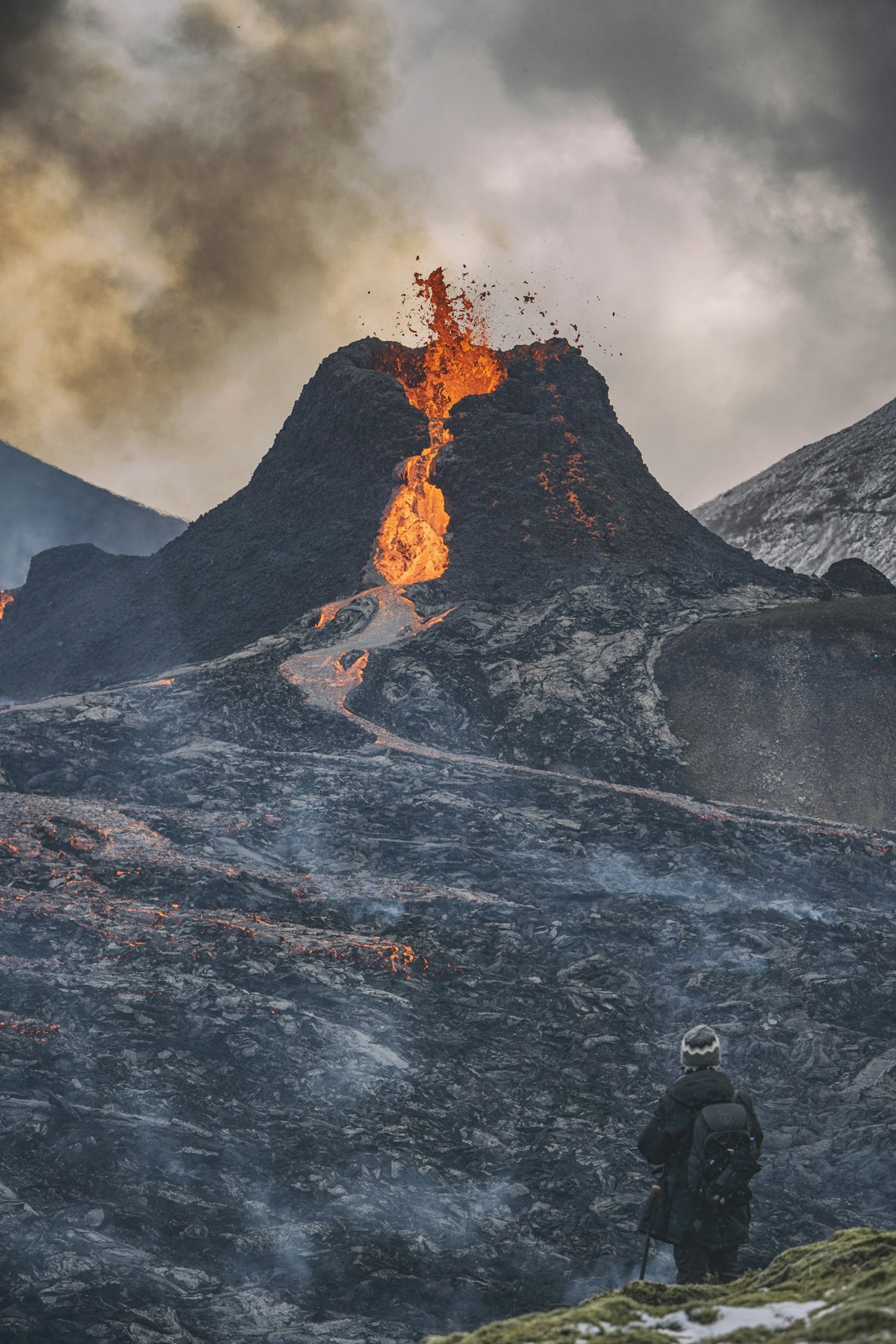
Iceland sits on the Mid-Atlantic Ridge, where the North American and Eurasian tectonic plates pull apart at roughly 2.5 cm per year. This makes it one of the most volcanically active landmasses on Earth, with eruptions somewhere on the island every few years on average. Several of the most significant volcanic sites are accessible to independent visitors or via organised tours.
Fagradalsfjall and the Reykjanes Peninsula
The Reykjanes Peninsula has been in an active eruption cycle since March 2021, when Fagradalsfjall erupted after 800 years of dormancy. Since then, multiple eruption events have occurred in the area - including eruptions near Grindavík and at Sundhnúkagígar that have affected the town.
What you see: Solidified lava fields from recent eruptions, cooling lava formations, and - when an eruption is active - lava flows and volcanic gas plumes visible from designated viewing areas.
Access: Free to visit when officially open. Check vedur.is for current status. The trail to the eruption area near Fagradalsfjall typically starts from the Suðurstrandarvegur road. Trail markers are posted. The walk from the car park to recent lava fields takes approximately 45–90 minutes depending on which site is accessible.
Safety rules: Never cross a barrier or closure. Volcanic gas (sulphur dioxide) concentrations are highest near active vents and in low-lying areas. Wear a gas mask or FFP2 respirator if visiting close to active vents - available at hardware stores in Reykjavík. Check air quality readings at vedur.is before setting out.
Organised tours from Reykjavík: Several operators run volcano tours to the Reykjanes Peninsula, typically as half-day trips (prices from approximately ISK 15,000 per person as of 2026). These include transport, a guide familiar with current access, and sometimes safety equipment. Useful if you don’t have a car or want the context a guide provides.
Askja Caldera (Highlands)
Askja is a remote caldera in the central highlands of Iceland, formed by a catastrophic 1875 eruption that deposited ash as far away as Scandinavia. The caldera contains a cold lake (Öskjuvatn, one of Iceland’s deepest) and a smaller geothermal pool, Viti, where bathing is permitted.
Access: Only open approximately July through mid-September, when the interior highland road F88 is passable. A 4WD vehicle is mandatory - the road involves river crossings and rough lava tracks. Do not attempt in a standard 2WD car.
Distance from Reykjavík: Approximately 320 km, around 5–6 hours drive. Most visitors treat it as a two-day trip, staying at the Dreki hut inside the caldera.
Organised tours: Guided Askja day tours run from Akureyri and from hubs along the Ring Road during summer. Prices start from approximately ISK 28,000–35,000 per person for a guided 4WD tour.
What to see: The Askja caldera floor, Öskjuvatn lake, the Viti geothermal pool (bring swimwear - the water is approximately 20–26°C, geothermally heated), and the Holuhraun lava field to the north, formed by the massive 2014–2015 Bárðarbunga eruption.
Snæfellsjökull (Snæfellsnes Peninsula)
Snæfellsjökull is a glacier-capped stratovolcano at the tip of the Snæfellsnes Peninsula, 180 km from Reykjavík. It is the volcano Jules Verne chose as the entry point to the Earth’s centre in Journey to the Centre of the Earth, which has given it persistent cultural resonance.
Access: The Snæfellsjökull National Park surrounds the volcano. The base is accessible year-round via Route 54. Glacier tours to the summit require a guide - the glacier has crevasses and weather can change rapidly.
Organised summit tours: Offered by local operators based in Arnarstapi and Ólafsvík. Snowmobile, Super Jeep, and guided walking options are available in season (typically May–September for summit trips). Prices from approximately ISK 16,000 per person.
What to see: The crater rim with glacier views, the Djúpalón black sand beach at the base, lava tube caves (Vatnshellir cave - guided tours from approximately ISK 2,500), and the wide sea views across Faxaflói bay toward Reykjavík.
Hekla
Hekla is Iceland’s most historically destructive volcano - described in the Middle Ages as the gateway to hell. It has erupted more than 20 times since settlement. The last major eruption was in 2000; seismic monitoring suggests it may erupt again at any time with little warning.
Access: The base of Hekla is accessible via Route 26 in South Iceland. Guided hiking tours to the crater are available when conditions permit. Hekla’s unpredictability means guides stay current with monitoring data before taking groups up.
Organised tours: Several South Iceland tour operators offer guided Hekla hikes. Prices start from approximately ISK 18,000 per person as of 2026.
Monitoring: vedur.is maintains a real-time Hekla seismic monitoring page. Check it if you are planning a self-guided approach.
Checking Conditions Before You Go
For any volcanic site in Iceland, checking vedur.is before departure is non-negotiable. The Icelandic Meteorological Office posts:
- Current eruption status
- Hazard area closures
- Air quality readings (sulphur dioxide and hydrogen sulphide concentrations)
- Travel advisories
For the Reykjanes Peninsula specifically, conditions can change within hours. A site that was open in the morning may be closed by afternoon if activity increases. Build flexibility into your schedule and do not make non-refundable bookings contingent on volcano access.
Browse Iceland tours - day trips, activity bookings, and multi-day packages across the country in one place.
Get travel insurance for Iceland - policies covering glacier hikes, F-road driving, and volcanic disruption.
Compare car hire in Iceland - a 4WD or campervan gives the flexibility to explore at your own pace.
Related Guides
- Reykjanes Peninsula guide - The volcanic heartland: geothermal fields, lava flows, and the Blue Lagoon
- Snæfellsnes road trip - Snæfellsjökull glacier volcano at the tip of the peninsula
- Glacier hiking in Iceland - Glacier walks on Vatnajökull and other outlets near volcanic zones
- Iceland F-roads guide - Accessing Askja caldera and the highland volcanic interior
- Geothermal pools in Iceland - Hot springs and geothermal baths formed by the same volcanic activity