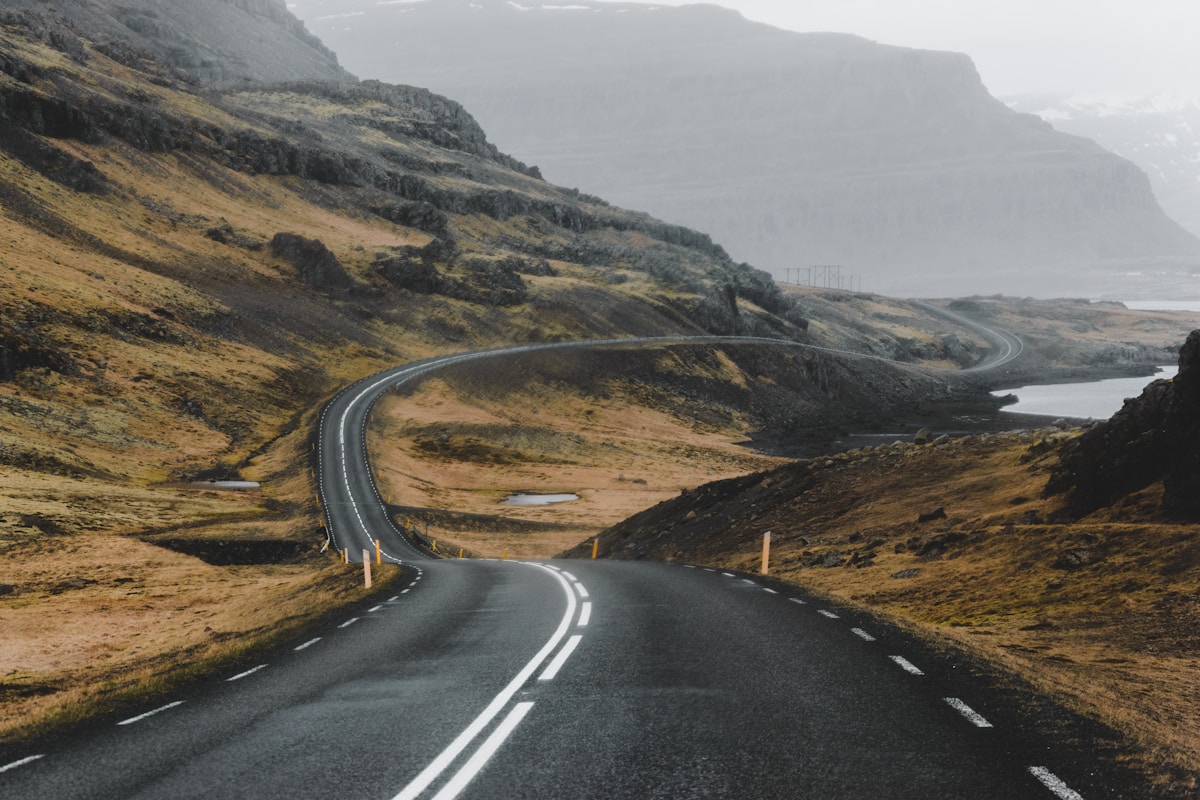
Iceland’s F-roads are the highland tracks that cut through the interior of the country - a vast, largely uninhabited volcanic landscape that sees snow for most of the year. The ‘F’ prefix stands for fjallvegur (mountain road). These routes are only open during the brief Icelandic summer, require a 4WD vehicle, and carry risks that don’t apply on the paved Ring Road. Done right, driving them is one of the most extraordinary experiences Iceland offers.
What F-Roads Are - and Are Not
F-roads are unpaved tracks. Some are graded gravel with little technical difficulty. Others cross active river fords, traverse lava fields, and traverse terrain where the track is barely visible. They share one rule: no 2WD car, no standard rental insurance, no exceptions.
The Icelandic Road Administration (Vegagerðin) opens and closes F-roads based on conditions. The official status appears at road.is - this is the only reliable source. Social media reports from other travellers can be a week out of date. Check road.is the morning you depart.
F-roads are not accessible from roughly October through mid-June. Attempting to drive a closed F-road is both dangerous and illegal, and the damage caused to the fragile highland terrain takes decades to recover.
Rental Car Rules
Before planning any F-road trip, hire a car rated for F-road use and confirm with your rental company that:
- The vehicle is a genuine 4WD (not front-wheel-drive with a “4WD mode” button)
- Your insurance policy explicitly covers F-roads
- You have a separate Super Collision Damage Waiver (SCDW) or equivalent that includes gravel protection
Standard CDW (Collision Damage Waiver) does not cover F-road damage. Sand and ash protection (SAAP) is separate again. Read the policy. If any of this is unclear, ask before signing - not after you’re stuck in a river.
Most rental companies that stock proper 4WDs (Dacia Duster, Toyota Land Cruiser, modified Jeeps) will quote you the full F-road package upfront. Budget rentals at Keflavík Airport are almost exclusively 2WD - unsuitable for any F-road.
River Crossings: Technique and Safety
River crossings (fords) are the most dangerous element of F-road driving. The technique:
Before crossing:
- Get out and walk the crossing first if safe to do so. Assess depth and current.
- Look for the widest, shallowest point - wider usually means shallower.
- Watch how other vehicles cross if possible. Wait and observe.
- Check road.is for current conditions - heavy rain 50km upstream can raise ford depths rapidly.
During the crossing:
- Enter slowly and keep moving at a steady walking pace. Do not stop.
- Keep the engine revs slightly elevated to prevent water entering the exhaust.
- Avoid following directly in another vehicle’s wake - churned-up water is deeper and less predictable.
- Do not rush. Fast entry creates a bow wave that floods the engine bay.
If you get stuck:
- Do not rev the engine repeatedly - this worsens the situation.
- Call 112 (Iceland emergency services) immediately. The 112 Iceland app sends your GPS coordinates automatically - download it before you leave Reykjavík.
- Rescue services in the highlands are provided by the Icelandic Association for Search and Rescue (ICE-SAR), who respond to all genuine emergencies.
Some crossings have depth markers (painted posts). A crossing at 30–40cm in a properly equipped vehicle is generally manageable. Above 50cm, wait or turn back unless you have extensive experience.
The Main F-Roads
F35 - Kjölur (Best for Beginners)
The Kjölur route runs from the Ring Road near Gullfoss in the south to Blönduós in the north, crossing the highland plateau between the Langjökull and Hofsjökull glaciers. It is approximately 200km long and takes around 4–5 hours without stops.
Why it’s the best starting point: No river crossings. The track is generally well-maintained with a gravel surface. It passes Hveravellir, a geothermal oasis in the middle of the highlands with hot pools (approximately ISK 1,500 entry as of 2026), a hut, and a cafe.
Kjölur can be done as a one-way through trip if you have two vehicles, or as part of a loop with the Ring Road. It remains one of the most visually dramatic drives in Iceland despite being the most accessible F-road.
F26 - Sprengisandur
The longest highland route at approximately 200km, Sprengisandur runs north–south through the central desert. It is one of the most remote drives in Iceland - vast black sand plains, almost no vegetation, and very few other vehicles outside peak summer weekends.
Sprengisandur has river crossings and requires more experience than Kjölur. The landscape is genuinely desolate in a way that few roads anywhere can match. Carry more fuel than you think you need - there are no petrol stations on the route.
F210 - Landmannalaugar
The approach road to Landmannalaugar, a renowned highland destination famous for its colourful rhyolite mountains, natural hot springs, and the start of the Laugavegur trekking route. This is a shorter F-road but includes river crossings that can be problematic after heavy rain.
Landmannalaugar is extremely popular in July and August. Arrive early in the day. Camping is available at the highland hut complex.
F249 - Þórsmörk
Þórsmörk (Thor’s Forest) sits in a glacial valley between three glaciers and is one of the most beautiful spots in Iceland. The approach on F249 involves multiple river crossings and requires a high-clearance 4WD. Even experienced drivers treat this route with respect after rain.
The alternative - and often preferable option - is to reach Þórsmörk by bus. The highland bus service (Reykjavík Excursions and Trex) runs scheduled services from Reykjavík throughout summer, removing the risk and expense of the drive. This is worth considering seriously if you’re not confident in river crossings.
Fuel in the Highlands
There are no petrol stations on any F-road. The nearest fuel points are on the Ring Road at either end of your highland route. Before turning off the Ring Road onto an F-road:
- Fill the tank completely.
- Carry a spare fuel jerry can if your vehicle allows it (check with rental company - some prohibit this for insurance reasons).
- A highland crossing of 150–200km in 4WD mode uses more fuel than the same distance on tarmac. Calculate conservatively.
For reference, the F35 Kjölur route has a cafe and limited services at Hveravellir, but no fuel. Plan as if Hveravellir doesn’t exist.
Emergency Preparedness
Download the 112 Iceland app before leaving Reykjavík. In an emergency, it transmits your GPS location to the coordination centre instantly - critical when you’re somewhere without a postal address.
Register your travel plans at safetravel.is before heading into the highlands. This means someone knows where you planned to go and when you planned to return. It costs nothing.
Carry: food and water for at least 24 hours beyond your planned trip duration, warm layers even in summer (highland temperatures drop rapidly), a first aid kit, a tow rope, and a charged power bank for your phone.
Season Summary
| Month | Status |
|---|---|
| January–May | Closed |
| June (early) | Kjölur may open; others still closed |
| June–July | Most F-roads open; check road.is daily |
| August | Peak season - all major routes typically open |
| September | Conditions variable; some close mid-month |
| October–December | Closed |
The Ring Road guide covers paved driving across Iceland. For highland trekking on foot, the Laugavegur trail guide covers the classic route that Landmannalaugar begins.
F-roads are not for everyone - and there’s no shame in taking the Ring Road and bus services instead. But for those who do drive them, the Icelandic interior offers a landscape you won’t find anywhere else.
Related Guides
- Iceland highlands guide - Reaching the interior without a car: highland buses, huts, and on-foot routes
- Landmannalaugar things to do - Iceland’s most visited highland area, accessible by F210
- Iceland car rental guide - Vehicle types, 4WD requirements, and what insurance you need for F-roads
- Iceland car rental costs - The real cost of hiring a 4WD for highland driving
- Þórsmörk valley hikes - Accessible via the F249 and F261 mountain roads