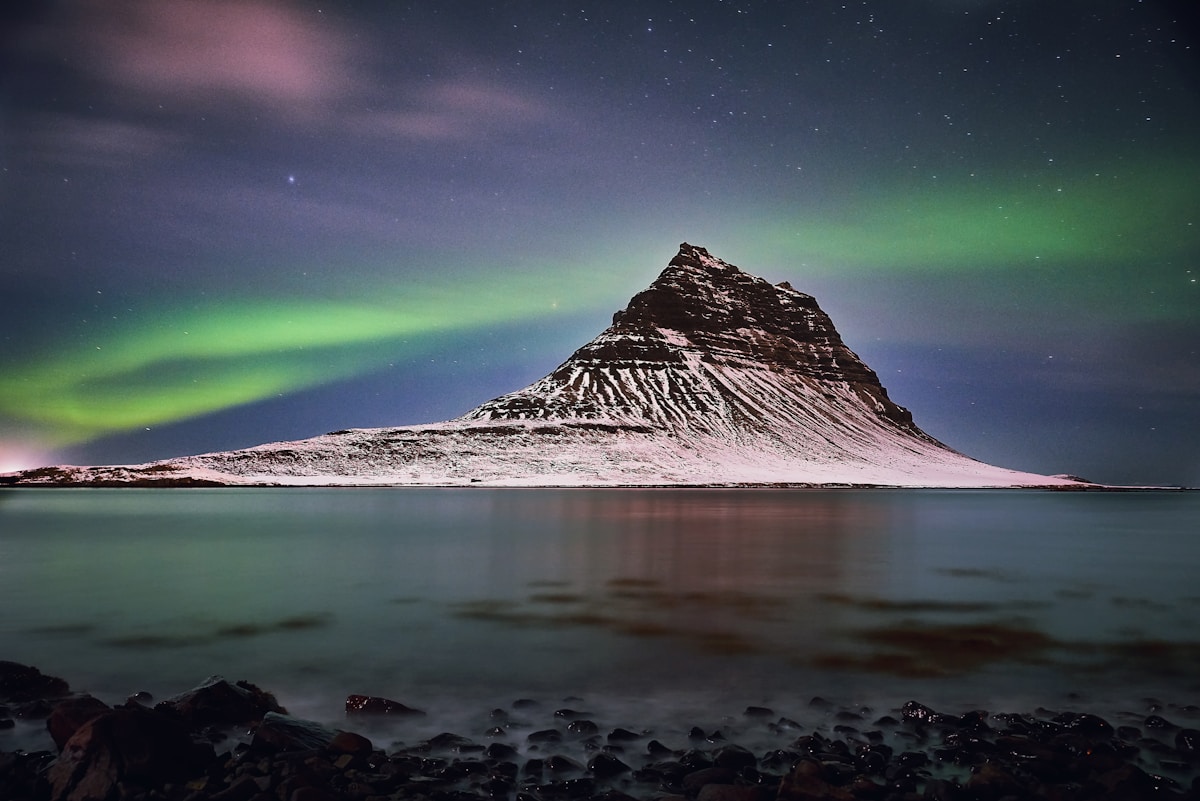
The Northern Lights (aurora borealis) are caused by charged particles from the sun colliding with gases in the Earth’s atmosphere. Iceland sits in the Northern Lights zone - directly under the auroral oval - making it one of the most accessible places on earth to see them. The challenge is the same as anywhere: you need dark skies, clear weather, and sufficient solar activity at the same time.
When to Go
The aurora is present year-round, but you need darkness to see it. From approximately late April through mid-August the Icelandic sky never gets fully dark - the midnight sun prevents Northern Lights viewing. The season runs from approximately late August through early April.
Best months: October, November, February, March - good darkness hours and more settled weather than January. January and February have the longest nights but Iceland’s weather can be especially unsettled in midwinter.
Where to Go
Near Reykjavík
Drive 30–60 minutes from the city in any direction. Popular spots: Þingvellir National Park (40 minutes east), the Reykjanes Peninsula coastal areas, and Þórsmörk direction on clear nights. Tours from Reykjavík take you to the best forecast location for that night.
Akureyri Area
Less light pollution than Reykjavík. The dark fjord landscapes above Eyjafjörður are excellent viewing spots in clear weather.
South Iceland
The flat South Coast with wide horizons - between Vík and Höfn in particular - gives excellent dark-sky conditions. Low light pollution across the entire area.
Highlands (Summer: No, Winter: Yes)
The highlands are remote and genuinely dark but are largely inaccessible in winter due to road closures. Not a reliable winter option.
Northern Lights Forecast
vedur.is - The Icelandic Meteorological Office aurora forecast is the most reliable local source. Shows cloud cover maps and a KP activity forecast. Check for the combination of minimal cloud cover and KP3+.
KP index: The planetary K-index measures geomagnetic activity.
- KP1–2: Faint aurora, visible only in very dark skies with high activity
- KP3–4: Clearly visible to the naked eye in dark conditions
- KP5+: Strong aurora, visible even in mildly lit areas, often multiple colours
What You’ll See
On a KP3–4 night with clear skies: green bands or curtains of light moving across the sky. On stronger nights (KP5+): pillars, crowns, rapid dancing movements, and occasional red or purple tinges. Cameras capture colour more vividly than the naked eye - long exposure photos often show more colour than you’ll see directly.
Manage expectations: About 50–60% of nights in Iceland in October–March have some aurora activity. But cloud cover is the killer - Iceland’s weather is unpredictable, and multiple clear nights in a row are not guaranteed. Budget multiple nights in Iceland to improve your odds.
Northern Lights Tours
All tour operators from Reykjavík run Northern Lights tours. They drive to the best forecast location for that night, typically spending 1–2 hours outside before returning. Tours run approximately 3–4 hours.
- Extreme Iceland: Tours from approximately ISK 9,900 adult
- Reykjavík Excursions: Bus tours from approximately ISK 7,900 adult
- Arctic Adventures: Super-jeep tours from approximately ISK 12,900–17,900 adult
Most tours offer a free resail if the aurora isn’t seen due to cloud cover. On clear nights with good forecast, you’ll almost certainly see something. Tours from Akureyri run on the same model at similar prices.
Photography Guide
Equipment: A camera with manual mode (DSLR or mirrorless; most modern smartphones also work in night mode), a sturdy tripod, and a wide-angle lens (f/2.8 or wider).
Settings starting point: ISO 800–3200, aperture f/2.8, shutter speed 5–25 seconds (shorter for faster-moving aurora, longer for static displays).
Composition: Include foreground interest - a mountain, a lake reflection, a farm building - rather than pointing at bare sky.
Cold weather: Batteries drain faster in cold. Keep a spare warm. Condensation can form when bringing cold equipment indoors - let it adjust gradually.
Book Northern Lights tours - operators run nightly from Reykjavík with a cloud-cover resail guarantee.
Get travel insurance for Iceland - policies covering glacier hikes, F-road driving, and volcanic disruption.
Related Guides
- Best places to see the Northern Lights in Iceland - The 12 top dark-sky locations from Þingvellir to the East Fjords, with access notes and dark-sky ratings
- Northern lights photography - Full technical guide to capturing the aurora with camera settings, composition tips, and location scouting
- Northern lights tours from Reykjavík - Guided tour options, operators, and what to expect on an aurora tour
- Iceland photography guide - Landscape photography tips across all of Iceland’s main subjects