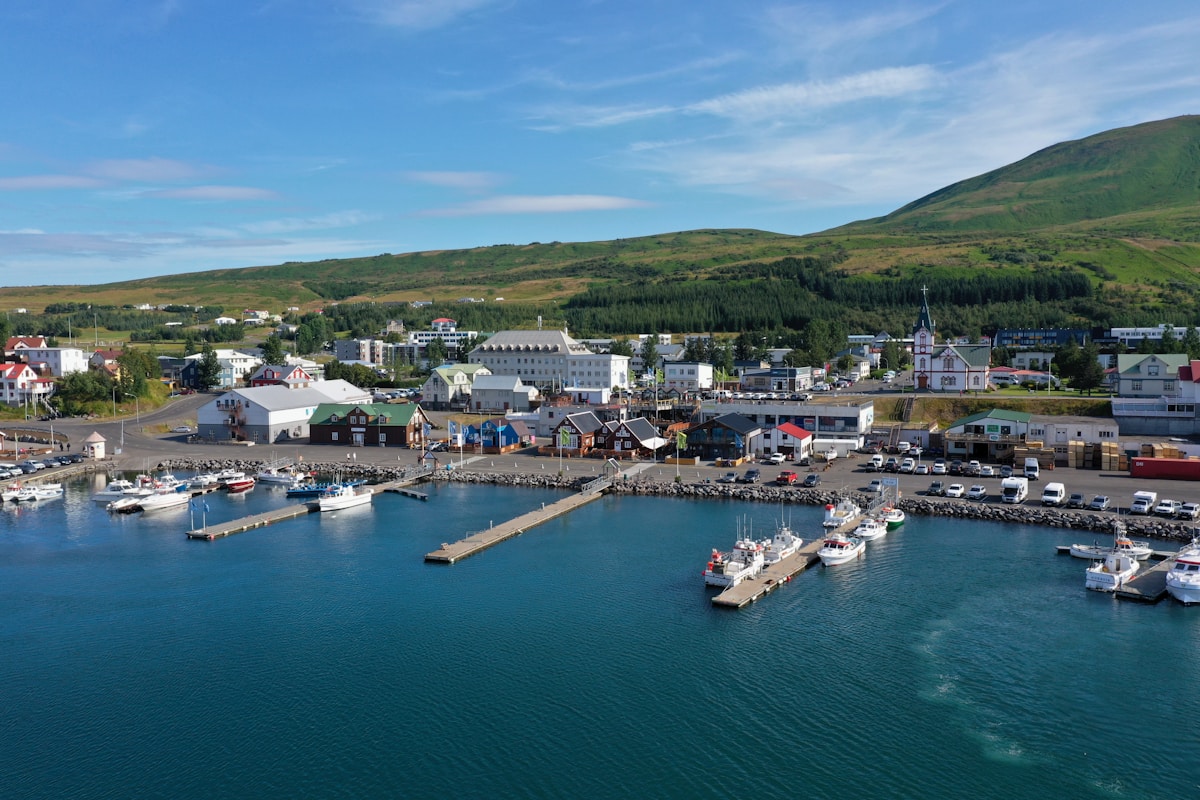
Húsavík is a small fishing and whale watching town of around 2,300 people on the north coast of Iceland, overlooking Skjálfandi Bay. It is best known internationally as Iceland’s whale watching capital - an accolade backed by genuine sighting statistics rather than marketing. Beyond whale watching, the town has invested significantly in visitor infrastructure over the past decade, and it now offers a full day of activity for anyone willing to make the journey north.
Whale Watching
Skjálfandi Bay is one of the world’s most reliable whale watching locations. Humpback whales are the species most commonly encountered - often in large numbers, sometimes breaching repeatedly. Minke whales are seen on most trips. Blue whales are rarer but are sighted here more often than at any other Iceland location; late summer (August–September) gives the best chance.
Two main operators run from Húsavík harbour:
North Sailing - One of Iceland’s most established whale watching companies, operating since 1995. Classic oak schooners make their tours distinctive from the standard RIB and catamaran format. Tours run approximately 3 hours and cost approximately ISK 12,900 per person as of 2026. North Sailing also offers electric RIB tours and combo packages with the GeoSea baths.
Gentle Giants - The other major operator, offering whale watching from approximately ISK 11,900 per person as of 2026. Tours are also around 3 hours. Gentle Giants has a particularly strong record in the shoulder months (May and September) when the bay is less congested.
Both operators offer a rebook guarantee if no whales are sighted - though this is rarely needed in the core summer months. Booking ahead is strongly recommended in July and August; departures fill days in advance at peak season.
Compare Whale Watching Tours on GetYourGuide
| Tour | Format | Duration | From (approx) | Book |
|---|---|---|---|---|
| Traditional Whale Watching Tour (North Sailing / Gentle Giants) | Classic vessel | 3 hrs | $85 | Book |
| Whale Watching + Puffins Guided Cruise | Classic vessel | 3 hrs | $85 | Book |
| Big Whale Safari + Puffins by Speedboat | RIB speedboat | 2 hrs | $170 | Book |
Prices from GYG as of 2026. Browse all Húsavík tours
What to bring: Warm layers regardless of the air temperature. Sea conditions on Skjálfandi Bay can be cold and windy even in July. Most operators provide waterproof overalls on request.
Puffin Colony at Lundey
Lundey (“Puffin Island”) sits in Skjálfandi Bay and hosts one of the most accessible puffin colonies in Iceland. Atlantic puffins arrive from May and begin departing in August. Several whale watching operators include Lundey in their routes or offer dedicated puffin watching trips alongside their whale watching excursions.
Puffins at Lundey can be approached quite closely - they show little fear of boats. Numbers are highest in June and early July before the breeding season ends. A dedicated puffin tour takes approximately 1–1.5 hours and costs around ISK 4,500–6,000. Check with North Sailing and Gentle Giants for current schedules.
GeoSea Geothermal Sea Baths
Opened in 2018, GeoSea sits on a headland above Húsavík harbour. The pools are filled with geothermal seawater - a mix of hot spring water and cold sea water heated to bathing temperature. The setting, with views across Skjálfandi Bay toward the mountains of Þingeyjarsveit, is arguably the finest of any outdoor pool in Iceland.
Entry costs approximately ISK 4,900 per person as of 2026. Opening hours run daily, typically 10:00–midnight in summer and shortened hours in winter. The facilities include changing rooms, lockers, a bar serving warm drinks and snacks, and a viewing platform.
Pre-booking online is strongly recommended during July and August - the pools have a capacity limit and can sell out. Evening visits (after 18:00) offer the best light for photography and tend to be less crowded than afternoon visits.
Húsavík Whale Museum (Hvalasafnið á Húsavík)
One of the best natural history museums in Iceland. The Whale Museum occupies a converted fish factory near the harbour and contains full-size skeletons of 10 whale species found in Icelandic waters, including a blue whale - at 25 tonnes, the largest whale skeleton on public display in the world.
Entry costs approximately ISK 2,200 as of 2026. Allow 1.5–2 hours. The exhibits explain the biology and ecology of each species clearly, and the historical exhibits on Icelandic whaling - which ended in this area in 1915 - are honest and informative.
The museum is family-friendly and genuinely engaging for visitors of all ages. It’s the best way to prepare for a whale watching tour - or to process what you saw on one.
Exploration Museum
Húsavík has an unexpected link to space exploration: it hosted NASA astronaut training in the 1960s, when the volcanic landscape near the town was used to simulate lunar conditions ahead of the Moon landings. The Exploration Museum tells this story alongside exhibits on Viking exploration of the North Atlantic.
Entry approximately ISK 2,000 as of 2026. The museum is compact - allow 45 minutes. It’s particularly good for visitors with an interest in the history of exploration beyond Iceland itself.
Day Trips from Húsavík
Dettifoss (1 hour east)
Europe’s most powerful waterfall by water volume, Dettifoss thunders down a 45m drop on the Jökulsá á Fjöllum river. The approach via Route 862 (paved) to the west bank takes around 55 minutes from Húsavík. The east bank (Route 864, gravel) is rougher but offers a different perspective. Free, year-round. Allow 2–3 hours for the drive plus visit.
Mývatn (45 minutes south)
The geologically extraordinary lake district accessible via Route 87 from Húsavík. A half-day covers the highlights: Skútustaðir pseudocraters, Dimmuborgir lava formations, and Námaskarð geothermal fields. The Mývatn Nature Baths add approximately ISK 5,900 to the day. See the Akureyri things-to-do guide for a full Mývatn breakdown.
Ásbyrgi Canyon (45 minutes east)
A horseshoe-shaped canyon 3.5km long and 1km wide, formed by a catastrophic glacial flood from the Vatnajökull ice cap. Ásbyrgi is part of Vatnajökull National Park (free entry) and has a trail network running through the birch forest at the canyon floor. The viewpoint from the rim above the canyon is dramatic. Allow 1.5–2 hours for a walk-through.
Best Time to Visit
June–August: Peak whale watching season. All tours fully operational. Puffins present on Lundey. GeoSea at full summer hours. Midnight sun visible in June and early July.
May and September: Shoulder season - tours operational but fewer departures. Smaller crowds. May has puffin arrivals; September begins the Northern Lights season.
October–April: Most whale watching tours closed. GeoSea open but winter hours. Northern Lights excellent on clear nights (Húsavík has low light pollution). The Whale Museum and Exploration Museum remain open year-round.
Book Húsavík whale watching tours - traditional oak boat and high-speed RIB options from the harbour.
Compare car hire in Iceland - a 4WD or campervan gives the flexibility to explore at your own pace.
See Also
- Húsavík city guide - Full overview of Iceland’s whale watching capital: getting there, hotels, and restaurants
- Where to Stay in Húsavík - Hotels and guesthouses with booking advice for peak whale watching season
- Day Trips from Húsavík - Dettifoss, Ásbyrgi canyon, and the Diamond Circle from Húsavík
- Whale watching in Iceland - Full guide to whale watching across Iceland: all departure ports, species, and operators
- Whale watching Húsavík vs Reykjavík - Which port has better sighting rates and when to choose Húsavík over the capital
- Puffin watching in Iceland - Puffin colonies near Húsavík, including Lundey island
- Lake Mývatn guide - 60km south on the Diamond Circle route: volcanic wonders and the Nature Baths
For accommodation nearby, Search hotels in Húsavík on Booking.com.