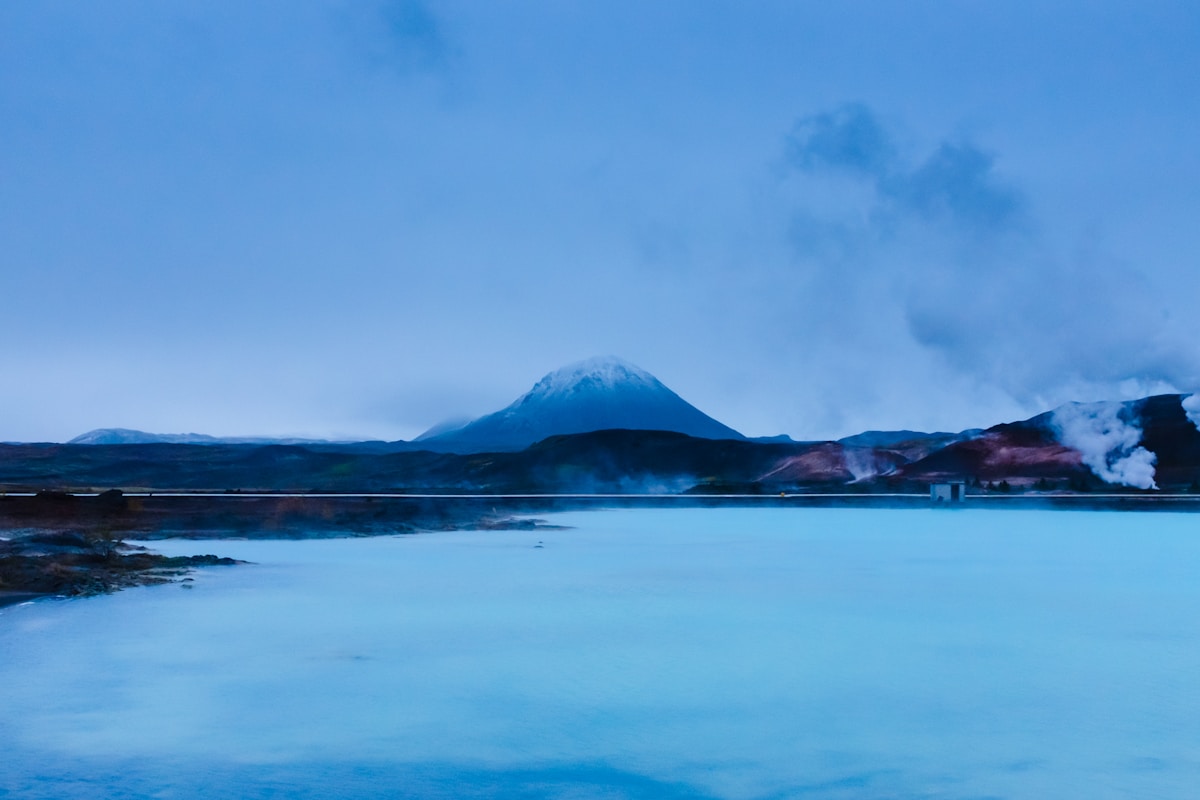
Lake Mývatn sits in the most volcanically active part of Iceland, 100km east of Akureyri on the Ring Road. The lake itself is shallow and warm, fed by geothermal springs, and surrounded by an improbable concentration of geological features: lava pillars, pseudo-craters, sulphur fumaroles, a dormant caldera, and a tephra crater large enough to walk around. A full circuit of the lake takes a day; doing it justice requires two.
Mývatn Nature Baths
The most popular single attraction in the area and a genuine alternative to the Blue Lagoon for those travelling the north of Iceland. The baths sit on a ridge above the lake with views east toward Krafla. The geothermal water is silica-rich, pale blue-grey, and maintained at around 36–40°C.
Entry approximately ISK 4,900 adult as of 2026 (myvatnnaturebaths.is). No booking required for off-peak times; July and August afternoons get busy, so morning arrivals before 10am or evening arrivals after 6pm are preferable. The site has changing rooms, lockers, a café, and a steam room. Allow 1.5–2 hours.
Dimmuborgir Lava Formations
Approximately 5km east of Reykjahlíð, Dimmuborgir (“dark castles”) is a field of unusual lava structures - towers, arches, and caves formed when a lava lake drained and left its outer shell standing. Several walking trails cut through the formations:
- Kirkjan (Church Trail): 2km loop, 30 minutes. Passes through a large natural lava arch.
- Lautahraun and Hellir trails: 3–4km, allow 1–1.5 hours. More extensive.
Free to enter. Informational boards at the car park. The site is busiest mid-morning; visiting in the evening gets you the formations in better light and with fewer people.
Pseudo-Craters at Skútustaðagígar
On the south shore of the lake at Skútustaðir village, a cluster of small craters formed when hot lava flowed over marshy ground - steam explosions created rootless cones that look like proper volcanic craters but have no connection to a magma pipe beneath. A 2km walking loop passes most of the main features. Free, 20 minutes from car park. Worth combining with birdwatching on the south shore.
Námaskarð Geothermal Area
East of the lake on a ridge called Námafjall, just off Route 1. Hot springs, mud pots, and yellow sulphur-encrusted fumaroles cover a wide hillside area and vent continuously. The smell is strong (sulphurous hydrogen) and the ground temperature around the vents is high - stay on the marked paths and boardwalks.
Free, year-round, 10 minutes from Reykjahlíð. Allow 45 minutes. One of the more visually dramatic geothermal areas in Iceland for those who have not visited the Geysir area in the south - the scale is larger and the surroundings more desolate.
Krafla Caldera and Víti Crater
Approximately 15 minutes north of Reykjahlíð via Route 863, Krafla is an active volcanic system that last erupted in the 1980s (the Krafla Fires, 1975–1984). The road passes a geothermal power station before reaching the car park for the crater.
Víti crater (“Hell crater”) is a 320-metre wide explosion crater containing a milky blue-green lake. A 15-minute walk from the car park brings you to the rim; the full circuit around the crater takes approximately 30–45 minutes. Free.
Views from Krafla toward the lake and the surrounding lava fields are extensive. On clear days the contrast between the turquoise crater water, the dark lava, and the blue sky is extraordinary.
Hverfjall Tephra Crater
A large symmetrical tephra crater approximately 1km in diameter, clearly visible from the main road east of the lake. Hverfjall was formed in a single explosive eruption roughly 2,500 years ago - one of the largest tephra craters in the world.
The trail to the rim from the car park takes approximately 20 minutes. The full circuit of the crater rim is 3.5km and takes about 45 minutes, with panoramic views over the lake, Dimmuborgir, and the surrounding volcanic landscape. Free. The path is dusty and the crater sides steep - walking poles are useful on the descent.
Birdwatching
Lake Mývatn supports the greatest concentration of nesting duck species in Europe. Fourteen species of duck breed here regularly, including several that are rare elsewhere - harlequin ducks, Barrow’s goldeneyes, and great northern divers are among them. The best season is May through July. No formal bird hides are required - the south shore near Skútustaðir and the shallow bays around Nesland are productive areas for slow walking with binoculars. A free viewpoint and picnic area at Nesland overlooks the main duck bays.
Fishing on the Laxá River
The Laxá river, which drains Mývatn westward to the sea, is one of the best salmon and brown trout rivers in Iceland. Day permits for fishing on the main beats cost approximately ISK 8,000–25,000 per rod per day as of 2026, depending on the section. The river season runs mid-June through September; salmon fishing is most productive July and August.
Permits and local information from the Laxá service station at Reykjahlíð or through houseboat operators on the lake. Bring your own equipment or hire locally.
For where to base yourself, see our where to stay at Lake Mývatn guide. For the wider North Iceland area, see our Akureyri things to do guide.
Browse Lake Mývatn tours - guided tours covering the geothermal area, Dimmuborgir, and Grjótagjá cave.
Compare car hire in Iceland - a 4WD or campervan gives the flexibility to explore at your own pace.
See Also
- Lake Mývatn city guide - Full overview of the Mývatn area: getting there, geology, and visitor essentials
- Where to Stay at Lake Mývatn - Hotels and guesthouses around the lake with booking advice
- Day Trips from Mývatn - Dettifoss, Ásbyrgi canyon, and the wider Diamond Circle
- Dettifoss visitor guide - Europe’s most powerful waterfall, 55km from Mývatn on the Diamond Circle
- Geothermal pools in Iceland - How the Mývatn Nature Baths compare to other geothermal bathing options
- Akureyri city guide - The best base for North Iceland: 1 hour west with flights from Reykjavík
For accommodation nearby, Search hotels in Mývatn on Booking.com.