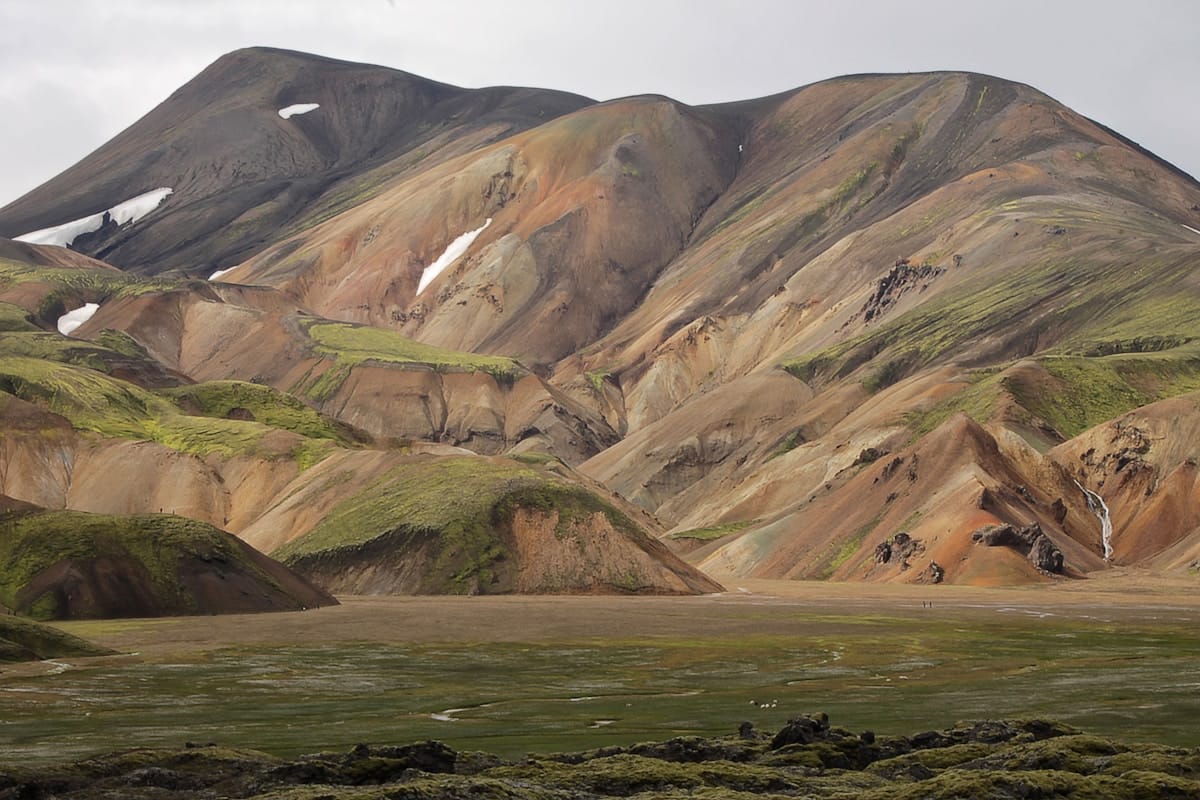
The Iceland highlands - the central interior known locally as the hálendi - are the least visited and most dramatic part of the country. No ring road runs through here. The F-roads that do exist cross rivers, volcanic plains, and snowfields, and they are only passable in a window of roughly 8 to 10 weeks each summer. This itinerary covers 5 days in the highlands, anchored around Landmannalaugar and Thorsmork, with a full day at Kerlingarfjoll if time allows. It is designed to work whether you are driving yourself or joining organised tours.
The Highland Window: July and August
The F-roads open when snowmelt allows - typically late June for the Kjölur Route (F35) and late June to early July for the F225 to Landmannalaugar and F249 to Thorsmork. By late August, roads are still open but weather turns unpredictable. September brings early snow and most F-roads close again.
The prime window is mid-July to mid-August. You get maximum daylight (effectively 24 hours in July), the highest chance of all roads being open, and the best conditions for river crossings. Book accommodation and tours for this window as early as you can - the highlands are popular and capacity is limited.
If you cannot visit in summer, highland Super Jeep tours operate year-round to accessible areas, but Landmannalaugar and Thorsmork are only reachable in the summer window.
Transport: Self-Drive vs Super Jeep Tour vs Highland Bus
Before planning day-by-day, decide on your transport - it determines your entire route structure.
Option 1: Self-Drive (4x4 Required)
Renting a proper highland 4x4 gives you maximum flexibility. Plan to pay approximately ISK 25,000–55,000 per day as of 2026 for a suitable vehicle (Toyota Land Cruiser, Toyota Hilux, or comparable). Budget vehicles and small SUVs are not suitable for the F225 and F249 river crossings - rental companies will void your insurance if you take an unsuitable vehicle onto F-roads.
What to check: Live road status at road.is. River water levels fluctuate with rain and glacial melt - what was passable at 07:00 may not be safe at 14:00. Cross rivers in convoy if possible, never alone. Watch for other vehicles crossing first. If the water reaches your door handles, wait.
Option 2: Super Jeep Tours
Guided Super Jeep tours depart from Reykjavik and cover Landmannalaugar and Thorsmork as day trips or multi-day combinations. These vehicles are purpose-built and driven by experienced guides - no river crossing anxiety, no rental insurance risk. Browse Super Jeep highland tours on GetYourGuide — prices range from approximately ISK 25,000–45,000 per person for a day tour as of 2026. Multi-day packages with hut accommodation are also available.
For solo travellers, couples, or anyone uncomfortable with serious off-road driving, Super Jeep tours are the most stress-free option.
Option 3: Highland Bus (Scheduled Services)
Reykjavik Excursions and Trex run scheduled bus services into the highlands in summer. These are large, specially converted vehicles that handle the river crossings. Services run from Reykjavik BSÍ terminal to Landmannalaugar and Thorsmork on set days (typically daily or near-daily in July and August). Book at re.is or trex.is. One-way fares run approximately ISK 7,000–9,500 per person as of 2026.
The bus is the most affordable option if you do not have a highland vehicle. It limits your flexibility (you travel on the bus schedule) but works well for anyone doing the Laugavegur Trail point-to-point.
Day 1: Reykjavik to Landmannalaugar
Distance from Reykjavik: approximately 180 km, allow 3.5–4.5 hours depending on road conditions and vehicle type.
Route: Ring Road (Route 1) east past Hella, then south-east on Route 26, then F208 or F225 into Landmannalaugar. Check road.is before departing - the specific approach road and river crossing conditions determine which route is active.
Arrive at Landmannalaugar by early afternoon. The setting is immediately striking: steam vents rise from geothermal fields beside a lava flow left by the 1477 Torfajökull eruption, and the surrounding mountains shift from red and orange to green and purple as the angle of the light changes. These are rhyolite mountains - the mineral-rich volcanic rock gives them their famous colouration.
Key things to do at Landmannalaugar:
- Soak in the natural geothermal hot spring (free, no changing facilities - change by the water)
- Walk the Bláhnjúkur summit trail (2–3 hours, moderate effort, panoramic highland views)
- Explore the lava flow and moss-covered terrain close to the huts
Where to sleep: Ferðafélag Íslands (fi.is) operates huts at Landmannalaugar with sleeping-bag accommodation for approximately ISK 8,500–11,000 per person per night as of 2026. Book months in advance. If huts are full, camping is permitted at the adjacent campsite for approximately ISK 2,500–3,500 per person per night.
Day 2: Landmannalaugar to Thorsmork (Þórsmörk)
Option A - Laugavegur Trail (on foot): The full Laugavegur Trail is 55 km, typically walked as a 4-day route. Doing just the first stage from Landmannalaugar to Hrafntinnusker (12 km, 4–5 hours) or continuing to Álftavatn (25 km, 8–9 hours) is a common approach. You overnight at huts along the route. This is one of the most celebrated multi-day hikes in Europe - volcanic ridges, obsidian fields, coloured rhyolite, and snowfields are all covered in the first day’s walking.
Option B - Super Jeep or bus transfer: If you are not hiking the full trail, highland bus or Super Jeep connections run between Landmannalaugar and Thorsmork in summer. Check re.is or trex.is for current schedules.
Reaching Thorsmork: Thorsmork (Þórsmörk, meaning “Thor’s Forest”) sits at the junction of three glaciers - Eyjafjallajökull, Mýrdalsjökull, and Tindfjallajökull. It is unusually sheltered and forested compared to the open highland terrain. The F249 approach requires crossing the glacial Krossá river - this crossing is one of the most unpredictable in Iceland and is best left to highland buses or Super Jeep operators if you are unfamiliar with glacial river crossings.
Where to sleep: Several hut operators run accommodation in Thorsmork:
- Húsadalur huts (Volcano Huts) - from approximately ISK 10,000 per person in sleeping-bag dorms
- Básar hut - operated by Ferðafélag Suðurlands (utivist.is)
- Langidalur hut - operated by Ferðafélag Íslands (fi.is)
All book up quickly in July. Camping is available at Húsadalur and Básar for approximately ISK 2,500–3,000 per person per night.
Day 3: Thorsmork - Valahnúkur and Valley Walks
Thorsmork rewards a full day of exploration. The hiking is more intimate than the open highland plateaux - trails wind through birch scrub and along river valleys, with glaciers always visible on the ridgelines above.
Top walks from Thorsmork:
- Valahnúkur (1–2 hours, easy to moderate): A short but spectacular summit above Húsadalur. The 360-degree view takes in all three surrounding glaciers, the Markarfljót river, and on clear days, Hekla to the north-east.
- Tindfjallajökull viewpoint trail (3–4 hours, moderate): A longer ridge walk with close-up views of the glacier snout. Start from Langidalur.
- Goðaland (access from Thorsmork, 4–5 hours round trip): The river canyon and rock formations on the approach to Fimmvörðuháls. Dramatic basalt spires and views into Eyjafjallajökull’s caldera rim are highlights.
Day 4: Thorsmork to Kerlingarfjoll (or Return to Reykjavik)
If driving self-drive: Return via F249 to Route 1, then head north via the Kjölur Route (F35) to Kerlingarfjoll. This is a longer drive - approximately 3–4 hours - but Kerlingarfjoll adds a completely different highland experience: the area is a geothermal field inside a mountain massif, with steaming vents, orange and red mineral deposits, and walking trails through otherworldly terrain. The Kerlingarfjoll Mountain Resort (kerlingarfjoll.is) offers lodge rooms and camping from approximately ISK 12,000 per person per night.
If on the highland bus: Kerlingarfjoll requires a private vehicle or organised tour from the Kjölur Route. If you are bus-dependent, use Day 4 as a return day - buses from Thorsmork return to Reykjavik via Hella.
What to do at Kerlingarfjoll:
- Walk the geothermal area trail (1–2 hours, mostly flat)
- Hike to Snækollur summit (4–5 hours, challenging, requires stable weather)
- Evening soak in the outdoor hot tubs at the resort
Day 5: Return to Reykjavik or Onward
If you overnighted at Kerlingarfjoll, the return to Reykjavik via the Kjölur Route (F35) and then Route 1 is approximately 3–4 hours. The Kjölur Route passes between the Langjökull and Hofsjökull ice caps - a vast, open landscape completely unlike the south. Stop at Hveravellir (mid-Kjölur) for more geothermal pools and the historic stone hut shelter.
If heading straight from Thorsmork, the drive back to Reykjavik takes 2–3 hours and passes Seljalandsfoss and Skógafoss on the South Coast - both worth a stop if you have not seen them.
Budget Guide (Per Person, Self-Drive)
| Expense | Budget Range (ISK, as of 2026) |
|---|---|
| Highland 4x4 rental (5 days, split 2 people) | 60,000–140,000 |
| Hut accommodation (4 nights, sleeping bag) | 34,000–44,000 |
| Fuel (highlands loop) | 15,000–20,000 |
| Highland bus transfers (if mixed approach) | 7,000–20,000 |
| Food (supermarket + hut meals) | 20,000–35,000 |
| Total per person | ~136,000–259,000 |
Prices are approximate. Exchange rates fluctuate - check the current ISK rate before planning. Hut accommodation requires sleeping bags; rental is available at the huts for approximately ISK 2,000–3,000 per night if you do not bring your own.
Hut Booking: Step-by-Step
- Ferðafélag Íslands (fi.is): Create an account and book Landmannalaugar and Langidalur (Thorsmork) huts here. Opens for summer bookings typically in January.
- Ferðafélag Suðurlands / Utivist (utivist.is): Book Básar hut (Thorsmork) here.
- Volcano Huts (volcanohuts.com): Book Húsadalur (Thorsmork) here - slightly higher end.
- Kerlingarfjoll Resort (kerlingarfjoll.is): Book direct. Both dorms and private rooms available.
Bring a sleeping bag rated to 0°C or colder even in July - highland nights are cold. Bring earplugs for hut dorms.
What to Pack for the Highlands
The highlands are exposed. Weather can shift from clear sunshine to horizontal rain within an hour. Pack for all seasons regardless of your arrival forecast:
- Waterproof shell jacket and trousers (not just water-resistant)
- Base layers (merino or synthetic - not cotton)
- Insulating mid-layer
- Hiking boots, waterproofed - not trail runners for F-road conditions
- Gaiters if hiking - river crossings and snow patches
- Headlamp (even in July if you plan late evening hikes)
- Trekking poles (helpful on Bláhnjúkur and Valahnúkur descents)
- Cash - some highland huts and camping areas do not accept cards
Book Your Trip
Flights — search and compare on Aviasales eSIM — stay connected with Airalo Travel insurance — get covered with EKTA Airport transfers — book with Kiwitaxi Car rental — compare with GetRentaCar Tours and activities — browse GetYourGuide