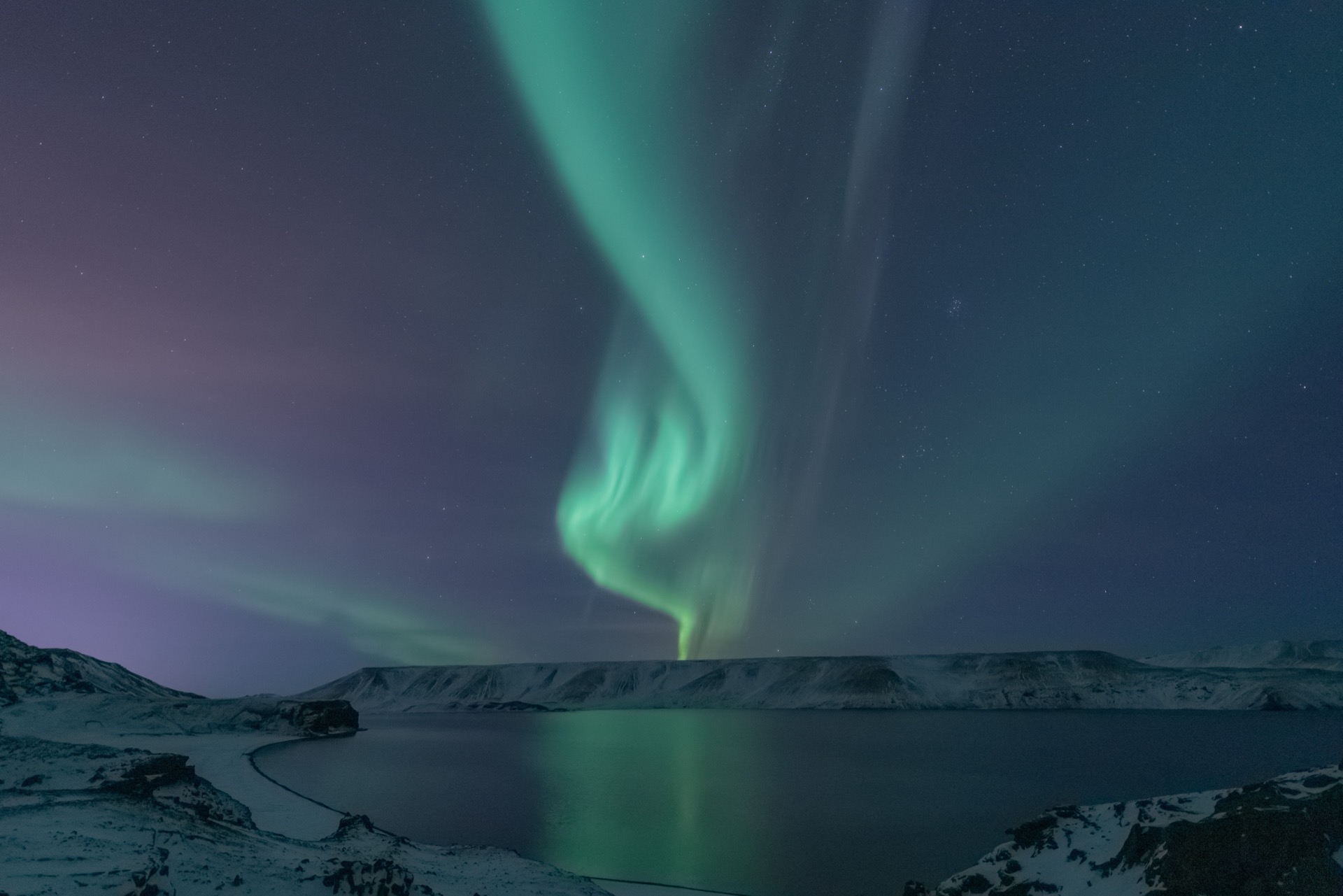
Iceland sits directly beneath the auroral oval — the ring of geomagnetic activity that encircles the Arctic. This means the Northern Lights are visible from virtually everywhere in the country on the right night. Location still matters: dark skies, clear weather, and a view to the north all improve your chances. Below are the 12 best spots to see the Northern Lights across Iceland, from easy drives out of Reykjavík to remote dark-sky destinations.
What You Need First
Before choosing a location, confirm two things at vedur.is: cloud cover at your chosen spot (clear or partly clear) and a KP index of 3 or higher. A perfect dark-sky location is useless under thick cloud. The best practice: check the forecast each evening by 8pm and choose a location where cloud cover is lowest. On good nights, the aurora can be visible anywhere on this list.
1. Grótta Lighthouse, Seltjarnarnes
Distance from central Reykjavík: 20 minutes (8 km west)
Dark sky rating: Moderate — some ambient glow from Reykjavík to the east, but dark to the north and west
Grótta is the easiest aurora spot accessible without a car — the city bus reaches Seltjarnarnes, or it’s a short taxi ride. The lighthouse sits at the tip of a small peninsula with open water on three sides and a clear northern horizon. On nights with KP4 or above, aurora is often visible here without leaving the capital area.
The beach has a natural hot pool (Kvos) beside the sea, open to the public year-round. Getting in after aurora watching is a genuine Reykjavík experience. Park at the Grótta car park and walk 10 minutes to the lighthouse tip.
Best for: Travellers without a car; same-night aurora attempts when the forecast is strong.
2. Þingvellir National Park
Distance from Reykjavík: 40 km east via Route 36
Dark sky rating: Good — low surrounding population, minimal artificial light
Þingvellir is the most popular day-trip destination in Iceland and also one of the best aurora spots within easy reach of Reykjavík. The rift valley cuts through the national park, and on clear winter nights the dark fissure landscape with aurora overhead is extraordinary. Park at Hakið viewpoint or the main Þingvellir visitor centre car park (free in winter, no booking required) and walk to the Öxará river to shoot reflections.
The lake (Þingvallavatn) reflects strong aurora displays on calm nights. Bring a tripod — the wide, flat landscape with minimal horizon clutter is ideal for long-exposure photography.
Best for: Easy drive from Reykjavík, landscape photography, combining with a Golden Circle day trip.
3. Nesjavellir Road (beyond Þingvellir)
Distance from Reykjavík: 55 km east
Dark sky rating: Very good
Continue beyond Þingvellir toward the geothermal power station at Nesjavellir. The road runs along the eastern shore of Þingvallavatn with no settlement for several kilometres. Pull over at any wide verge — there are no lights here, and views across the lake with mountains behind are excellent.
On strong aurora nights (KP4+), the steam plumes from the Nesjavellir geothermal plant create a surreal foreground. Accessible in a standard 2WD car.
Best for: Quieter alternative to Þingvellir with better darkness.
4. Hella Area (South Iceland)
Distance from Reykjavík: 90 km east on Route 1
Dark sky rating: Excellent — wide flat plains with almost no light pollution
Hella is known in aurora circles largely because of Hotel Rangá, the most serious aurora-hunter hotel in Iceland. The hotel offers a wake-up service: if KP rises above 3 and skies clear while you’re asleep, reception calls your room. The hotel sits on a wide plain with 360-degree sky access and runs nightly aurora alerts for guests.
You don’t need to stay at Hotel Rangá to use this area. Pull off Route 1 anywhere between Hella and Hvolsvöllur and step away from your headlights — the darkness on the South Coast plains is exceptional.
Best for: Aurora wake-up service at Hotel Rangá; ideal starting point for South Coast aurora chasing.
5. South Coast between Vík and Jökulsárlón
Distance from Reykjavík: 180–380 km east
Dark sky rating: Outstanding — one of the darkest stretches of road in the country
This 200 km stretch of Route 1 has almost zero artificial light. On nights when the aurora is active and skies are clear, you can pull over at Skógarfoss, Seljalandsfoss, or the Diamond Beach near Jökulsárlón and shoot reflections in glacial icebergs. The flat coastal plain gives wide north-facing horizons with mountains and glaciers as backdrops.
Note: this section of the Ring Road requires alert driving in winter — ice, single-lane bridges, and unexpected weather. Stop at designated pull-offs rather than the road edge.
Best for: Aurora photographers; combining with Jökulsárlón glacier lagoon (icebergs + aurora = some of Iceland’s most iconic shots).
6. Snæfellsnes Peninsula — Hellissandur
Distance from Reykjavík: 185 km northwest
Dark sky rating: Excellent — peninsula juts into the open Atlantic
The Snæfellsnes Peninsula is directly northwest of Reykjavík, oriented away from the capital’s light dome. The tip of the peninsula (Hellissandur and Arnarstapi) is one of the best aurora spots in West Iceland, with Snæfellsjökull glacier and the sea as a dramatic backdrop.
Weather on Snæfellsnes often differs from Reykjavík — the peninsula reaches 55 km into the Atlantic and can have clear skies when the capital is overcast. Basing yourself in Hellissandur or Grundarfjörður for two nights and waiting for the right forecast is a reliable aurora strategy that gets you away from the Reykjavík cloud pattern.
Best for: Weather escape from Reykjavík’s typical cloud cover; stunning volcanic/glacier backdrop.
7. Lake Mývatn Area
Distance from Reykjavík: 460 km north
Dark sky rating: Excellent — minimal light pollution in North Iceland
Lake Mývatn is one of the best places in Iceland to combine aurora viewing with hot springs. Mývatn Nature Baths (ISK 6,400 adult as of 2026, open late nightly in winter) let you soak in 38–40°C geothermal water while watching the aurora overhead. The baths open until 10pm in winter — arrive at 8pm, watch darkness fall, and stay as the aurora builds.
On clear nights, the lake itself reflects the lights, and the volcanic landscape at Dimmuborgir creates one of the most dramatic foregrounds in the country. The KP index needed to see aurora from Mývatn is slightly lower than in the south — you’re further from the equator and directly under the auroral zone.
Best for: Aurora and hot spring combination; best dark skies accessible by campervan on the Ring Road.
8. Akureyri / Eyjafjörður
Distance from Reykjavík: 400 km north (Myflug/Eagle Air also has flights)
Dark sky rating: Good — small city, but dark hillsides above the fjord are immediately accessible
Akureyri is Iceland’s second-largest town but has far less light pollution than Reykjavík. Drive 10 minutes up Kjarnaskógur hill or to the ski area car park above the city for an unobstructed northern sky. The aurora reflects off the fjord on calm nights.
North Iceland also has more clear nights statistically than the south — the mountain ranges block some moisture from the Atlantic. For a dedicated aurora trip, basing in Akureyri for 3–4 nights and chasing dark spots within an hour’s drive (toward Hrísey island ferry, or east along the fjord) is one of the most reliable strategies.
Best for: Travellers flying into Akureyri directly; longer aurora-focused stays.
9. East Fjords — Egilsstaðir and Beyond
Distance from Reykjavík: 650 km east
Dark sky rating: Outstanding — one of the least-populated stretches of Iceland
The East Fjords are the darkest and least-visited part of the country. The narrow fjords channel views of a perfectly dark sky corridor, and the fjord water reflects strong displays. Egilsstaðir is the regional hub with accommodation and services; from here, drive into any fjord (Mjóifjörður, Eskifjörður, Norðfjörður) for complete darkness.
This region is a serious commitment — it requires either driving the full Ring Road or flying to Egilsstaðir from Reykjavík. For travellers spending a week in Iceland who want the best possible aurora conditions, positioning in the east for two nights mid-trip is worth considering.
Best for: Serious aurora chasers who want maximum darkness and minimal tourists.
10. Westfjords — Ísafjörður and Dynjandi
Distance from Reykjavík: 465 km northwest (or domestic flight to Ísafjörður)
Dark sky rating: Some of the darkest in Iceland
The Westfjords are Iceland’s most remote region — roads require 4WD in winter, and many passes close. But for aurora viewing, the combination of extreme darkness and dramatic fjord scenery is unmatched. The Westfjords experience long winter nights and, being surrounded by the sea on three sides, have particularly clear northern skies on calm nights.
Ísafjörður is the only town with regular flights from Reykjavík. A dedicated aurora trip of 3–4 nights based in Ísafjörður, using the fjords as viewing spots, gives some of the best chances in Iceland for a strong sighting.
Best for: Maximum darkness; serious off-the-beaten-track aurora experience. Not suitable for quick trips.
11. Jökulsárlón Glacier Lagoon
Distance from Reykjavík: 380 km east
Dark sky rating: Outstanding — nearest town (Höfn) is 80 km away
Jökulsárlón offers what is probably Iceland’s most photogenic aurora foreground: blue-white icebergs floating in a glacial lagoon, with Vatnajökull glacier rising behind. On a strong aurora night (KP4+), the lights reflect in the lagoon water between the icebergs in a scene that has appeared on the front page of every major photography site.
The lagoon car park stays accessible in winter. Diamond Beach (directly opposite the lagoon across Route 1) offers icebergs washed up on black sand, equally dramatic on an aurora night. The nearest accommodation is a handful of guesthouses near the Skaftafell area, or Höfn (80 km east). This spot is worth building an entire night’s stop around.
Best for: Aurora photography; combining with ice cave tours in the Vatnajökull area (book well ahead in winter).
12. Reykjanes Peninsula (from Reykjavík)
Distance from Reykjavík: 40–60 km southwest
Dark sky rating: Moderate to good
Often overlooked because tourists head east to Þingvellir, the Reykjanes Peninsula goes southwest instead, away from that cluster of traffic. The coastal area around Reykjanes lighthouse (the one near the volcanic eruption zone) and the lava fields around Kleifarvatn lake have dark conditions and clear northern horizons.
The peninsula road can have spectacular conditions in winter with volcanic steam and lava flows as foreground on strong aurora nights. Check volcano.is before driving into active areas — eruptions have made some access roads temporary.
Best for: A different direction from most Reykjavík aurora hunters; volcanic landscape foreground.
How to Plan Your Aurora Night
- Check vedur.is by 8pm — both the cloud layer map and the aurora forecast (KP index)
- Choose the spot with least cloud cover, even if it means driving 90+ minutes from Reykjavík
- Set an alert (the Vedur app sends push notifications when KP rises)
- Go out by 9–10pm — aurora is most active in the hours around local midnight
- Stay flexible — cloud patterns change; be ready to drive to a new location mid-evening
Book Northern Lights tours from Reykjavík — guides track the forecast in real time and drive to wherever conditions are best each night. Most include a free resail if no aurora is seen.
Get travel insurance for Iceland — useful for weather delays, volcanic disruptions, and F-road driving incidents.
Related Guides
- Northern Lights Iceland — Complete guide: when to go, forecast apps, KP index explained, and what to expect
- Northern Lights tours from Reykjavík — Bus tours, super jeeps, boat tours, and photography specialist operators compared
- Northern Lights photography — Camera settings, tripod positions, and composition tips for capturing aurora
- Iceland winter itinerary — Full week-long winter trip plan built around aurora viewing and ice caves
- Iceland in October — First month of serious aurora season: what to expect