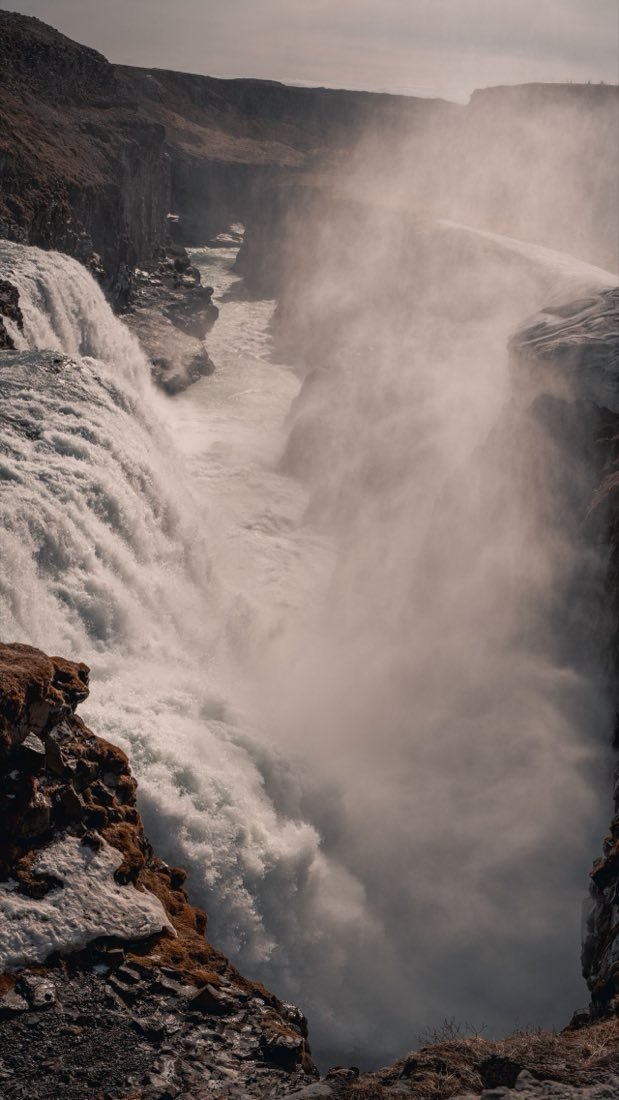
Gullfoss, the Golden Falls, is the third anchor of the Golden Circle and the one that sells the route. The Hvítá river, fed by meltwater from Langjökull, drops in two stages and then disappears sideways into a narrow canyon that appears to swallow it. The power of the water, and the cloud of spray it throws, makes it one of Iceland’s most visited waterfalls without a fee.
Getting to Gullfoss
Gullfoss is about 120 km north-east of Reykjavík. Drive Route 1 to Selfoss, then Route 35 through Flúðir, or take Route 36 and Route 35 via Þingvellir and Geysir. The final approach is paved. There are two car parks, an upper one beside the visitor centre and a lower one close to the falls. If you would rather not drive, compare Golden Circle tours from Reykjavík, which usually combine Gullfoss with Þingvellir and Geysir. If you are self-driving, hire a car in Iceland.
Viewpoints
The upper platform sits above the falls and gives the widest view of both drops and the canyon. It is open all year.
The lower path follows a boardwalk and then a rough trail to the rim of the first drop. Here you stand a few metres from the water and feel the spray. In winter the path is regularly closed because of ice. Obey the ropes and signs; the rock is slick and the drop is fatal.
The canyon-edge view from the eastern side shows how the falls turn at a right angle into the gorge. It is less photographed and just as good.
Facilities and Costs
Entry to Gullfoss is free, but parking is charged, with some guides quoting around 750 ISK per car; confirm the current rate at the car park or in the payment app, because it is set privately and changes. The visitor centre has a cafe and shop with toilets. Prices in the cafe are higher than at Geysir. Allow 45 to 60 minutes, or longer if you walk to every viewpoint.
The Story of Sigríður Tómasdóttir
Local tradition credits Sigríður Tómasdóttir, the daughter of the farmer who owned the land, with preventing a hydroelectric scheme in the early twentieth century. She is said to have threatened to throw herself into the falls if the plan went ahead. Whatever the details, the falls were protected, and a memorial stands near the upper path.
Best Time to Visit
- Summer: Highest volume, more rainbows, more tour groups. Arrive before 10am or after 5pm.
- Autumn: Fewer people and softer light.
- Winter: Ice forms around the rim and the canyon, which is spectacular, but access to the lower path is limited. Check road status at road.is and wear spikes.
Combining Gullfoss With Other Stops
The usual loop is Þingvellir, Geysir, Gullfoss, with an optional stop at Kerið crater or the Secret Lagoon on the way back. For the full route, read our Golden Circle road trip guide and the broader Iceland waterfalls guide.
Where to Stay
A night in the area lets you see Gullfoss when it is quiet. Search stays in Selfoss for the best range, or check our where to stay in Selfoss guide for the options. Hotels in Hella work if you are continuing east to the South Coast the next day.
Practical Tips
- Waterproof jacket for the lower path, particularly in summer when the spray is heaviest.
- Fuel up before leaving Selfoss; there are no stations at the falls.
- Keep to marked paths. Fatalities have occurred when visitors left them.
- Early starts avoid the main tour buses.
A Realistic Timing Plan
The Golden Circle works best in reverse if you want Gullfoss to yourself. Most coaches go Þingvellir, Geysir, Gullfoss in the morning, so the falls are busiest from 11am to 3pm. Starting at Gullfoss at 9am, then driving back via Geysir and Þingvellir, puts you ahead of the buses at the first stop and behind them for the rest. In winter, with short daylight, shift the whole route earlier and keep Gullfoss for the middle of the day, when the light is highest and the canyon walls are lit. If conditions look icy, stay on the upper platform and skip the lower path altogether: the view of both drops is just as clear from above, and the risk is far lower.
Browse Golden Circle tours for guided days that include Gullfoss.