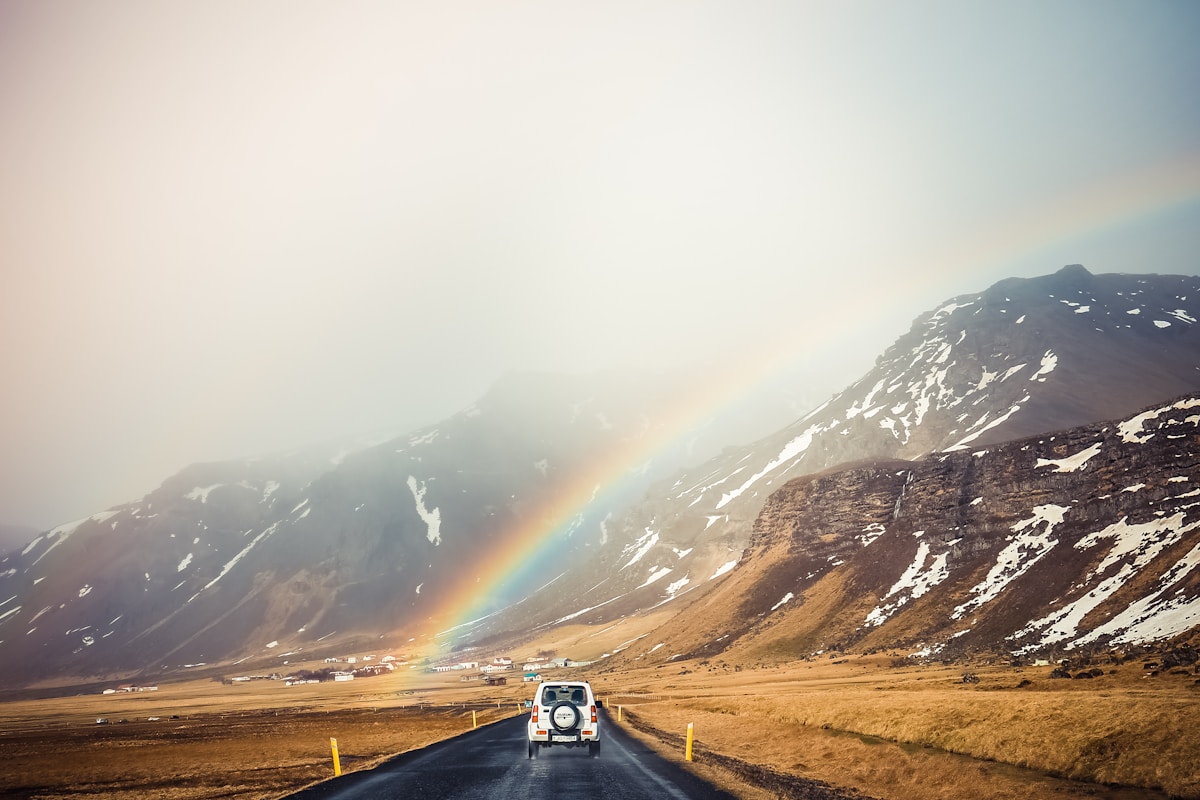
The advertised price of an Iceland car rental is not what you will pay. This is not a quirk of one company or one category of vehicle - it is structural to how car rental is sold in Iceland, and understanding the gap between the base rate and the real cost is the most useful financial preparation you can make before arriving.
The base rate covers the car. Everything else - insurance, kilometres, equipment, fuel handling, young driver fees - is additional. On a summer rental for 7 days, the total often comes to 60–90% more than the price advertised online.
The Base Rate and What It Does Not Include
Most Iceland rental car listings show a nightly or daily rate for the vehicle itself. This typically includes:
- Basic Collision Damage Waiver (CDW) - covering major accidents, but with a large excess
- Third-party liability insurance (required by law)
- The vehicle
It does not include:
- Gravel protection
- Sand and ash protection
- Tyre protection
- Undercarriage protection
- Mileage over a daily cap (if the rate is limited)
- Airport pick-up or drop-off fees
- Young driver surcharge (under 23–25, varies by company)
- Additional driver fee
- GPS or child seat rental
- Fuel handling charges
The critical items for Iceland specifically are gravel protection, SAAP, and tyre protection - these are optional add-ons everywhere else in Europe but are genuine, common risks in Iceland.
Kilometre Taxes and Mileage Caps
Some rental companies - particularly budget operators - offer base rates with limited included kilometres. Common caps are 200km/day or 300km/day. This looks reasonable until you map your route:
- Ring Road total: 1,332km
- Reykjavík to Jökulsárlón and back: 900km
- Reykjavík to Westfjords and back: 900km+
On a 7-day rental with a 200km/day cap (1,400km total), a straightforward Ring Road drive (1,332km) would be close to the limit before adding any detours or side roads.
Excess kilometre rates vary by company but typically fall between ISK 30–60 per km as of 2026. At ISK 50/km, 300km of overage costs ISK 15,000 - adding approximately ISK 2,000 to your daily rate across the rental.
What to look for: When comparing quotes, look for “unlimited mileage” or “unlimited kilometres” explicitly stated in the rate description. If the rate does not mention kilometres, check the fine print or contact the company before booking. Unlimited mileage rates cost slightly more upfront but are worth it for any itinerary beyond the immediate Reykjavík area.
Gravel Protection (GP)
Iceland has approximately 8,000km of unpaved roads - including sections of the Ring Road in remote areas and most of the F-road highland network. Even on the main South Coast route (Route 1), sections near the black sand plains east of Vík can see gravel kicked up by passing vehicles.
Gravel chips to windscreens are extremely common. The scenario: a truck or 4WD passes you on a loose-surface section and throws up a stone that impacts your windscreen. Without gravel protection, you are liable for the full repair or replacement cost.
- Windscreen replacement in Iceland: approximately ISK 60,000–120,000 or more, depending on vehicle
- Standard CDW excess: often ISK 150,000–200,000 or higher
Gravel Protection (GP) cost: Approximately ISK 1,500–3,500 per day as of 2026, depending on company and vehicle class.
If you are driving F-roads (highland roads requiring 4WD), gravel protection is close to essential - these roads are entirely unpaved and often have loose stone surfaces. If you are only driving the Ring Road and paved south coast routes, the risk is lower but not zero.
Sand and Ash Protection (SAAP)
Iceland’s volcanic landscape produces two specific hazards that most countries’ car rental industries do not cover:
Sand: The southeast sandur plains near Reynisfjara and the South Coast can experience sand storms when high winds pick up the fine black volcanic sand. Sandblasting removes paint, damages headlights, and pits windscreens. It can happen quickly and without warning.
Ash: Volcanic eruptions deposit fine ash that, when blown by wind, acts similarly to sand. Even eruptions some distance from your location can produce ash fall conditions.
SAAP cost: Approximately ISK 1,500–3,000 per day as of 2026.
If you are driving the South Coast in any season or in the vicinity of the Reykjanes volcanic system (which has been periodically active since 2021), SAAP is worth considering seriously. The undercarriage protection add-on (for river and F-road crossings) is a separate product from SAAP.
Tyre and Undercarriage Protection
Tyre protection: Covers punctures and tyre damage. Iceland’s road surfaces - particularly gravel roads and lava fields near highland areas - can cause punctures that standard CDW does not cover. Approximately ISK 500–1,500 per day.
Undercarriage protection (UP): Covers damage to the vehicle’s underside from rocks, river crossings, or rough terrain. If you are driving F-roads or any river crossings (common in the highlands), undercarriage damage from a single crossing can be substantial. Standard CDW does not cover undercarriage damage regardless of what other add-ons you have. Approximately ISK 1,000–2,500 per day.
Note: Undercarriage protection does not make it acceptable to drive a standard car on F-roads. Only vehicles certified for 4WD river crossings should cross rivers - and the crossing is always at the renter’s risk regardless of insurance if you drive a non-4WD vehicle on an F-road.
Fuel Costs
Iceland has no self-service petrol stations in the traditional sense outside main towns - many are automated 24-hour stations accepting credit cards only. As of 2026, petrol costs approximately ISK 290–330 per litre (diesel similar).
Practical fuel cost: A standard small car (e.g. Toyota Yaris or Kia Picanto) uses approximately 5–6 litres per 100km. Driving 1,500km (a short Ring Road trip): approximately 75–90 litres of fuel = ISK 22,000–30,000 in fuel. For a larger 4WD: fuel consumption is 9–12 litres per 100km, making a 1,500km drive approximately ISK 40,000–60,000 in fuel.
Fuel handling fees: Some companies offer “full-to-full” (fill the tank before return, no fee) or “full-to-empty” (pay for a full tank upfront, return empty) options. The full-to-empty option charges for fuel at the rental company’s rate, which is usually higher than pump prices. Full-to-full is nearly always the cheaper choice - avoid prepaid fuel where possible.
Airport vs City Pick-Up
Keflavík International Airport (KEF) has multiple rental car companies on-site. The convenience of picking up at arrivals is real - but airport pick-up typically incurs a surcharge of ISK 2,000–5,000 or a percentage fee on the total rental cost.
Reykjavík city centre rental offices are 45–50km from the airport. Some travellers save money by taking the Flybus to Reykjavík, picking up the car the next morning, and returning it to the city office before catching the bus back to the airport. The saving can be ISK 10,000–20,000 on a week’s rental, though it adds complexity.
What a Realistic Budget Looks Like
A summer 2026 example for a 7-day compact 2WD rental with adequate coverage:
| Item | Approximate cost (ISK) |
|---|---|
| Base rate (7 days, unlimited km) | 70,000–100,000 |
| CDW excess reduction | Included or ISK 5,000–15,000 extra |
| Gravel protection | 10,500–24,500 |
| SAAP | 10,500–21,000 |
| Tyre protection | 3,500–10,500 |
| Airport surcharge | 2,000–5,000 |
| Fuel (1,500km approx) | 22,000–30,000 |
| Total | 118,000–206,000 |
At mid-range: approximately ISK 160,000 (roughly €1,100–1,200 or £950–1,050 as of 2026 exchange rates) for 7 days. That is materially different from the ISK 50,000–70,000 base rate many aggregators advertise.
Rental Companies in Iceland
The major companies operating in Iceland include:
- Hertz Iceland (hertz.is) - airport and Reykjavík city; premium pricing
- Avis Iceland (avis.is) - similar tier to Hertz
- Budget Iceland (budget.is)
- Geysir Car Rental (geysir.is) - Icelandic-owned, often competitive on price
- Lagoon Car Rental (lagooncarrental.is) - newer operator, frequently well-priced
- Sad Car Rental (sadcarrental.is) - budget-focused, large fleet
- Blue Car Rental (bluecarrental.is) - well-regarded mid-tier
Comparing through Bílaleiga.is (an Iceland-specific aggregator) or Rentalcars.com typically gives a broader view of available pricing than going to individual company sites. You can also hire a car in Iceland directly through GetRentaCar, which aggregates rates across Icelandic operators.
For a full overview of vehicle types, 4WD requirements, and driving rules, see our Iceland Car Rental Guide.
Related Guides
- Iceland car rental guide - Vehicle types, 4WD requirements, insurance, and booking advice
- Iceland driving guide - Speed limits, road rules, winter conditions, and F-road access
- Iceland campervan guide - Renting a campervan as an alternative to hotel stays
- Iceland budget guide - Total cost breakdown for an Iceland trip including car hire and fuel
- Iceland F-roads guide - Which roads need 4WD and the extra insurance requirements
Plan Your Trip
✈️ Book your flights to Iceland 🛡️ Get travel insurance 📱 Stay connected with an eSIM 🚗 Rent a car