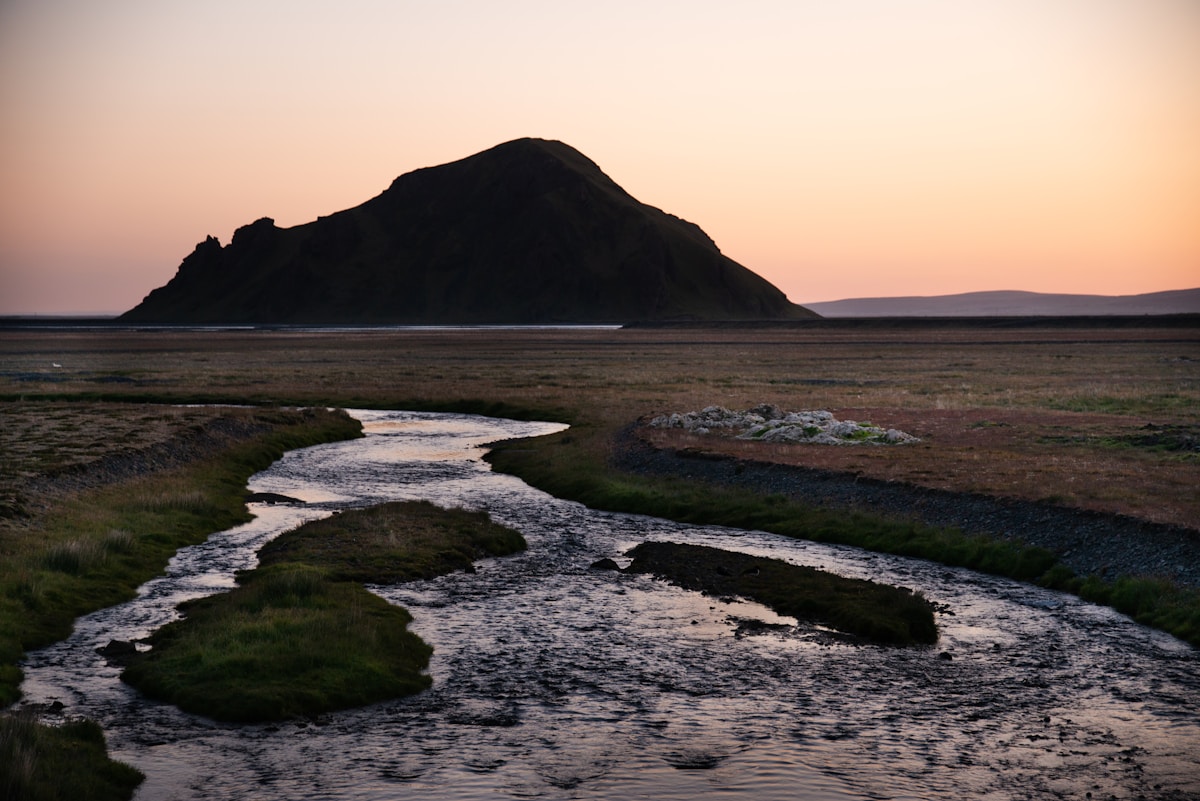
Iceland sits between 63° and 67° north latitude - the northernmost inhabited point, Grímsey Island, straddles the Arctic Circle at 66.5°N. This means that in summer, the country experiences 24-hour or near-24-hour daylight. The effect is striking even in Reykjavík, where the sky stays bright throughout the night for most of June and July. For the astronomy behind this — axial tilt, the Arctic Circle threshold, and why latitude determines how long daylight lasts — see How the midnight sun works.
When the Midnight Sun Occurs
Peak period: Around the summer solstice, June 21. Continuous daylight extends from approximately mid-June to early July in northern Iceland.
Broader season: From late May through late July, there is no true astronomical darkness across Iceland. In Reykjavík, sunset near the solstice occurs just after midnight and sunrise follows within three hours - it never gets fully dark. By mid-August, darkness returns but nights are still short (5–6 hours).
| Date | Reykjavík sunset | Reykjavík sunrise | Night darkness |
|---|---|---|---|
| June 1 | 11:38pm | 3:10am | Minimal twilight |
| June 21 | 12:03am | 2:57am | No true darkness |
| July 15 | 11:31pm | 3:28am | Brief twilight |
| August 1 | 10:53pm | 4:08am | Short twilight |
| September 1 | 9:19pm | 6:05am | 3 hours darkness |
Times are approximate and vary slightly year to year.
Where to Experience It
Reykjavík
Most visitors to Iceland experience the midnight sun from Reykjavík or the surrounding area. The city does not get fully dark from mid-May through late July. Walking along the Sæbraut coastal path at midnight, with full daylight and minimal crowds, is one of the more unusual urban experiences available in Iceland.
The Hallgrímskirkja church tower observation deck is open until 9pm typically - check for extended summer hours. The Perlan museum lookout has unobstructed 360° views that make for good midnight photography in June.
Akureyri
Akureyri is at 65.7°N - further north than Reykjavík and with more pronounced midnight sun. The town sits in a fjord, so sunrise and sunset times are slightly different from exposed coastal locations, but the ambient light is continuous around the solstice. The botanical garden (open until 10pm in summer) and the fjord viewpoints make for good evening walks.
Grímsey Island
Grímsey, a small island 40 km off Iceland’s north coast, sits directly on the Arctic Circle at 66.5°N. Around the summer solstice, the sun is theoretically at the exact horizon at midnight - the true “midnight sun” experience. The island is accessible by ferry from Dalvík (approximately 3 hours) or by small plane from Akureyri. There are very few permanent inhabitants and limited accommodation - this is an unusual trip that requires planning, but it is the only place in Iceland to experience the Arctic Circle crossing. Certificated as an official Arctic Circle crossing.
Sleep Tips
The main practical challenge of the midnight sun for visitors is sleep disruption. The human body’s melatonin production is triggered by darkness; with continuous light, natural sleep cues are absent.
What works:
- Blackout curtains: Most Icelandic hotels and guesthouses provide them in summer. When booking, specifically check or request them if light sensitivity is an issue.
- Sleep mask: A compact eye mask is the simplest and most portable solution. Silicon ear plugs help if you are camping or in a shared hostel.
- Melatonin: Available over the counter in Iceland at pharmacies (apótek). A low-dose supplement (0.5–1mg) taken 30 minutes before your target sleep time can help reset the sleep cycle in the first few nights.
- Routine: The most effective adjustment is keeping a fixed sleep and wake schedule, even if it feels artificial. Your body adjusts within two to three days.
What Changes With 24-Hour Daylight
The midnight sun fundamentally changes the structure of a travel day in Iceland. Practical implications:
Outdoor activities at any hour: Hiking, photography, and driving are possible at 1am with full natural light. Waterfall and glacier sites that are packed at noon can be almost empty at 10pm. This is one of the best-kept practical advantages of summer travel in Iceland.
Midnight golf: The Arctic Open golf tournament at Akureyri Golf Club traditionally plays rounds at midnight in late June. The course is open for play during midnight sun hours. Green fees approximately ISK 7,500 as of 2026.
Midnight hikes: Several Reykjavík-area hiking trails - Esja, Helgafell, and the trails in Þingvellir National Park - are frequently hiked at 10–11pm in June by locals and tourists alike. Trail-heads are not staffed and access is free.
Photography: The midnight sun produces exceptionally even, soft light from about 9pm through 3am in summer - a photographer’s equivalent of golden hour that lasts several hours. Waterfalls and coastal cliffs at 11pm in June see some of the best photographic conditions of the year.
Midnight Sun Festivals
Akureyri Midnight Sun Run: An annual road race held in late June, timed to coincide with the midnight sun. Runners complete the 10km course at midnight under full daylight. Entry is open to visitors and fills quickly - check akureyri.is for the current year’s registration.
Reykjavík summer events: The city’s summer festival calendar (Reykjavík Culture Night, ArtWaves) runs through June and July, with some events scheduled specifically for late evening midnight sun hours.
Browse Iceland tours - day trips, activity bookings, and multi-day packages across the country in one place.
Compare car hire in Iceland - a 4WD or campervan gives the flexibility to explore at your own pace.
Get travel insurance for Iceland - policies covering glacier hikes, F-road driving, and volcanic disruption.
Related Guides
- How the midnight sun works - The astronomy of axial tilt, the Arctic Circle, and why Iceland’s sky stays bright all night in June
- Iceland in June - June has the longest midnight sun: what to do with 24-hour daylight
- Iceland in July - July is peak midnight sun season and the busiest tourist month
- Iceland summer itinerary - A trip built around midnight sun hiking, puffins, and long summer evenings
- Puffin watching in Iceland - Evening puffin viewing is extended by the midnight sun
- Reykjavík city guide - The capital at midnight sun: where to eat and what to do at 11pm
Plan Your Trip
✈️ Book your flights to Iceland 🛡️ Get travel insurance 📱 Stay connected with an eSIM 🚗 Rent a car