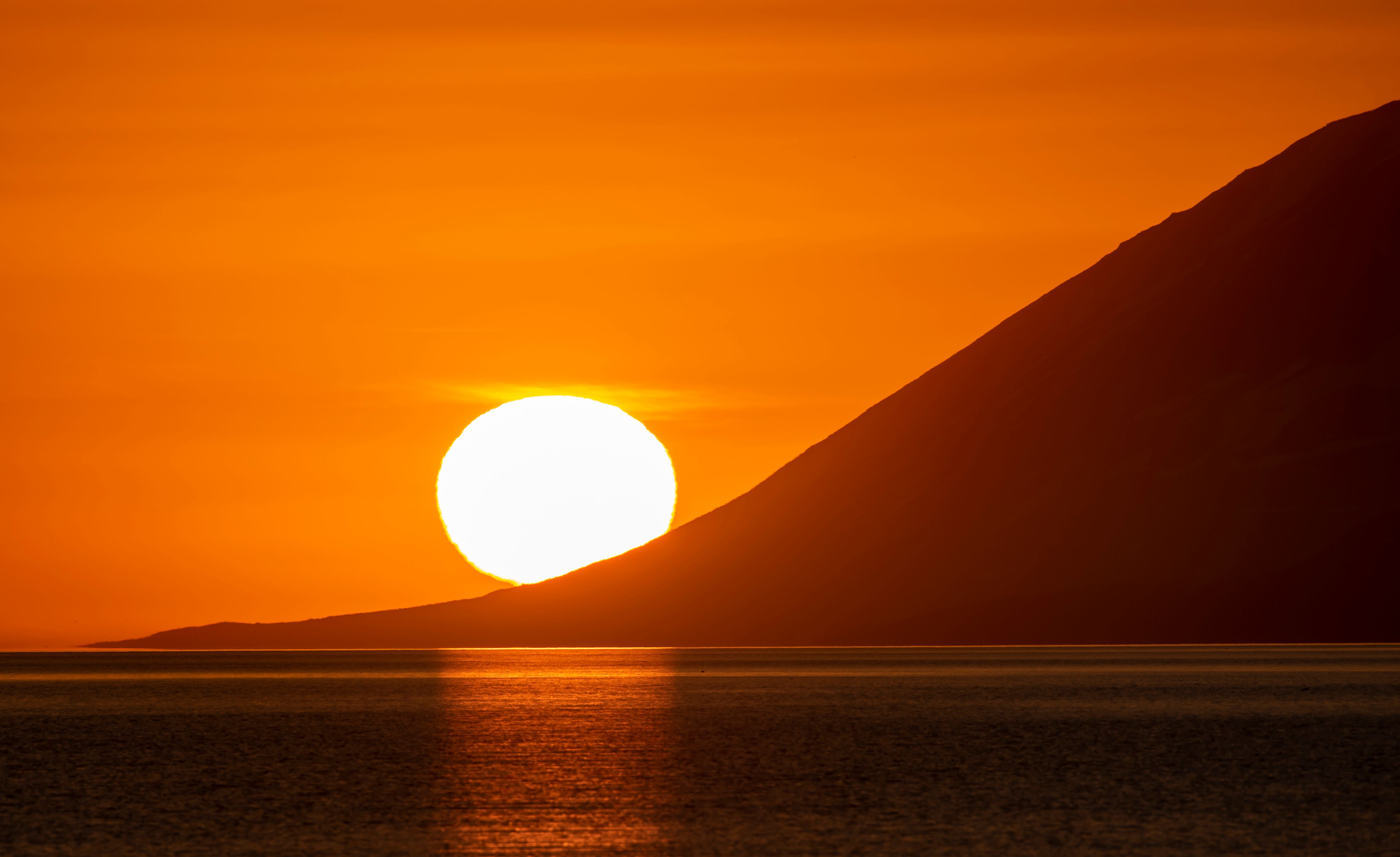
In late June, visitors to Iceland experience something that no amount of description quite prepares you for: the sun is low, the shadows are long, everything looks like late afternoon — and it has been doing this continuously for hours. You check your watch: 1:47am. The sky outside is fully bright.
This is the midnight sun, and it is not magic. It is geometry. Here is how it works.
Earth’s Axial Tilt: The Root Cause
Earth does not orbit the sun standing straight up. Its axis is tilted at approximately 23.5° relative to the plane of its orbit around the sun. This tilt stays constant as Earth orbits — the axis always points toward the same spot in the sky (near Polaris, the North Star).
The consequence is seasonal: for half the year, the northern hemisphere tilts toward the sun. For the other half, it tilts away. These are summer and winter.
At the equator, the tilt makes little difference to day length — roughly 12 hours of daylight year-round. But at high latitudes, the effect is extreme. At the North Pole in midsummer, the sun circles the sky at a constant low angle, never setting at all. Six months later, it never rises.
Iceland sits at 63°N to 67°N. Not quite the North Pole — but far enough north that the summer solstice geometry produces weeks of near-continuous daylight.
The Arctic Circle: The Threshold
The Arctic Circle sits at latitude 66.5°N. This is the precise latitude at which, on the summer solstice (around June 21), the sun does not set at all — it skims the horizon at midnight and immediately begins rising again.
At latitudes above 66.5°N, continuous daylight extends beyond a single day — the polar day period grows longer the further north you go.
Iceland straddles this threshold:
| Location | Latitude | Midnight sun? |
|---|---|---|
| Grímsey Island | 66.5°N | Exactly on the Arctic Circle — true polar day |
| Akureyri | 65.7°N | Sun very close to horizon at midnight — no true darkness |
| Reykjavík | 64.1°N | Sun sets briefly after midnight — sky never darkens |
| Vik | 63.4°N | Very short period below horizon — bright twilight all night |
Most of Iceland sits just below the Arctic Circle. The sun does technically dip below the horizon, but only barely — and the sky never transitions to true darkness.
Why the Sky Stays Bright: Twilight Types
When the sun is just below the horizon, it still illuminates the atmosphere. The relevant measure is how far below the horizon the sun drops:
Civil twilight: Sun 0°–6° below the horizon. Enough light for outdoor activity without artificial lighting. Sky looks fully bright.
Nautical twilight: Sun 6°–12° below the horizon. Sky darkens noticeably; horizon visible to sailors. Some stars appear.
Astronomical twilight: Sun 12°–18° below the horizon. Sky dark enough for most astronomical observation. Many stars visible.
True night / astronomical dark: Sun more than 18° below the horizon. Full darkness, all stars visible.
In Reykjavík near the summer solstice, the sun’s maximum dip below the horizon is approximately 5° — it never leaves civil twilight. There is no astronomical night in Reykjavík from mid-May to late July.
This is why photographs taken at 1am in Reykjavík in June look like early evening. The light is real. The sky is genuinely illuminated by the sun’s scattered light through the atmosphere.
Why the Light Looks Unusual
The midnight sun produces distinctive, extended photographic conditions. Around midnight, the sun is at a very low angle above or just below the northern horizon. Low-angle sunlight travels through more atmosphere than high-angle sunlight, scattering shorter blue wavelengths and allowing warmer reds and oranges to dominate. The result is the warm, diffuse, directional light associated with golden hour — but persisting for several hours.
Cloudless summer nights in Iceland produce an extended period where the light is constantly warm and angled, casting long shadows and saturating colours. Professional photographers specifically time Iceland trips to midsummer for this reason.
Iceland’s Position: Why Here Specifically
Iceland sits in the North Atlantic at the latitude where the midnight sun effect is accessible but not overwhelming. Most of the country experiences the midnight sun as extended near-continuous light rather than strict polar day — the sun still dips below the horizon, making the experience more gradual and less disorienting than further north.
The combination of accessible latitude (flights from London and New York are 2–3 hours), dramatic landscape, and the specific quality of the midnight light makes Iceland one of the most-visited destinations for the midnight sun experience. Svalbard (78°N) and Lapland also offer polar day, but are more remote.
The Grímsey Island exception — exactly on the Arctic Circle — is worth noting for those who want to experience a specific latitude achievement. A ferry from Dalvík takes approximately three hours. A certificate of Arctic Circle crossing is available on the island.
What Happens on the Other Side: Polar Night
The axial tilt is symmetric. The same geometry that produces continuous summer daylight produces continuous winter darkness. Iceland’s polar night is less extreme than strict Arctic darkness — in Reykjavík, the winter solstice brings only about four hours of daylight (sunrise around 11:22am, sunset around 3:30pm) — but it is still a major feature of Icelandic winter.
| Date | Reykjavík daylight hours |
|---|---|
| Summer solstice (June 21) | ~24 hours bright sky (civil twilight through the “night”) |
| Equinox (March/September) | ~12 hours |
| Winter solstice (December 21) | ~4 hours |
For visitors planning around the midnight sun, the optimal window is June–July. The solstice is June 21. Late June and early July are the peak weeks.
How It Feels in Practice
Most visitors underestimate how strongly the brain processes light as a time cue. The sleep disruption associated with the midnight sun is a real biological effect: melatonin production is suppressed by light, and continuous daylight interferes with the body’s signal to sleep. Two to three days of adjustment is typical.
The practical upside: outdoor activities are possible at any hour. Popular hiking trails near Reykjavík — Esja, Helgafell, trails in Þingvellir National Park — are regularly hiked at 10pm–midnight in June. Glacier tours and waterfall sites that are crowded at noon are sometimes empty at 11pm under full light.
Browse Iceland tours — midnight sun boat tours, midnight hikes, and summer activity packages across Iceland.
Get travel insurance for Iceland — policies covering glacier hikes, F-road driving, and volcanic disruption.
Related Guides
- Midnight sun Iceland: when, where, and what to do - The practical guide: timing, locations, sleep tips, and activities during 24-hour daylight
- Iceland in June - June has the longest midnight sun: what to do with 24-hour daylight
- Iceland in July - July is peak midnight sun season and the busiest tourist month
- Best time to visit Iceland - How the midnight sun, northern lights, and seasonal conditions shape the visit decision
Plan Your Trip
Book your flights to Iceland Get travel insurance Rent a car Search hotels in Iceland