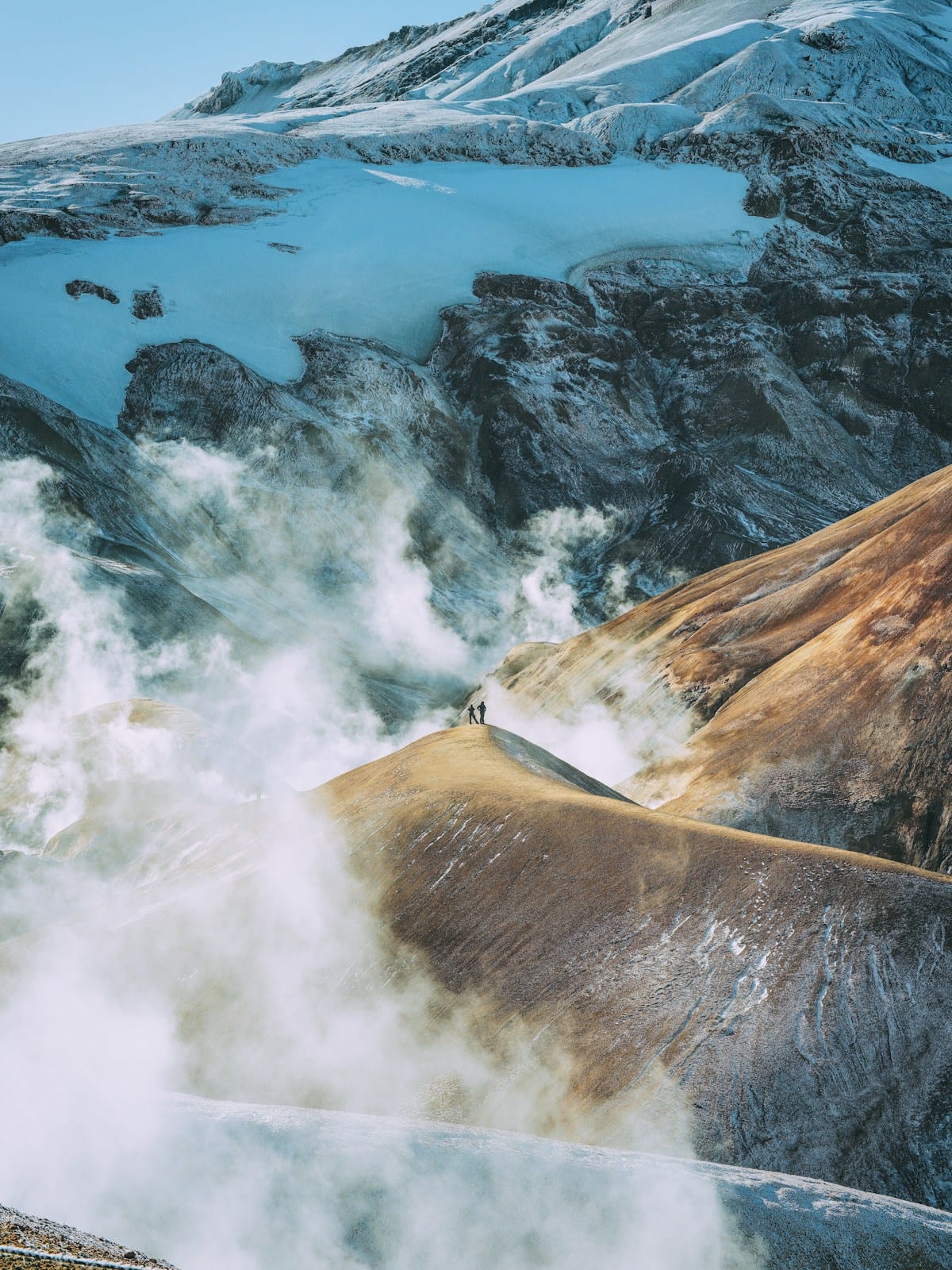
Tucked into the central highlands at around 900 metres above sea level, Kerlingarfjöll is one of Iceland’s most rewarding highland destinations - and one of the least crowded relative to what it delivers. A geothermal mountain massif threaded with steaming vents, vivid rhyolite ridges and natural hot springs, it sits roughly 170km from Reykjavík along the F35 Kjölur highland route. Most people who come stay overnight. Those who visit as a day trip from the Ring Road usually wish they had.
Getting There: The F35 Kjölur Route
Kerlingarfjöll is reached via the F347, a spur road off the F35 Kjölur route. The F35 is Iceland’s most accessible highland road - no mandatory river crossings, wide gravel surface, and usually the first of the major highland routes to open each year (typically late May or early June). From the southern end near Gullfoss, the Kerlingarfjöll junction sits roughly 130km into the F35.
From Reykjavík, allow 2.5 to 3 hours of driving. From Akureyri in the north, the drive is around 2 hours. The F347 spur to the resort itself is approximately 10km from the F35 junction and is rough gravel throughout - a high-clearance 4WD is mandatory. No river crossings are involved, but the track climbs and drops sharply in places, and pulling a caravan on this section is not advisable.
A 4WD campervan, Dacia Duster or Toyota Land Cruiser are all appropriate vehicles. A standard Kia Sportage or Hyundai Tucson is borderline and may struggle on the rougher sections - if in doubt, hire a larger 4WD specifically for this leg of your trip.
Hveradalir: The Geothermal Valley
The centrepiece of any Kerlingarfjöll visit is Hveradalir, a high-altitude geothermal valley roughly 30 minutes’ walk from the resort. The valley floor is an otherworldly mix of sulfur-yellowed earth, red and orange rhyolite, steaming fumaroles and boiling mud pools. On a clear morning the steam drifts low across the ridgeline and the contrast with the snowfields above is striking.
Several marked walking routes cross the area. The main loop around Hveradalir takes about two to three hours at a comfortable pace and gains around 250 metres of elevation. The trail is colour-coded and well-maintained, but there are sections of loose scree and steep descent - proper hiking boots and trekking poles are both worth having. Trainers are not suitable for the upper sections.
A longer ridge route extends above the valley floor and connects to the flanks of the Kerlingarfjöll massif, with views west across the highland plateau on clear days. Allow a full day for this extension. The trails are marked but signage thins out above the main valley, so carrying an offline map (the Veðurstofa app or Maps.me with Iceland coverage downloaded) is sensible.
Natural Hot Springs and the Resort Pool
The resort operates a geothermal bathing pool fed directly from natural springs. Water temperature holds steady around 36–40°C depending on the season and flow rate. The pool is small by Blue Lagoon standards - this is a highland mountain pool, not a spa resort - but the setting, with steam rising off the water against a backdrop of volcanic ridgelines, is genuinely exceptional.
Entry to the pool for day visitors costs approximately 2,500–3,500 ISK as of 2026 (confirm on-site, as rates are reviewed annually). Overnight guests have access included in their stay. Lockers and basic changing facilities are available. Bring your own towel.
Wild hot springs also exist in Hveradalir itself - some travellers sit in pools of warm runoff along the valley floor. These are not designated bathing areas and ground conditions around active geothermal features can be unstable, so exercise caution and stay on marked paths.
Accommodation at Kerlingarfjöll Mountain Resort
Search hotels in Iceland on Booking.com
The resort offers several accommodation types suited to different budgets and group sizes.
Huts and dormitories - The most affordable option. Shared dormitory beds start from approximately 8,000–12,000 ISK per person per night as of 2026, depending on the season and bed count. Bedding is not always provided - bring a sleeping bag liner or sleeping bag if staying in dorms. Kitchen facilities for self-catering are available.
Private rooms and cottages - The resort has a range of private rooms and small cottages, typically running 25,000–45,000 ISK per night for two people. Facilities vary by cottage type - some have private bathrooms, others share facilities. Book well in advance for July and August, which fill out months ahead.
Camping - A designated camping area with basic facilities is available. Pitch fees run approximately 2,500–3,500 ISK per person per night. The altitude means temperatures can drop sharply overnight even in midsummer - a three-season sleeping bag is the minimum, and a four-season bag is more comfortable.
The resort also operates a restaurant and café serving hot meals, sandwiches and soup. Prices are typical of a remote highland setting - a bowl of soup and bread costs approximately 2,500–3,500 ISK. There is no grocery shop, so bring your own supplies if you are planning to self-cater for multiple days.
When to Visit
The season runs from late May to early October, with the F347 spur typically accessible from around mid-June once snowmelt allows. July and August are peak season - trails are fully accessible, the resort is fully staffed, and the midnight sun means you can hike at 11pm without a headtorch. These months also bring the most visitors.
Late May and early June offer near-solitude and the chance of snow on the ridges above the valley - dramatic scenery but trails may be partially blocked. September is an excellent shoulder option: the crowds have thinned, autumn colour is beginning to appear, and overnight temperatures are crisp rather than cold. The Hveradalir valley is particularly atmospheric in low autumn light.
Combining Kerlingarfjöll with a Highland Itinerary
Kerlingarfjöll sits naturally at the midpoint of a broader highland trip. Travelling south on the F35 puts you at Gullfoss within two hours, giving direct access to the Golden Circle. Heading north returns you to the Ring Road near Blönduós or Varmahlíð. Hveravellir, another geothermal highland stop with a natural pool and hut accommodation, lies about 50km south of the Kerlingarfjöll junction on the F35 and makes a natural complement to the trip.
For a fuller highland route including Landmannalaugar and Þórsmörk, see our Iceland highlands itinerary for a five-day plan that covers the major sites with overnight options at each.
Practical Notes
- Fuel: No fuel at Kerlingarfjöll - fill up at Gullfoss service station (southern approach) or in Blönduós or Varmahlíð (northern approach) before heading onto the F35. The round trip from Gullfoss to the resort and back consumes approximately 20–30 litres depending on your vehicle.
- Connectivity: No mobile signal at the resort - download maps and weather forecasts before you arrive. Wifi is sometimes available in the main lodge but is slow and unreliable.
- Weather: Highland weather changes rapidly. Even in July, wind and low cloud can move in within an hour. Check vedur.is for forecasts specific to the highlands, not just Reykjavík.
- Gravel damage insurance: If renting a car, verify whether your policy covers F-road gravel damage (stone chips on paintwork and windscreen). Many standard policies exclude this - a highland-specific supplement is worth adding before the trip.
Not travelling with your own 4WD? Browse Iceland highland tours — day tours and multi-day highland itineraries covering the Golden Circle and interior on GYG.
Compare car hire in Iceland — a 4WD is essential for F-road access to Kerlingarfjöll.