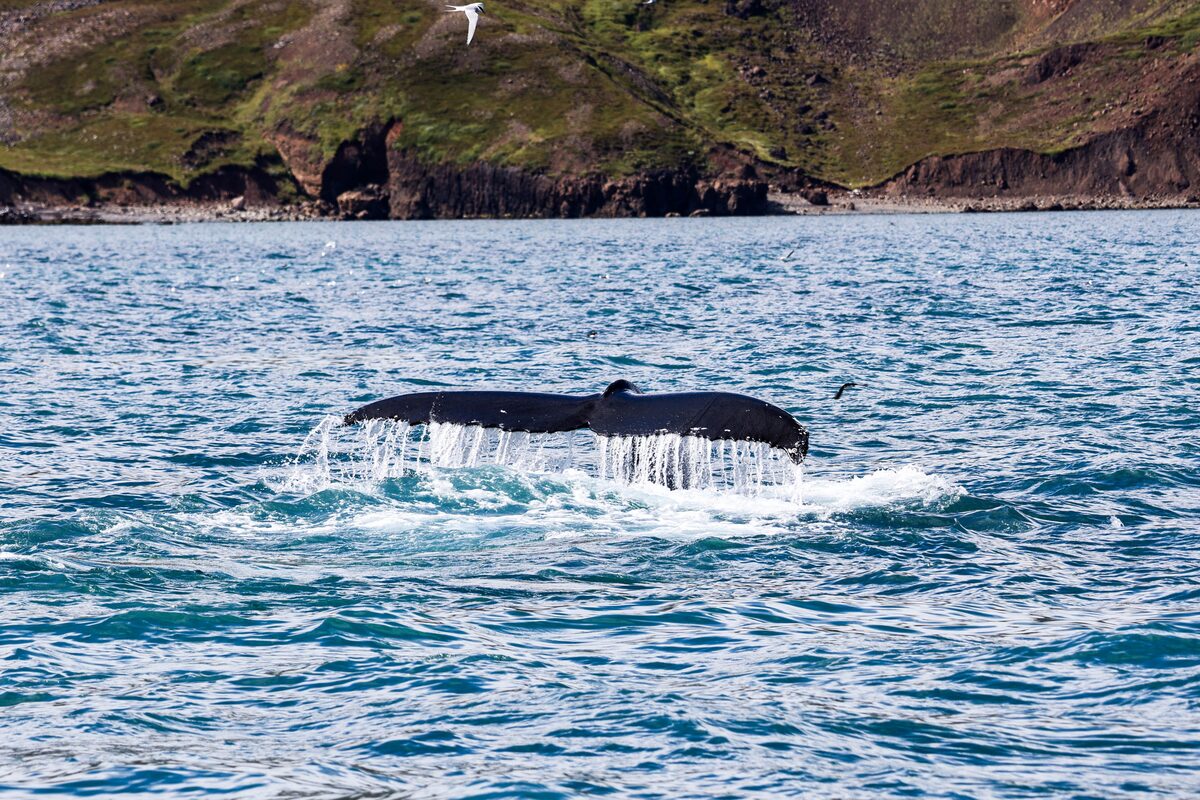
Iceland has two whale watching capitals with very different profiles. Húsavík, on the north coast, has built its entire identity around whale watching and consistently produces Iceland’s highest sighting rates. Reykjavík offers the same activity from the capital’s Old Harbour, with the obvious advantage of requiring no additional travel. Choosing between them comes down to your itinerary, how important raw sighting rates are to you, and whether you’re already heading north.
The Core Difference
Húsavík wins for sightings. Skjálfandi Bay, the cold, deep bay that Húsavík sits beside, channels large quantities of krill and small fish that attract humpback whales in high numbers from May through September. In peak summer (June–August), sighting rates on most tours exceed 95%. Blue whale encounters also happen here, particularly in summer — one of the few Iceland locations where this is a realistic expectation.
Reykjavík wins for convenience. Whale watching from the Old Harbour requires zero additional travel time for anyone already in the capital, which is most visitors to Iceland. Tours run year-round, operators have more boats and more flexibility, and the activity pairs easily with a city day or a half-day layover. Sighting rates are lower than Húsavík — especially for humpbacks — but remain good, and minke whales and white-beaked dolphins are reliable year-round.
Sighting Rates by Month
| Month | Húsavík | Reykjavík |
|---|---|---|
| Jan–Mar | Very low (limited tours) | Low; minke + dolphin possible |
| Apr–May | Building; minke + early humpback | Good; humpback arrivals |
| Jun–Aug | Excellent; humpback 95%+ | Good; humpback and minke |
| Sep–Oct | Good; humpback tapering | Moderate; minke through Oct |
| Nov–Dec | Limited tours | Low; minke + dolphin only |
Húsavík’s dominance is clearest in summer. Outside June–August, the gap narrows and Reykjavík’s year-round operation becomes a stronger argument.
Getting There
To Húsavík
Húsavík has no regular scheduled flights from Reykjavík. The practical route is:
- Fly to Akureyri — Air Iceland Connect runs multiple daily flights from Reykjavík Domestic Airport (40–60 min, from approximately ISK 13,000–18,000 one-way).
- Drive from Akureyri — 90km northeast via Route 85, approximately 1 hour. Car rental agencies operate at Akureyri airport.
Alternatively, drive the full Ring Road — approximately 5.5 hours Reykjavík to Húsavík. This makes sense if you’re touring the north and treating Húsavík as a stop rather than a dedicated destination.
There is no regular bus between the two cities. Without a car, joining an organised tour from Reykjavík that includes Húsavík is the other option (multi-day tours covering the Diamond Circle and north Iceland exist).
To Reykjavík
If you’re already in Reykjavík — which covers most first-time visitors and anyone on a short Iceland trip — whale watching from the Old Harbour involves a walk or short taxi ride to the embarkation point. Tours depart from Ægisgarður pier, clearly signposted from the harbour area.
The Tours
Húsavík
North Sailing (northsailing.is) operates traditional oak sailing schooners — a distinctive experience that differentiates Húsavík from anywhere else in Iceland. 3-hour tours approximately ISK 13,900–15,000 per adult. The slower pace and wooden deck create a different atmosphere to modern vessels.
Gentle Giants (gentlegiants.is) runs a larger fleet including traditional vessels and high-speed RIBs. 3-hour tours from approximately ISK 12,900–14,900 per adult. RIB tours cover more distance and tend to appeal to those who want faster positioning.
Both operators offer a resail guarantee if no whales are sighted.
Book Húsavík whale watching tours on GetYourGuide
Reykjavík
Elding Adventures at Sea (elding.is) is one of the largest operators in Reykjavík, running 3-hour tours from approximately ISK 12,900–15,900 per adult. Also offers midnight sun tours in summer (a genuinely good combination).
Special Tours (specialtours.is) runs 3-hour tours from approximately ISK 11,900–14,900 per adult and offers express 1.5-hour tours — the fastest way to tick whale watching from the capital without committing a half-day.
Book Reykjavík whale watching tours on GetYourGuide
Cost Comparison
| Húsavík | Reykjavík | |
|---|---|---|
| Standard 3-hour tour | ISK 12,900–15,000 | ISK 11,900–15,900 |
| Flight from Reykjavík | ISK 13,000–18,000 return | — |
| Car hire (per day) | From ISK 8,000–12,000 | — |
| Total additional cost | ISK 21,000–30,000+ | — |
The activity itself costs about the same from either port. The real cost difference is the travel. If you need to fly to Akureyri and hire a car specifically for Húsavík whale watching, you’re adding ISK 21,000–30,000 to the experience. That’s still reasonable value if a Húsavík-level sighting is a priority — but it changes the calculation for travellers on tight itineraries.
If you’re already driving the Ring Road north, Húsavík becomes a natural stop with no additional transport cost.
Where to Stay
Staying in Húsavík
Search hotels in Húsavík on Booking.com
Húsavík has a small but functional accommodation selection. Fosshotel Húsavík sits above the town with bay views and is the main hotel option, from approximately ISK 30,000 per night ($218). North Iceland Guesthouse offers a well-regarded mid-range option from around ISK 22,000 per night ($160). Smaller guesthouses and apartments fill the budget end from ISK 18,000.
Availability tightens significantly in July and early August — Húsavík’s accommodation pool is small relative to peak visitor numbers. Book 4–6 weeks ahead for summer if you’re set on staying in the town. See our Húsavík where to stay guide for current options.
Staying in Reykjavík
Search hotels in Reykjavík on Booking.com
Reykjavík has a much larger accommodation market ranging from budget hostels to design hotels. Options within walking distance of the Old Harbour (where tours depart) make combining accommodation with whale watching straightforward. Our Reykjavík where to stay guide covers the neighbourhood options in detail.
Which Should You Choose?
Choose Húsavík if:
- You’re already touring north Iceland or have the Ring Road on your itinerary
- Humpback whale sightings are a priority — you want the highest odds
- You want the oak schooner experience that’s unique to Húsavík
- You’re travelling June–August and want to maximise the encounter
- The Whale Museum and GeoSea baths alongside the tour appeal
Choose Reykjavík if:
- You’re on a short Iceland trip (2–4 days) and mainly based in the capital
- You want year-round availability or are visiting outside peak season
- Your itinerary doesn’t include north Iceland
- You’d rather put the travel budget toward other experiences
If your Iceland trip includes a week or more, the answer is often both: whale watching in Reykjavík on arrival (easy, no extra logistics) and again from Húsavík as part of a north Iceland loop. Doing the same activity twice sounds redundant but produces very different experiences — minke whales from a modern catamaran in Faxaflói Bay versus humpbacks on a wooden schooner in Skjálfandi Bay.
Related Guides
- Whale watching in Iceland: full guide — all departure ports, species by season, booking advice, and tour comparison table
- Things to do in Húsavík — Whale Museum, GeoSea baths, puffin watching, and what else fills a day or two in the town
- Húsavík vs Akureyri — comparing north Iceland’s whale watching capital with its main city for basing yourself
- 7-day Iceland itinerary — how to include the Diamond Circle, Húsavík, and Mývatn in a one-week self-drive loop