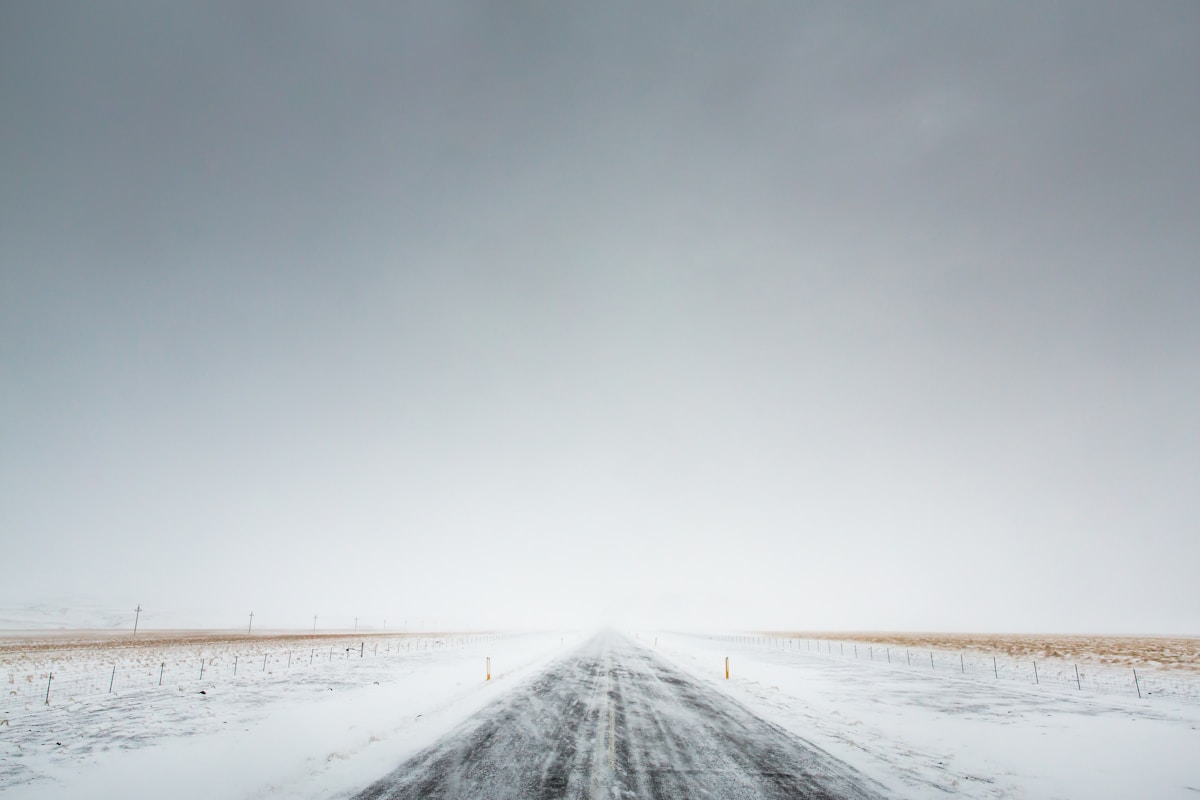
Our general Iceland driving guide covers rules, fuel, and rental basics. This article covers the part that changes everything between October and April: driving on ice, in wind that can take a car door off, through weather that can erase the road in front of you. Icelandic winter driving is entirely manageable - locals do it daily - but it punishes the assumption that it’s like winter driving anywhere else.
The Two Websites That Run Your Trip
road.is (Vegagerðin - the road administration). A live colour-coded map of every road in the country, updated continuously: green (clear), yellow-green (spots of ice), light blue (slippery), dark blue (extremely slippery), white (snow), red (impassable), and black-outlined Lokað - closed. Check it every morning before driving and again before any leg over 50 km. The map also shows live wind speed at roadside stations.
- “Slippery” (light blue) is normal winter condition - drivable with care.
- “Extremely slippery” (dark blue) means polished ice; if you’re not confident, reschedule.
- Closed (Lokað) is legally closed. Driving past the sign voids your insurance and makes you liable for rescue costs.
vedur.is (Icelandic Met Office). Issues yellow, orange, and red weather warnings by region. Treat them like this: yellow - drive with caution and flexibility; orange - do not plan road travel, attractions and tours will be cancelling; red - nobody drives, including locals. Roughly a dozen orange/red wind events hit some part of Iceland in a typical winter.
Also register your travel plan at safetravel.is and download the 112 Iceland app, which sends your GPS location to emergency services if you call.
Wind: The Underrated Killer
Snow gets the headlines, but wind causes more rental damage in Iceland than anything else. Two specific habits:
- Hold the door with both hands, every time. Gusts routinely bend doors past their hinges - “door blew open” damage is approximately ISK 150,000–400,000 to repair as of 2026 and is excluded from most rental insurance policies, including many zero-excess packages. Park nose into the wind when you can.
- Know your numbers. Sustained wind above 15–18 m/s makes high-sided vehicles (campervans, large 4x4s) genuinely hard to keep in lane; above 20–25 m/s, gusts can move any car. road.is shows live m/s readings - if stations along your route read 20+, wait.
Whiteout Procedure
A whiteout - blowing snow erasing all contrast between road, land, and sky - can develop in minutes, especially on the south coast around Vík and on mountain passes. If you’re caught:
- Slow right down, hazard lights on, and follow the yellow roadside marker poles - they’re spaced for exactly this.
- Do not stop in the travel lane; cars behind can’t see you. Pull past the marker poles only if you can identify a safe pull-out.
- If you can no longer safely move: stop where visible (or as far off the road as you can confirm), keep hazards on, stay in the car, call 112. The car is shelter; people who walk for help in whiteouts are the rescue stories that end badly.
- The engine can idle for heat, but check periodically that drifting snow isn’t blocking the exhaust.
Tyres, Vehicles, and Technique
Studded tyres are permitted from 1 November to 14 April and are standard on most winter rentals - confirm when you book your car. On technique:
- Triple your following distance. Braking distance on ice can be 5–10× dry pavement. ABS doesn’t repeal physics.
- Slow before bends, not in them. Most single-car winter accidents in Iceland are loss of control on icy curves and one-lane bridges.
- Bridges and shaded valleys ice first. A road reading “spots of ice” means exactly those spots.
- Speed limits are maximums for dry summer roads - 90 km/h paved, 80 gravel. In winter, 60–70 km/h on a “slippery” road is normal local pace.
- A 4x4 is worth having December–March for snow depth and crosswind stability, but it brakes no better than a 2WD on ice. The most overconfident cars in the ditch are big 4x4s.
- Headlights on at all times (the law year-round) and note that around the winter solstice you get only 4–5 hours of usable daylight - plan driving legs inside them.
What Rescue Actually Costs
Emergency rescue by ICE-SAR volunteers is free - but vehicle recovery is not, and the two usually travel together. Towing a stranded car from a rural road commonly runs ISK 50,000–150,000; recovery requiring specialised machinery, long distances, or a callout to a closed road can exceed ISK 450,000 as of 2026. If you drove past a closure or into a river/F-road, your insurance is void and the bill is yours. All F-roads (highland routes) are closed in winter, full stop - see our F-roads guide.
Build Slack Into the Itinerary
The single best winter safety measure is a schedule that can absorb a lost day. Book accommodation with free cancellation, don’t chain tight one-night stops around the full Ring Road, and never plan to drive 4 hours to the airport on the morning of your flight - stay within an hour of Keflavík the final night. If a storm pins you down, that’s not a failed day; that’s the system working. For vehicle choice and insurance detail, our car rental guide covers the winter-specific options.
Related Guides
- Iceland car rental guide - Choosing between 2WD and 4WD, winter tyres, and insurance for self-drive trips
- Iceland driving guide - General rules of the road, single-lane bridges, and F-road regulations
- Iceland F-roads guide - Which highland roads are closed in winter and what 4WD means in practice
- Iceland in January - Northern lights season, winter driving conditions, and what to expect in deep winter
- Ice caves in Iceland - Winter-only tours to the blue ice caves inside Vatnajökull: logistics and booking
- Ring Road Iceland - The Route 1 circuit: which sections are most challenging in winter
Plan Your Trip
✈️ Book your flights to Iceland 🛡️ Get travel insurance 📱 Stay connected with an eSIM 🚗 Rent a car