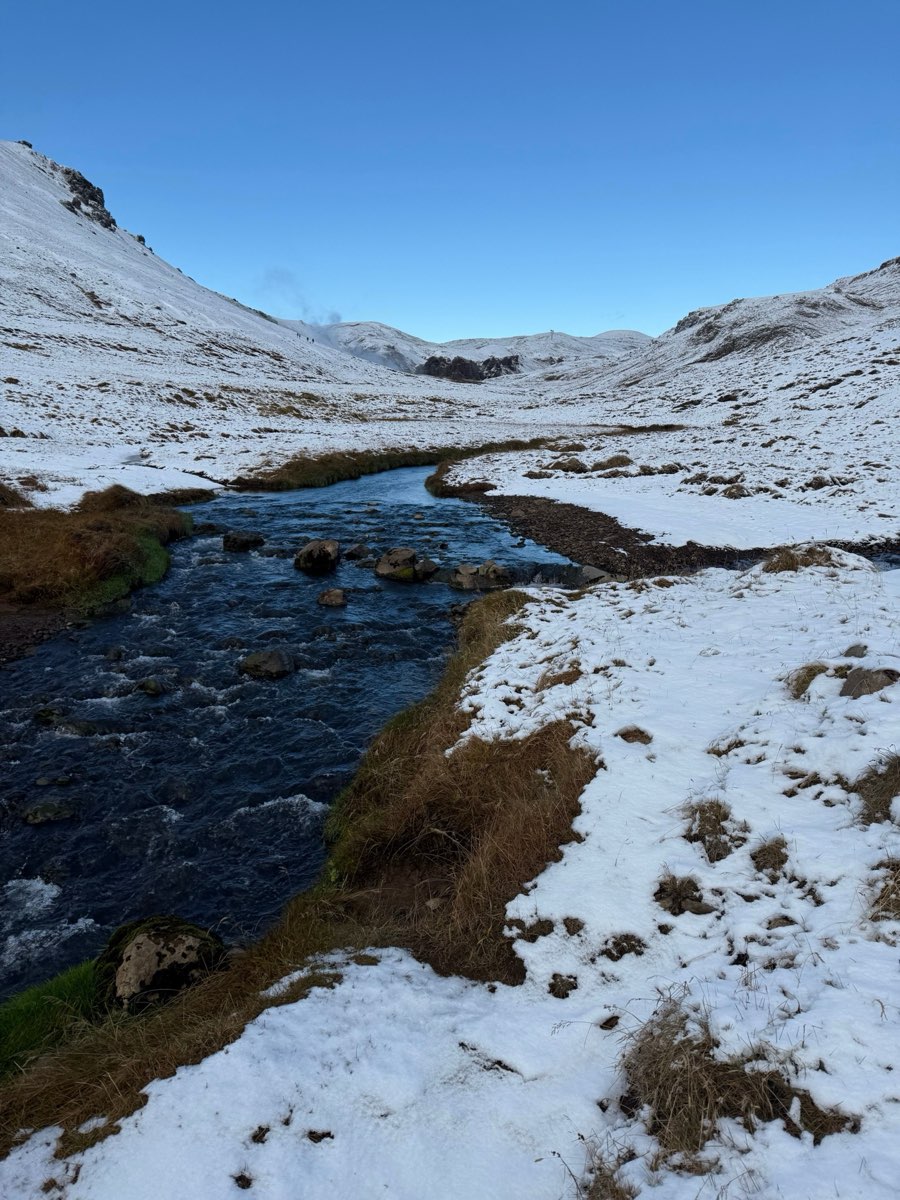
Winter in Iceland runs from October through March — six months of shortening and then lengthening days, shifting between the first autumn storms and the returning light of spring. Each month has its own character. October is accessible and dramatic; November gets raw; December is the cultural high point; January is the quietest and darkest; February and March are when most serious travellers visit, combining the best aurora odds with improving daylight and ice caves still open.
This guide covers what changes season by season, what is uniquely available in winter, how Icelanders actually experience the dark months, and what you need to know practically before you go.
The Seasonal Arc: October to March
October
The first serious aurora month. Days are still 10–11 hours long in early October — plenty of time for driving and sightseeing — and nights darken enough for aurora after 7–8pm. Weather is unsettled but not punishing. Highland F-roads typically close by late October; everything else remains open.
October is one of the best months for first-time winter visitors: you get the Northern Lights, the landscape turns rust and brown as the last of summer colour fades, and there are no Christmas crowds. Tourist numbers drop significantly from summer, meaning guesthouses and car rentals are easier to book and cheaper.
What’s unique in October: First aurora sightings of the season; autumn colours on tundra vegetation; waterfalls at full flow from autumn rainfall; puffins have departed but whales are still in the waters around Húsavík.
November
The hardest month. Days shrink to 6–7 hours in Reykjavík, weather is often stormy, and the tourist infrastructure scales down — some rural guesthouses and restaurants close for the season from November through February. Ice caves open in late November, and aurora opportunities increase as nights lengthen.
November rewards travellers who want genuine solitude. Prices are at their lowest. Popular waterfalls (Seljalandsfoss, Skógarfoss) get ice formations. The Akureyri Christmas lights go up in late November, giving the north an atmospheric warmth. Not the easiest month, but authentic.
What’s unique in November: Ice caves begin opening (late November); near-empty roads; dramatic pre-winter landscapes; lowest accommodation prices of the year.
December
The cultural heart of Icelandic winter. The solstice brings just 4–5 hours of daylight in Reykjavík (3–4 hours in Akureyri), but the Christmas period fills this darkness with lights, traditions, and events. December is the most atmospheric month to visit if you connect with winter culture.
Aurora opportunities are excellent — 19–20 hours of potential darkness per day in the south, more in the north. The tradeoff: weather in December can be rough, and Christmas week (December 20–January 2) sees prices spike significantly.
What’s unique in December: Yule Lads arrive (December 12–24); Akureyri Christmas lights; Reykjavík Christmas market; New Year’s Eve fireworks (one of Europe’s most spectacular); ice caves in prime condition.
January
The quietest month of the year in Iceland. No Christmas, no summer tourists, just the long dark and the Northern Lights. January has the longest nights and statistically some of the best aurora conditions — but also some of the worst weather. Storms come through regularly in the first half of January; February tends to be more stable.
For serious aurora chasers with flexibility on dates, late January through February is the prime window: long nights still, but weather patterns starting to settle.
What’s unique in January: Virtually no tourists; lowest prices; longest nights for aurora; ski season at Hlíðarfjall ski area near Akureyri (30+ runs, lifts operating weekends and some weekdays).
February
The month that most travellers who research Iceland choose for winter. Days are noticeably longer than January (8 hours by late February), weather is often the most stable of the winter months, ice caves are in peak condition, and aurora season is still going strong. Northern Lights tours from Reykjavík report some of their best sighting rates in February.
Valentine’s week brings a small spike in romantic travel (hot spring packages, aurora hotels), but overall February is still quiet and prices are well below summer levels.
What’s unique in February: Best overall conditions for combining aurora, ice caves, and daylight activities; ski season in full swing; Bolludagur (Cream Puff Day, late February) — Icelanders eat enormous cream-filled pastries in one of the country’s more joyful food traditions.
March
The transition month. Aurora season continues through late March, daylight returns rapidly (reaching 12+ hours by the equinox), and the first hints of spring appear in lowland areas. Highland F-roads remain closed, but all Ring Road destinations are accessible. Ski season runs through March at Hlíðarfjall.
March is arguably the best single month to visit Iceland: you get aurora (still active), long enough days to drive and see landscapes in light, ice caves still open in early March, and fewer crowds than April onward.
What’s unique in March: Longest days with aurora still possible; best balance of winter and spring; puffins begin returning in late March; some tours resume that were closed in deep winter.
The Dark Season: Living with Limited Light
One of the things visitors most underestimate is how profoundly the short days shape the winter experience in Iceland. In Reykjavík in late December, usable daylight runs from approximately 11am to 3:30pm — four and a half hours. In Akureyri it’s closer to three.
Icelanders have adapted over centuries. Indoor culture is central: cafés stay busy from morning to night, pools (every town has a geothermal pool) are the social institution, and home becomes more important. The concept of hlýlegur (roughly: cosy, warm, safe from the storm) is not just a word — it’s a daily orientation. Restaurants are busier in winter evenings than summer ones. The arts scene in Reykjavík — concerts, theatre, cinema — is more active in winter.
For visitors, adjusting to the dark means:
- Planning around golden light: The 4–5 hour window of winter daylight in the south is often golden or pink — spectacular for landscape photography, especially around noon when the sun angles low.
- Night activities: Treat evening as primary time. Aurora hunting, hot spring soaks, restaurant dinners, and Reykjavík nightlife (the bar scene on Laugavegur runs late year-round) fill the long dark hours.
- Embracing indoor culture: Geothermal pools are year-round social hubs. Reykjavík’s museums (Perlan, National Museum, Harpa concert hall) all merit several hours. The Akureyri botanical garden closes in winter but the town itself is exceptionally cosy.
Hot Springs in Winter
Soaking in geothermal water while surrounded by snow and cold air is one of the defining winter Iceland experiences. Several options, across price ranges and accessibility:
Blue Lagoon — The most famous, 40 minutes from Reykjavík on the Reykjanes Peninsula. Milky blue silica water at 37–39°C. Outdoor complex with multiple pools, sauna, and steam cave. Pre-booking is mandatory (capacity controlled). Prices from ISK 9,990 (Comfort entry, includes silica mud mask and drinks) as of 2026. Winter is arguably the best time to visit: steam rises dramatically against cold air, and occasionally aurora is visible from the water.
Sky Lagoon — 10 minutes from central Reykjavík at Kársnes harbour in Kópavogur. A large infinity pool facing the sea, plus a traditional Icelandic skjól (ritual) involving sauna, cold plunge, steam, and the lagoon. Prices from ISK 8,990 (Pure Pass) as of 2026. Easier to book than Blue Lagoon; the sunset (around 3:30pm in December) from the infinity edge is exceptional.
Mývatn Nature Baths — North Iceland, 6 hours from Reykjavík. A geothermal lagoon with turquoise water and mountain backdrop. Much less crowded than Blue Lagoon. Open until 10pm in winter. ISK 6,400 adult as of 2026. Combine with aurora watching — the baths face north and the KP threshold for visible aurora is lower at this latitude.
Reykjadalur Hot Spring River — A geothermal river an hour’s hike from the car park at Hveragerði (45 minutes from Reykjavík). Free to use. In winter, the hike crosses snow and requires warm layers, but the river itself stays warm. The contrast of warm water and snowy hillsides is worth the effort. Not suitable in very bad weather.
Seljavallalaug — A historic geothermal pool at the base of a valley near Skógar. Free, no facilities. One of the most atmospheric pools in the country: old, slightly worn, with mountain walls on three sides. The 20-minute walk from the road car park is easy in dry winter conditions. Water temperature around 30°C — not the warmest, but the setting is exceptional.
The 13 Yule Lads (Jólasveinar)
Iceland’s Christmas mythology centres not on Santa Claus but on the 13 Jólasveinar — mischievous mountain trolls who descend from the highlands one by one in the 13 nights before Christmas. Each has a distinct personality and a corresponding prank, though in modern tradition they’ve been softened into benevolent gift-givers for children.
They arrive one per night from December 12 through December 24, and depart one per night from December 25 through January 6. Children leave a shoe on the windowsill each night; a good child receives a small gift, a naughty child receives a potato.
The thirteen, in arrival order:
- Sheep-Cote Clod (Stekkjastaur) — harasses sheep (December 12)
- Gully Gawk (Giljagaur) — hides in gullies and steals milk (December 13)
- Stubby (Stúfur) — abnormally short, steals pans to eat the crust (December 14)
- Spoon-Licker (Þvörusleikir) — steals and licks wooden spoons (December 15)
- Pot-Scraper (Pottaskefill) — steals unwashed pots (December 16)
- Bowl-Licker (Askasleikir) — hides under beds and steals bowls (December 17)
- Door-Slammer (Hurðaskellir) — slams doors loudly at night (December 18)
- Skyr-Gobbler (Skyrgámur) — obsessed with skyr (December 19)
- Sausage-Swiper (Bjúgnakrækir) — hides in rafters stealing smoked sausages (December 20)
- Window-Peeper (Gluggagægir) — peers through windows (December 21)
- Doorway-Sniffer (Gáttaþefur) — sniffs out leaf bread (laufabrauð) with an abnormally large nose (December 22)
- Meat-Hook (Ketkrókur) — uses a hook to steal smoked meat (December 23)
- Candle-Stealer (Kertasníkir) — follows children for their candles (December 24)
The Yule Lads’ mother is Grýla, an ogress who eats children who misbehave, and they share a black cat — The Yule Cat (Jólakötturinn) — who traditionally ate children who didn’t receive new clothes before Christmas. These darker elements have been softened over the past century but are part of Icelandic folklore education from childhood.
Shop window displays in Reykjavík and Akureyri feature the Yule Lads throughout December. The National Theatre sometimes stages Jólasveinar performances for families in the run-up to Christmas.
What’s Open and What Closes
Open all winter
- Ring Road (Route 1) — plowed and passable; check road.is daily
- Jökulsárlón glacier lagoon (no boat tours, but walkable shore)
- Reykjavík restaurants, museums, geothermal pools
- Blue Lagoon, Sky Lagoon (book ahead)
- Most Reykjavík whale-watching operators (reduced schedule, fewer whales)
- Akureyri city
- Main waterfall attractions (Seljalandsfoss, Skógarfoss, Godafoss)
- All supermarkets, petrol stations on Ring Road
Open only in winter
- Natural ice caves inside Vatnajökull (approximately November–March)
- Hlíðarfjall ski area near Akureyri (usually December–April)
- Ice cave tours at Mýrdalsjökull (Katla ice cave, year-round but best November–March)
- Akureyri Christmas lights (late November–January)
Closed or limited in winter
- Highland F-roads (closed approximately November–May)
- Landmannalaugar (road access closed; area not reachable)
- Þórsmörk (road access closed; bus services stop)
- Many rural guesthouses and farm restaurants (November–February)
- Whale watching in Húsavík (reduced, some operators suspend)
- Many camping sites and camping-dependent tours
Practical Winter Notes
Winter tyres are mandatory November 1 through April 15 — all Icelandic rental cars are fitted with them by law. For F-roads and mountain passes, an SUV or 4WD is necessary. For the Ring Road, a standard 2WD car is adequate if driven carefully.
Darkness and driving: In December, you may drive in the dark both departing and returning. Keep headlights on at all times (legally required in Iceland regardless of conditions). Allow extra time — winter roads require slower speeds, especially after snowfall.
Budget for winter: Accommodation prices are 20–40% lower than summer outside of Christmas week (December 20–January 2), when prices equal or exceed summer rates. Activity costs (ice cave tours, aurora tours) add to the budget. A rough estimate for 7 days including car hire, mid-range accommodation, and key activities: ISK 300,000–450,000 (approximately €2,000–€3,000) per person, excluding flights.
What to wear: The key is layers and windproofing, not a single heavy coat. A full kit for Icelandic winter:
- Merino wool base layer (top and bottom)
- Fleece mid-layer
- Insulated down or synthetic jacket
- Hard-shell waterproof outer layer (essential — Iceland’s wind drives rain sideways)
- Waterproof insulated boots with grip for ice
- Wool hat covering ears, waterproof gloves, neck gaiter
- Hand warmers for long outdoor waits (aurora tours, ice cave walks)
Winter Activities Summary
| Activity | Available | Best Month |
|---|---|---|
| Northern Lights | Late August–April | Oct, Feb, Mar |
| Ice caves (Vatnajökull) | November–March | Dec–Feb |
| Katla Ice Cave | Year-round | Nov–Mar |
| Skiing (Hlíðarfjall) | December–April | Jan–Mar |
| Hot springs | Year-round | Any (most magical Dec–Feb) |
| Golden Circle | Year-round | Oct–Mar (snow-covered) |
| Whale watching | Year-round (reduced) | Not ideal (summer is better) |
| Puffins | Late March onwards | March return only |
| Highland F-roads | Closed | Spring–autumn only |
| Ice fishing | December–March | Jan–Feb |
Plan Your Winter Trip
Book Northern Lights tours — guides track the forecast nightly and drive to the clearest skies.
Hire a car in Iceland — a 4WD is worth the upgrade in winter; all cars come with winter tyres fitted.
Get travel insurance for Iceland — winter policies should cover volcanic disruptions, ice road incidents, and weather delays.
Book your flights to Iceland — compare fares on Aviasales; January and February are typically the lowest-cost months to fly.
Related Guides
- Iceland winter itinerary — Day-by-day 7-day winter trip plan covering aurora, ice caves, and the South Coast
- Best places to see Northern Lights in Iceland — 12 specific locations from easy Reykjavík drives to East Fjords dark-sky sites
- Northern Lights tours from Reykjavík — Bus, super jeep, boat, and photography tour operators compared
- Iceland winter driving — Road conditions, winter tyre rules, and how to read road.is forecasts
- Iceland in December — The Christmas and New Year’s month in full detail
- Iceland in January — Quietest and darkest: what to expect
- Iceland in February — Best overall winter month for most travellers
- Best time to visit Iceland — Full year comparison across weather, crowds, and seasonal highlights
Plan Your Trip
✈️ Book your flights to Iceland 🛡️ Get travel insurance 📱 Stay connected with an eSIM 🚗 Rent a car