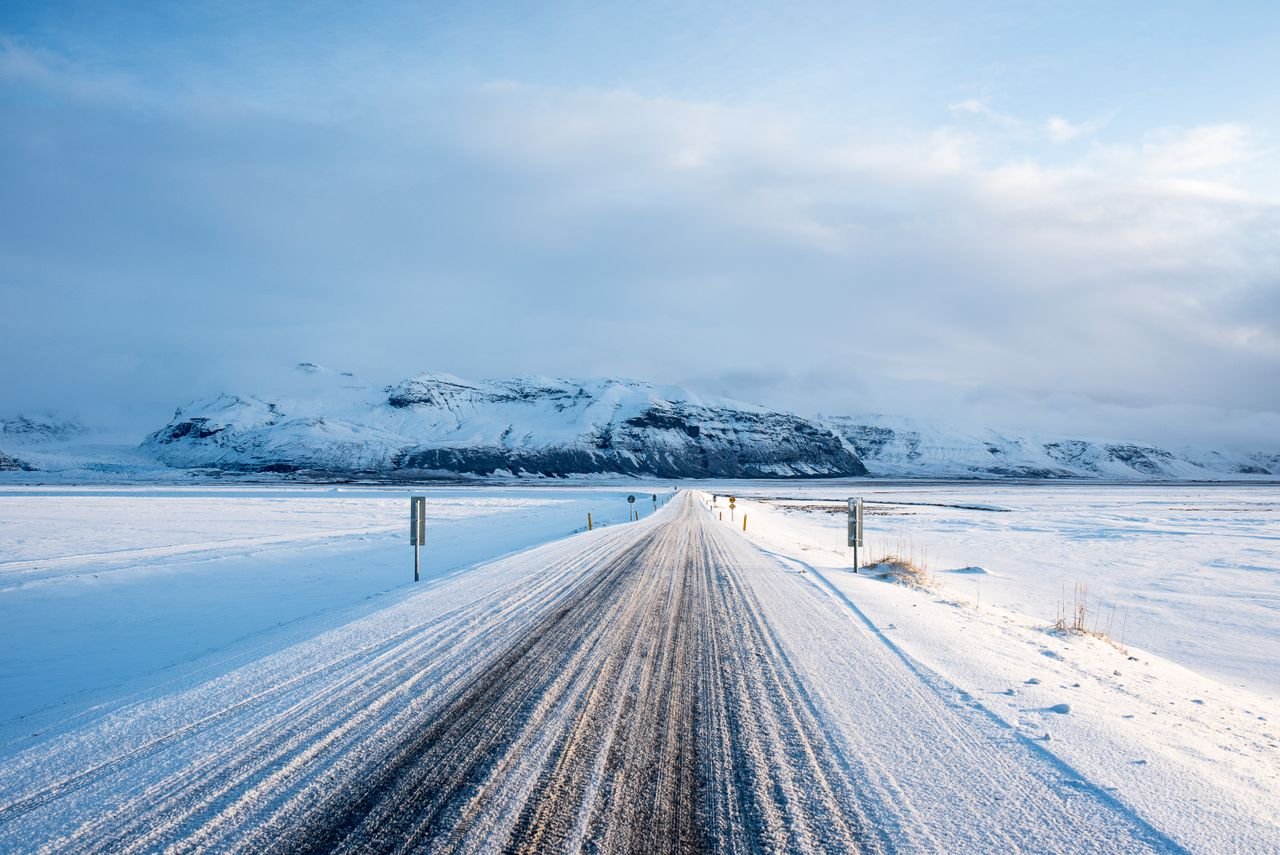
Driving the full Ring Road (Route 1, 1,322 km) between November and March is entirely possible, and it is one of the best ways to see Iceland: frozen waterfalls, ice caves, glaciers under low golden light and a real chance of aurora every clear night. It is also a trip that rewards flexibility far more than a fixed schedule. This guide covers conditions, daylight, aurora stops, the sights worth your limited light, and what it costs. For the general loop, see our Ring Road driving guide; for technique on ice and in wind, read our Iceland winter driving guide.
Should You Do the Full Loop in Winter?
We think yes for confident drivers with 8 or more days, and no for anyone with a hard 5-day window. If time is short, the south coast to Jökulsárlón and back is the better winter trip (see the South Coast drive). The full circuit adds the north and east, which are quieter, more weather-exposed and the most likely to cost you a day.
For official, up-to-date information, see umferdin.is for live road conditions.
Daylight Hours: Plan Around the Light
Daylight is the real constraint, not the road. Approximate Reykjavik figures (the north is shorter in December, longer in March):
| Month | Daylight | Practical driving window |
|---|---|---|
| November | 5-8 hours, shrinking fast | 09:30-16:00 |
| December | about 4-5 hours (around 4 on the 21st) | 11:00-15:30 |
| January | 5-7 hours, growing | 10:30-16:30 |
| February | 8-10 hours | 09:00-17:30 |
| March | 11-13 hours | 08:00-19:00 |
Twilight stretches usable light a little either side, but plan long drives for the middle of the day and never schedule a 4-hour leg to end after dark on an unfamiliar pass. Driving in the dark is legal and normal, but ice and animals on the road are far harder to see.
Road Conditions and Where It Closes
Route 1 is paved, ploughed and gritted, and carries the bulk of Iceland’s traffic. Expect packed snow and ice patches most days from December to February, with bare tarmac common on the south coast.
Check these every morning and evening:
- road.is for live closures, ice and wind. Closed means Lokað in black: do not pass it.
- vedur.is for yellow, orange and red weather warnings.
- safetravel.is to register your plan, and the 112 Iceland app for emergencies.
Typical trouble spots, with the usual pattern:
- Hellisheiði and Þrengsli (near Reykjavik): snow and fog, usually reopen within hours.
- Mýrdalssandur and the Vík area: extreme crosswinds, sometimes closing the road to high-sided vehicles.
- Öxnadalsheiði (before Akureyri) and Vatnsskarð: the most common northern closures, mostly storm-related.
- Mývatnsöræfi and Möðrudalsöræfi (northeast highlands): exposed and bleak, prone to whiteouts and multi-day closures in bad stretches.
- Breiðdalsheiði, Fagridalur and Almannaskarð (east): steep, icy mountain passes.
Because the northeast is the weakest link, many drivers go counterclockwise in winter, so the most exposed section is hit while you have the most buffer days left.
Aurora Viewing Stops Along the Route
The Ring Road is an excellent aurora route because it passes long stretches with no light pollution. Aurora season runs roughly late August to mid-April, with the best darkness from October to March. You need three things: a clear sky, a dark location and some solar activity (check the aurora forecast at vedur.is and treat Kp 2 or higher as workable).
Our favourite stops, in route order:
- Þingvellir and the Golden Circle side: an easy first-night option 45 minutes from Reykjavik, with open sky and few buildings.
- Reynisfjara and Vík: black sand with the Reynisdrangar sea stacks as a foreground. Stay well back from the waves, which are dangerous year-round.
- Jökulsárlón and Diamond Beach: the strongest postcard shot, with aurora over the lagoon and ice chunks on the shore. A few hours from Reykjavik, so make it a night stop. See our Höfn guide for nearby bases.
- Mývatn: one of the best inland aurora locations, with minimal light pollution and the lakeshore for reflections. Details in our Mývatn guide.
- Akureyri fjord edges: quick, convenient viewing within minutes of town. See Akureyri.
Practical aurora tips: dress for -10 C or colder, bring a tripod and a flask, turn off the car headlights when parked, and accept that clouds, not the sun, decide most nights. For gear and camera settings, see our Northern Lights guide. If you would rather not chase it yourself, Northern Lights tours from Reykjavik reposition by weather forecast and often offer a free repeat attempt.
Key Attractions Worth Your Daylight
Use the light for the sights that need it and save dusk for the aurora.
- Seljalandsfoss and Skógafoss (south): both run year-round and look dramatic with ice and snow. Boots with grip are essential.
- Vík and Reynisfjara: short stops, wind permitting.
- Vatnajökull and ice caves (Nov to March): natural blue ice caves are only safe in winter and only with a guide. Book a day in advance and expect an alternative day if conditions change. Browse ice cave tours and glacier hikes.
- Jökulsárlón: best between sunrise and mid-morning when the low sun hits the icebergs. See Jökulsárlón tours.
- East Fjords: quiet coastal roads and the village of Seyðisfjörður, usually reachable via Fjarðarheiði when open.
- Goðafoss and Dettifoss (north): Goðafoss is right off Route 1, while Dettifoss access in winter depends on road 864 or 862, which can be closed. Check road.is first.
- Akureyri and Húsavík: whale watching continues year-round from Húsavík, with fewer boats and cold conditions.
- Mývatn Nature Baths: a hot soak after a cold driving day is the best reward on the route.
A Realistic 8-Day Winter Itinerary
- Day 1: Reykjavik to Vík via Seljalandsfoss and Skógafoss (about 180 km).
- Day 2: Vík to Höfn via Jökulsárlón, with an ice cave tour if booked (about 270 km).
- Day 3: Höfn to the East Fjords (Egilsstaðir or Seyðisfjörður) (about 200 km).
- Day 4: Buffer day for weather in the east, or a slow day around Egilsstaðir.
- Day 5: East Fjords to Mývatn via the northeast highlands, only if road.is shows the road open (about 170 km).
- Day 6: Mývatn, Goðafoss, then Akureyri.
- Day 7: Akureyri to Borgarnes or the Snæfellsnes side (about 350 km).
- Day 8: Return to Reykjavik and Keflavik (about 130 km).
Leave at least one buffer day. If you want a ready-made plan, see the Iceland winter itinerary, which covers a base-in-Reykjavik trip with day tours rather than the full loop.
Practical Tips
- Tyres: winter tyres are required by law from 1 November to mid-April and are fitted on all rental cars. Studded tyres are common. Check the car has an ice scraper and snow brush.
- Vehicle: a small 2WD is fine on Route 1 but a 4x4 gives noticeably more stability. Campervans are a poor choice in winter wind. See our car rental guide and driving guide.
- Insurance: gravel, sand and ash protection and wind damage are the most common claims. Check that door damage from wind is covered, as many policies exclude it.
- Fuel: fill up whenever the tank drops below half. Stations are sparse between Höfn and Egilsstaðir and between Mývatn and Egilsstaðir.
- Food and layers: carry water, snacks and a spare layer in the car. Closures can strand you for hours.
- F-roads: all highland F-roads are closed in winter, which is why they do not feature on this route.
- Booking: book accommodation ahead for January to March, as small towns in the east and north have few beds. Free cancellation makes weather changes painless.
What the Trip Costs
Estimated for two people sharing, 8 days, as of 2026 and subject to change:
| Item | Approximate cost |
|---|---|
| 4x4 rental with full insurance (8 days) | ISK 190,000-340,000 |
| Fuel (about 1,600-1,900 km) | ISK 45,000-65,000 |
| Accommodation, mid-range (7 nights) | ISK 180,000-320,000 |
| Food (self-catering plus some restaurants) | ISK 60,000-120,000 |
| Ice cave tour (per person) | ISK 20,000-35,000 |
| Northern lights tour (per person, optional) | ISK 12,000-20,000 |
A realistic total is approximately ISK 550,000-1,000,000 for two, depending on car, comfort and add-ons. Winter car rental is typically cheaper than July, but good 4x4s still sell out for school holiday weeks. Compare car rental options early.
Is Winter Better Than Summer for the Ring Road?
Summer gives you 20+ hours of daylight, open highlands and easier driving, but no aurora, no ice caves and the highest prices. Winter gives you the glaciers at their most dramatic, solitude and the northern lights, in return for flexibility and careful planning. If you are a first-time visitor who loves photography, winter is the stronger trip. Read our best time to visit Iceland to compare.
For the capital before or after the loop, browse Reykjavik tours and the wider range of Iceland tours.